Duplicate Letters in Waffle | The Funky Dingo Rule Explained
Quick answer: Duplicate letters in Waffle trip up even good players, because two tiles that look identical can belong in two different words. The Funky Dingo rule says a highlighted letter only means the word contains that letter, not that this exact tile belongs there. Count how many copies each word needs before you swap, and you will stop wasting moves on letters that were never in the wrong place.
You know the feeling. The board is nearly solved, four words are green, and one word will not settle. You swap a letter in, it turns yellow, you swap it back, and nothing changes. The swap counter drops, the board looks the same, and you cannot see what you did wrong. Nine times out of ten, a duplicate letter is the culprit. This guide explains the rule behind it, shows you how to count copies before you swap, and works through a real board where four identical A tiles each belong in a different word.
If the color rules themselves still feel shaky, read our guide to what the colors mean in Waffle first. It covers green, yellow and grey with board examples. This post builds on those rules and focuses on the one case where the colors mislead you: when the same letter appears more than once.
What Duplicate Letters Are, and Why They Trick You
A duplicate letter is simply a letter that appears more than once on the same board. It can be the same letter twice in one word, like the two O letters in ONION, or the same letter spread across several words, like an E in the top row, another E in the middle row, and a third E in the bottom row. Both kinds cause trouble, but for different reasons.
The first reason duplicates trick you is that your eye treats matching tiles as interchangeable. Two E tiles look the same, so your brain assumes they are the same clue. They are not. Each tile sits in a different spot, belongs to a different word, and carries its own color. One copy may already be home while the other still needs to travel. A guide on duplicate letters puts it well: repeated letters must be counted, not guessed, because one correct copy can hide another misplaced copy. That guide is waffleword.io’s duplicate letters page, and its first rule is the one this whole post is built on.
The second reason is that the colors do not count copies. This is stated plainly on this site’s own homepage: if a letter appears anywhere in the word, a spare copy of it still shows yellow, even when the word needs only one copy. So a yellow tile never tells you how many copies the word needs. It only tells you that at least one copy belongs somewhere in that word. A player who reads a yellow tile as proof of a second copy will chase a letter that does not exist.
The third reason is the crossing. A tile that sits where a row and a column meet belongs to two words at once, so a duplicate on a crossing can mislead you in two directions. The DleRank Waffle guide warns about exactly this: at an intersection, a yellow letter can belong in the horizontal word or the vertical word, and the color alone does not say which one. When the letter is a duplicate, the choice is even harder, because both words might plausibly need it.
None of this means duplicate letters are rare. They are the norm. In the daily sample series on this site, almost every board has at least one repeated letter. Yesterday’s sample had five O tiles with five different homes. Today’s sample has four A tiles, three E tiles and three T tiles. If you play Waffle regularly, you will meet duplicates on most boards, so learning to handle them is not an advanced skill. It is a basic one.
The Funky Dingo Rule, Explained in Plain Words
The strangest name in Waffle strategy is the Funky Dingo rule, and it is the rule that governs duplicate letters. It comes from the official game’s help text, and it is quoted in guides across the web, including the original game itself. Here is the rule in plain words.
A highlighted letter only means the target word contains that letter. It does not mean that this specific tile is the one that has to go there. Once you place the correct number of copies in the word, any extra copies lose their highlight, which shows they belong somewhere else.
Read that again, because it is the whole trick. Suppose a word needs one N, and the board shows two N tiles highlighted in that word’s row. Only one of those tiles belongs in the row. The other one is highlighted only because the word contains an N, not because that tile is in the right place. The moment you put the correct N in its spot, the spare N loses its color and turns grey, which tells you it belongs in a different word entirely.
This is why duplicate letters feel so confusing. The highlight looks like a promise, but it is only a hint about the word, not about the tile. The tile and the word are two different things, and the Funky Dingo rule is the reminder to keep them separate in your head.
There is a second half to the rule that matters just as much. Once the correct number of copies is in place, the extras stop being highlighted. That is your signal. If you place one N correctly and a second N in the same word suddenly turns grey, you have your answer: the word needed one N, and the grey one belongs elsewhere. Do not fight the grey tile. Follow it to its real home.
One caution before you use this rule on this site. The original game has six words, three across and three down, with a centre tile that crosses two words. This site’s standard board has five words, three across and two down, and the centre tile belongs to the middle row only. The Funky Dingo rule works the same on both boards, because it is about letters and words, not about grid size. But when you read a guide written for the original game, remember that its centre-tile advice does not apply here. Our guide to solving the corners first explains the difference in detail, including why the centre tile is less powerful on this site’s board.
How Yellow Lies About Copies
Yellow is the color that lies about duplicates, and it does so in three specific ways. Learn all three, and you will stop trusting a yellow tile further than it deserves.
First, a spare copy can still show yellow. Say a word needs one E, and the board shows two E tiles in that word’s row. One of them is the real E, sitting in the wrong spot. The other is a spare that belongs in a different word. Both can show yellow, because the color only checks whether the letter appears in the word, not how many copies the word needs. The spare looks like it belongs, but it does not. The only way to tell them apart is to count: the word needs one E, so one of the two tiles has to leave.
Second, a yellow tile does not say which copy should move. The DleRank guide makes this point directly: a yellow tile does not identify which specific copy of a letter should move to which destination. You have to combine the color with the whole row and column, not match equal-looking tiles by appearance alone. Two identical yellow tiles in the same row can need completely different destinations, and swapping the wrong one costs you a move and teaches you nothing.
Third, a yellow tile on a crossing can belong to either word. A corner tile sits in a row and a column at the same time, so its yellow color could mean it belongs in the row word or the column word. With a duplicate letter, both words might contain that letter, so the yellow tells you almost nothing on its own. Check the crossing first. If the row word already has its copy of that letter in green, the yellow tile almost certainly belongs to the column word, and the other way round.
Here is a practical test you can run on any board. Pick a yellow tile, then ask three questions. Does the word it sits in still need a copy of this letter? Is there another tile of the same letter already green in that word? And does the crossing word need a copy too? If the word already has its copy in green, the yellow tile is a spare, and it belongs elsewhere. If the crossing word needs it, send it there. This test takes five seconds, and it replaces guessing with counting.
The Wasted Swap Trap
The most expensive duplicate mistake is also the simplest: swapping two identical letters with each other. It changes nothing on the board, and it still costs you a swap. The original game’s FAQ states it plainly, and the clone guides repeat it: swapping two identical letters changes nothing, so check before you move either one.
It happens more often than you would think, because it looks like progress. Two yellow tiles of the same letter sit in the same word, and swapping them feels like doing something. But if both tiles hold the same letter, the board after the swap is identical to the board before it. The letters have traded places, and since they are the same letter, no word has changed. You have spent one of your 15 swaps and learned nothing.
The trap has a sneakier version too. Two identical tiles in different words can look like a good swap, because the colors change after you move them. But if neither tile lands in a spot where its letter belongs, the swap still wasted a move. Before every swap, name the destination of both tiles out loud, even if only in your head. If you cannot say where each tile is going, do not make the swap yet.
There is one more cost to wasted swaps that new players miss. Every swap beyond the 10-swap par costs a star on the original game, where 10 swaps earns 5 stars and 15 swaps earns none. On this site there is no star score, so the cost is simpler: a wasted swap is one fewer swap for the real solve. Our guide to how many swaps you get in Waffle explains the 15-swap limit and the 10-swap par in full, with the star maths labelled as the original game’s rule only.
The fix for the wasted swap trap is a habit, not a talent. Before you swap, check the two letters. If they are the same letter, stop. Then check the destination of each tile. If either tile has no clear home, stop. A swap that fixes two tiles at once is the goal, and a swap that fixes nothing is the mistake to avoid.
Count the Copies Before You Swap
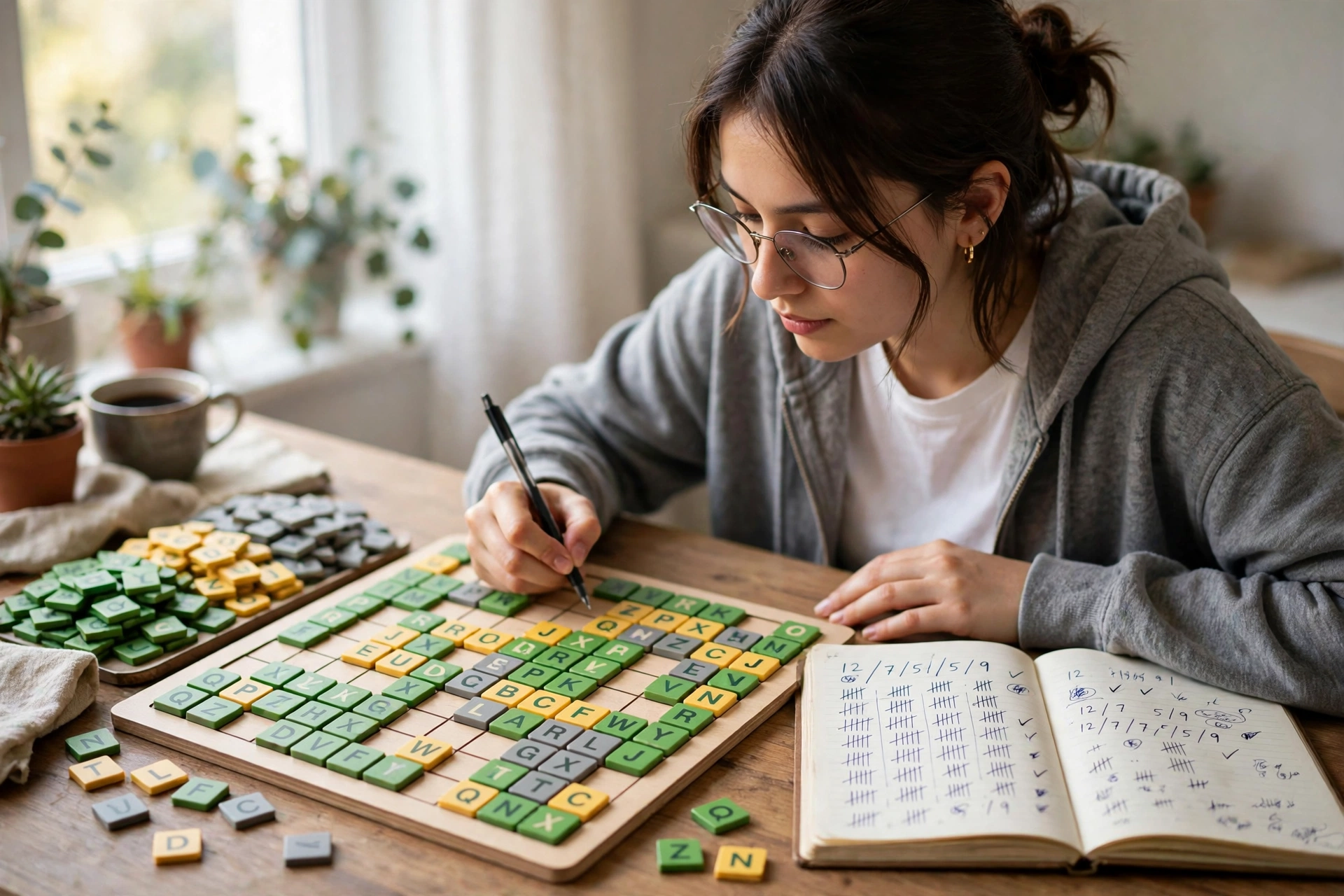
Counting is the skill that replaces guessing, and it is a four-step check you can run before your first swap. It takes about ten seconds, and it saves swaps on nearly every board.
Step one: pick the letter that repeats. Scan the board for any letter that appears twice or more. The most common repeaters are vowels, especially E and A, and the letter T. On most boards there is one letter that repeats more than the rest, and that is the one to count first.
Step two: count how many copies the board holds. Count every tile with that letter, green ones included. Green tiles are already home, so they tell you how many copies are already placed. The rest are the copies still looking for a home.
Step three: count how many copies each word needs. This is the step players skip, and it is the step that matters. Look at each word the letter could belong to, and work out how many copies of that letter the finished word holds. A word like ONION needs two O letters. A word like CREAM needs one A. A word like STONE needs one E and one T. Add the needs across all five words, and compare the total with the count from step two. If the board holds more copies than the words need, the extras belong in words you have not considered yet, or they are spares that will turn grey.
Step four: match copies to homes, one at a time. Start with the green tiles, because they are already placed. Then place the yellow tiles whose word still needs a copy. Leave the spares for last, because their homes will reveal themselves once the real copies are placed.
Here is the check applied to a real board, today’s sample puzzle, which hides CREAM, LEAPT, STONE, CALLS and MATTE. The board starts with five green tiles and four A tiles. Work through the count with the table below.
| Letter | Copies on the board | Copies the five words need | Where they go |
|---|---|---|---|
| A | 4 | 4 | One in CREAM, one in CALLS, one in MATTE, one in LEAPT |
| E | 3 | 3 | One in CREAM, one in LEAPT, one in STONE |
| T | 3 | 3 | One in LEAPT, one in MATTE, one in STONE |
| L | 2 | 2 | One in LEAPT, one in CALLS |
Read the A row first, because it is the trap. Four A tiles, four A homes, and each home is a different word. One A belongs in the top row, one in the left column, one in the right column, and one in the middle row, where it starts green in the centre. In the starting board, two of the four A tiles sit in the fourth row, even though no single word needs two A tiles. A player who tried to put both of them in one word would waste at least two swaps. The count tells you the truth in ten seconds: each A goes to a different word, so the two A tiles in the fourth row must split up, one to the left column and one to the right column.
The E row teaches the same lesson on a smaller scale. Three E tiles, three E homes, one per word. No word needs two E letters, so any row that seems to hold two E tiles is holding a spare. The T row is identical: three T tiles, three homes, one per word. And the L row shows the two-copy case: LEAPT needs one L, CALLS needs one L, and the board holds exactly two.
The full sample solves in 7 swaps, and every swap in that solve moves a duplicate letter to its counted home. If you want to see the method in action, the sample post solves the board step by step. For a shorter illustration of the same idea, the clone guides use a single-row example: a row that should spell PLANT but currently reads PNALT, where the N and L only need to trade places. That example is their illustration, not a real board, but it shows the cheapest duplicate move there is: two tiles of different letters, each in the other’s spot, fixed with one swap.
Duplicate Letters on Corners and Crossings
Corners are where duplicates cause the most damage, because a corner tile belongs to two words at once. Move a duplicate off a corner, and you change two words. Move the wrong duplicate onto a corner, and you break two words. Our guide to solving the corners first explains why corners matter so much, and the same logic applies double to duplicates on corners.
The rule for a duplicate on a corner is simple: solve the crossing first. Before you decide where a corner duplicate belongs, work out what each of the two words needs. If the row word already has its copy of that letter in green somewhere else, the corner tile belongs to the column word. If the column word already has its copy, the tile belongs to the row word. If both words still need a copy, the corner tile can go to either one, and you should place it in the word that has fewer open spots, because that word is closer to finished.
The centre tile is the opposite case. On this site’s five-word board, the centre tile belongs to the middle row only, because there is no down word through the centre column. A duplicate in the centre is therefore simpler than a duplicate on a corner: it has only one word to satisfy. If the centre tile is green, it is the middle word’s copy, and every other copy of that letter belongs somewhere else. If the centre tile is yellow, it needs to move within the middle row, and it cannot help any column word. Do not let a centre duplicate distract you into column plans that cannot work.
There is one more crossing to watch: the second and fourth rows. On this site’s board, the second and fourth rows hold letters only in the first and last columns, because those are the down words. A duplicate tile in the second row belongs to a down word, not to a row word, because there is no across word in that row. New players often try to read the second row as a word, and that mistake is worse with duplicates, because the letter seems to fit a word that does not exist. If a tile sits in the second or fourth row, its only word is the column it stands in.
Duplicate Letters in Deluxe Mode
Deluxe mode makes duplicates harder, because the board is bigger and holds more letters. On this site, Deluxe is a 5 by 6 grid with six words and 25 swaps, against the standard board’s five words and 15 swaps. More tiles means more repeats, and more repeats means more counting. Our Deluxe guide covers the mode in full, including how it differs from the original game’s 7 by 7 Deluxe board.
The counting method does not change in Deluxe, but the numbers do. A Deluxe board can easily hold five or six copies of E, and three or four copies of A and T. The four-step check still works, but step three takes longer, because there are six words to count instead of five. The habit that saves you is the same: count before you swap, and start with the letter that repeats most.
One Deluxe-specific warning: the bigger board has more crossings, so a duplicate on a crossing can mislead you in more directions. A tile in the middle of a Deluxe board can belong to a row word or a column word, and both words might need that letter. When that happens, place the copy in the word with fewer open spots first, then let the colors confirm it. If the tile turns grey after you place the correct number of copies, the Funky Dingo rule has done its job, and the spare belongs in the other word.
If Deluxe still feels new, practise the counting method on the standard board first. Unlimited mode gives you endless fresh boards to practise on, and the counting habit transfers directly when you step up to Deluxe.
Practice Drills You Can Do on Any Board
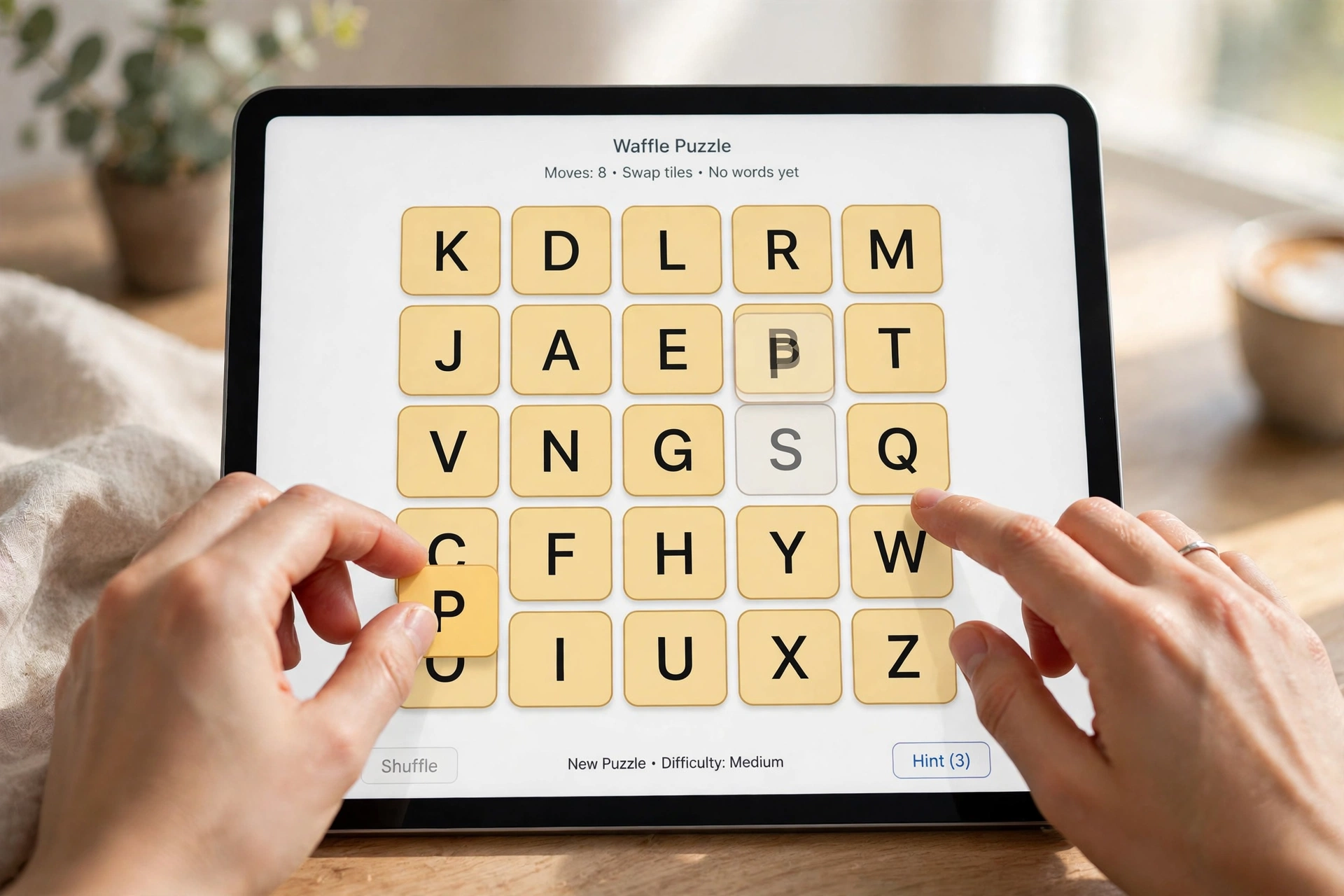
Counting is a habit, and habits need practice. Here are three drills you can run on any board, in under a minute each. Do them on your next three boards, and counting will start to feel automatic.
Drill one: the ten-second count. Before your first swap, pick the letter that appears most on the board and count its copies. Then count how many copies the five words need. Write the two numbers down if it helps, even on a scrap of paper. If the numbers match, every copy has a home. If the board holds more copies than the words need, find the spare before you swap anything.
Drill two: the late-game check. When the board is nearly solved and one word will not settle, stop swapping and inspect every repeated letter. Ask whether each copy is correct because it is proven, or only because it looks plausible. The duplicate-letters guide on waffleword.io recommends exactly this check before your final swaps, and it catches the mistake most often: a word that looks finished but holds a spare copy in the wrong spot.
Drill three: the identical-swap test. Before every swap, look at the two letters. If they are the same letter, do not make the swap. Then name the destination of each tile. If you cannot name both destinations, do not make the swap yet. This drill feels slow at first, and then it feels obvious, which is the point. A swap you can explain is a swap worth making.
Run these drills on today’s sample puzzle first, because the answers are printed there and you can check your count against the table. Then run them on your own board, where the answers are a mystery. The method is the same either way.
Common Mistakes With Duplicate Letters
Most duplicate mistakes fall into five patterns. Learn to spot them, and you will avoid the swaps they cost.
| Mistake | What happens | What to do instead |
|---|---|---|
| Trusting a yellow tile as proof of a second copy | You chase a copy the word does not need | Count how many copies the word needs first |
| Swapping two identical letters | The board does not change, and the swap is spent | Check both letters before every swap |
| Putting two copies in one word | One copy is a spare, and the real home stays empty | Spread copies across words, one per need |
| Ignoring a grey spare | You keep trying to place a letter that belongs elsewhere | Follow the grey tile to its real word |
| Reading the second row as a word | You plan swaps for a word that does not exist | Remember the second and fourth rows hold column letters only |
The first mistake is the most common, and it is the one the Funky Dingo rule exists to prevent. A yellow tile means the word contains the letter, not that it needs another copy. Count first, then place.
The second mistake is the most expensive per swap, because it spends a move for zero change. It is also the easiest to prevent, because the check takes one second: are the two letters the same? If yes, stop.
The third mistake is the one that breaks nearly-solved boards. A word looks finished except for one spot, and a spare copy of the right letter sits nearby, so you place it there. But the word already had its copy, and the spare belonged in the crossing word. Now two words are wrong instead of one. The count prevents this: if the word already has its copy, the spare goes elsewhere.
The fourth mistake is a failure of trust. A tile turns grey, and instead of believing it, you keep trying to fit it into the word it came from. Grey means the letter does not belong in that word. Believe it, and ask where else it could live.
The fifth mistake is specific to this site’s five-word board, where the second and fourth rows are not words at all. A duplicate letter in the second row belongs to the left or right column word, never to a row word. Plan the swap for the column, not the row.
Frequently Asked Questions
Can you swap two identical letters in Waffle?
You can, but it changes nothing on the board and still costs you a swap. Two identical tiles hold the same letter, so trading their places leaves every word exactly as it was. Check both letters before every swap, and skip any swap where the two tiles match.
Does a yellow tile mean the word has two of that letter?
No. A yellow tile only means the word contains that letter somewhere. The colors do not count copies, so a spare copy can still show yellow even when the word needs only one. Count how many copies the word needs before you trust a yellow tile.
What is the Funky Dingo rule in Waffle?
It is the official rule for duplicate letters. A highlighted letter means the target word contains that letter, not that this exact tile belongs there. Once you place the correct number of copies in the word, any extra copies lose their highlight and turn grey, which shows they belong in a different word.
Do duplicate letters appear in every Waffle puzzle?
Almost every board has at least one repeated letter, because five five-letter words share only 19 tiles and common letters like E, A and T appear often. Some boards have several repeats. Counting copies before you swap is a basic skill, not an advanced one.
What happens if I place a duplicate in the wrong word?
The tile will usually turn grey once the correct number of copies is placed in the right word, which is the Funky Dingo rule working as intended. The grey tile is your signal to move it elsewhere. It costs you the swap you spent, but the board tells you the truth if you read the color.
Do green tiles help with duplicate letters?
Yes. A green tile is a copy already home, so it tells you how many copies are placed and how many are still needed. If a word needs two copies of a letter and one is green, exactly one more copy belongs in that word. Plan your swaps around the green tiles, and never move one, because green tiles are locked.
Conclusion
Duplicate letters in Waffle are not a flaw in the game, and they are not bad luck. They are the puzzle. Every board hides a few letters that appear more than once, and every one of them has a counted home. The Funky Dingo rule tells you how to read them: a highlight means the word contains the letter, not that this tile belongs there, and the spare copies reveal themselves the moment the right number is placed.
The method is short enough to remember. Count the copies on the board, count the copies each word needs, match them one at a time, and never swap two identical letters. Run the ten-second count before your first swap, run the late-game check before your last swaps, and name both destinations before every move. Do that, and the board that used to stall on a duplicate will solve in fewer swaps than you expected.
For more on the rules that support this method, read our guide to what the colors mean in Waffle and our guide to how many swaps you get in Waffle. Then open the game and try the count on a fresh board. The letters are different, but the method is the same, and it works on every board you will ever play.