Waffle Sample Puzzle and Hints for Today, November 13, 2026
Quick answer: Looking for waffle hints today? This post gives you a sample Waffle puzzle for November 13, 2026, with spoiler-free hints for all five words. It is not the puzzle you will see today, because every player gets a different board. It hides HEART, OCEAN, RIVER, HONOR and TUNER, starts with five green tiles, and solves in 7 swaps.
Before we go any further, let us be clear about what this post is. It is a sample puzzle. It is not today’s puzzle from the game, and it is not a list of today’s answers. The five words in this post were picked by us, and the board was built by us, so that you can practise with a real board, real hints and a real solution. When you open the game yourself, you will see a completely different board with completely different words.
If you are brand new to Waffle, our beginner’s guide to Waffle walks you through the rules, the colours and the three game modes in plain language. If you already know how to play, jump straight to the board below. Yesterday’s sample puzzle hides a different set of five words and solves in a different way, so it makes good extra practice.
Why This Is a Sample Puzzle, Not Today’s Answers
Search the web for Waffle answers and you will find plenty of sites that publish one set of words each morning. GGRecon publishes a fresh answers post every morning, and that makes sense for the original game, where every player in the world gets the same board on the same day.
That approach does not work on this site, and it would be wrong to pretend that it does. On thewafflegame.uk, there is no shared daily puzzle. There is no puzzle number to look up, no midnight reset, and no single board that every player sees. Each time you load the game, it builds a brand new board from a random set of words. Your board belongs to you alone, your friend’s board will be different, and a reload gives you yet another board. That is a strength, not a weakness, because you never have to wait until tomorrow to play again.
So why publish a daily sample puzzle at all? Three reasons. First, it gives you a real puzzle to practise on, with hints that do not spoil the fun and a solution to check at the end. Second, it teaches the swap logic in a way that transfers to any board. Third, it gives you a daily habit, a fresh puzzle with your morning coffee.
Every post in this series follows the same honest format: one sample board, five words chosen by us, hints first, then the full solution behind a clear spoiler warning. Nothing here is ever presented as today’s answers, because on this site, today’s answers do not exist as one set of words.
How the Sample Board Works
The sample board follows the exact rules of the standard game on this site. It is a 5 by 5 grid that hides five five-letter words: three across and two down. You get 15 swaps to solve it. Green means a letter is in the right spot, yellow means it belongs in that word but sits in the wrong spot, and grey means it does not belong in that word. Green tiles lock in place, so every plan starts from them.
The three across words run along the top, middle and bottom rows. The two down words run along the left and right columns. Six tiles sit where a row and a column cross, so those tiles belong to two words at the same time. Fixing a crossing tile helps two words at once, which is why the corners matter so much. Our guide to getting 5 stars in Waffle explains how swap counts work.
The starting board already has five green tiles in place. That is deliberate: this sample is built to teach, so it starts with enough anchors to show you how to read the board. A normal board might start with four green tiles, or six. The method is the same either way.
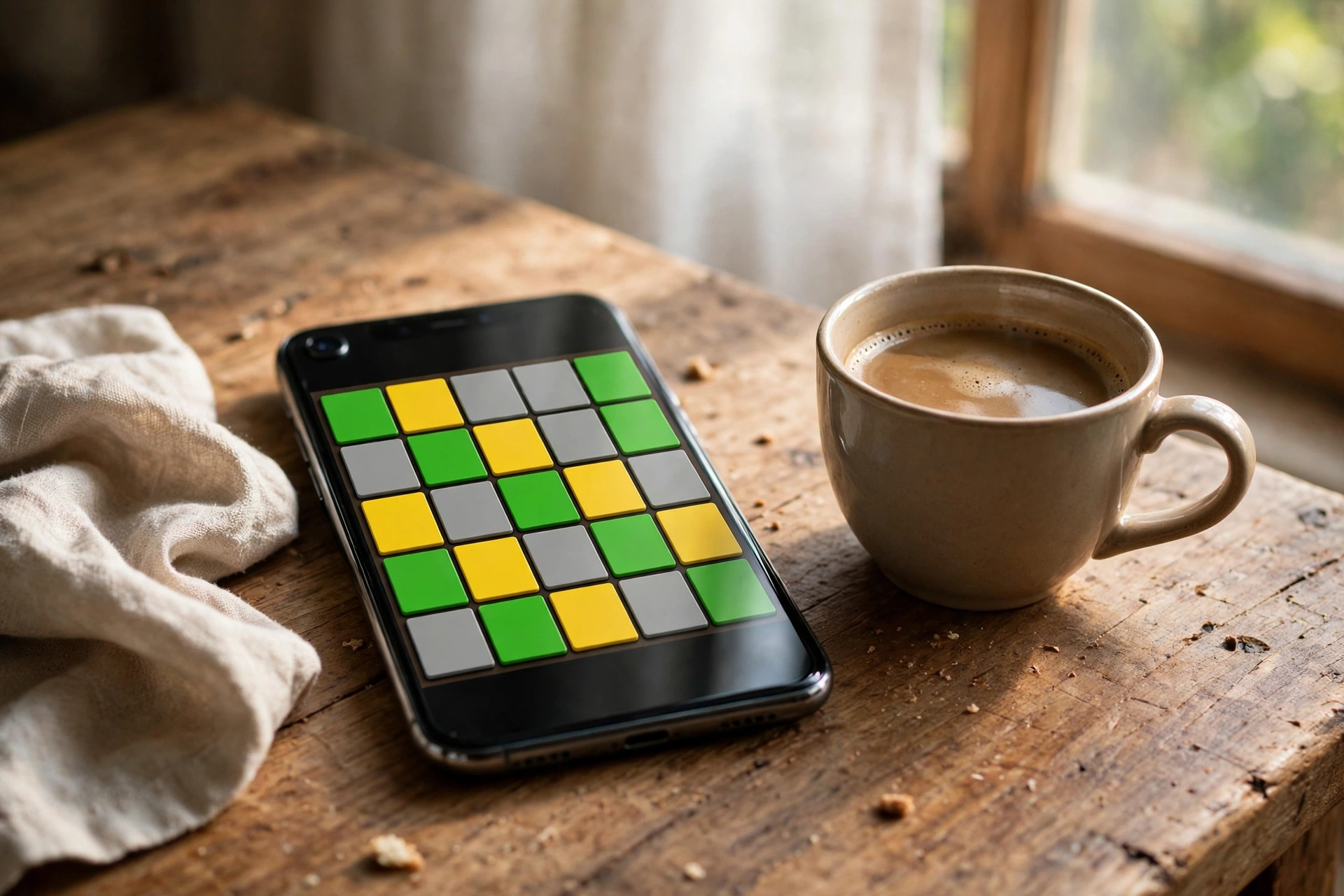
Here is the starting board. Read it row by row, from the top down.
| A | E | H | T | R |
|---|---|---|---|---|
| R | E | |||
| A | I | E | O | N |
| N | U | |||
| O | C | E | V | R |
The empty squares are not missing tiles. The grid only has 19 letter tiles, and the six blank squares are the gaps that give the board its waffle shape. The second and fourth rows hold letters only in the first and last columns, because those are the down words.
Before you look at the hints, take a minute to study the board yourself. The green E in the top row sits in the second spot of a word. The middle row has a green E right in the centre of the board. The bottom row has a green R at the very end. See if you can guess even one of the five words before reading on. That first guess is the most useful skill in Waffle.
What the Colours Tell You on This Board
If the colours still feel confusing, the beginner’s guide explains all three in detail, and WordUnscrambler shows the same colour rules on its daily hints page. Here is the short version, applied to this exact board.
Green tiles are finished. They are in the right spot and they cannot move. On this board, the green tiles are E in the top row, second spot; E in the middle row, centre spot; N in the middle row, last spot; N in the fourth row, first spot; and R in the bottom row, last spot. Those anchors already narrow each word down: the top word has E second, the middle word has E third and N last, and the bottom word ends in R.
Yellow tiles are close but not finished. The letter belongs in that word, but it sits in the wrong spot. On this board, the yellow tiles are A, H, T and R in the top row; E in the second row on the right; A and O in the middle row; U in the fourth row on the right; and E and V in the bottom row. Yellow is the most useful colour, because it tells you the letter is in the word. A yellow tile is never a wrong letter. It is a right letter in the wrong place.
Grey tiles do not belong in that word at all. They belong somewhere else on the board, usually in the word that crosses the same square. On this board, the grey tiles are R in the second row on the left, I in the middle row, and O and C in the bottom row. Do not try to force a grey letter into its current word. It is telling you to look elsewhere. The R in the second row belongs at the start of the bottom row, not in the left column. The I in the middle row belongs in the bottom row, not in the middle word.
One trap to watch: a letter can be grey in one word and still matter a lot. The O in the bottom row is grey for the bottom word, yet O is the first letter of the middle word. The C in the bottom row is grey for the bottom word, yet C is the second letter of the middle word. The I in the middle row is grey for the middle word, yet I is the second letter of the bottom word. Grey means “not in this word”, never “not on the board”.
A second trap sits at the crossings. A tile where a row and a column meet belongs to two words, so its colour answers to both of them. The R in the top right corner is yellow because it belongs in the right column word, but it also belongs in the top row word in a different spot.
Hints for the Sample Puzzle (Spoiler Free)
These hints give you one clue per word, with no answers spelled out. Read as many as you need and stop as soon as one clicks. Each hint also tells you the word’s first letter, because a first letter plus a clue is usually enough to crack a five-letter word.
Across Word 1 (Top Row): Starts With H
The organ in your chest that beats and pumps blood around your body. You can feel it when you put your hand on your chest after a run. The green E is the second letter, and the other letters you need are all in the top row already, just in the wrong order.
Across Word 2 (Middle Row): Starts With O
The vast salty water that covers most of the Earth. Ships sail on it, and beaches sit at its edge. The green E is the third letter, and the green N is the last letter. The A and the O in the row are both yellow, so they belong in this word in different spots.
Across Word 3 (Bottom Row): Starts With R
Water that flows across the land toward the sea. It runs between banks, under bridges, and past towns. The green R is the last letter. The V and the E in the row are both yellow, so they belong in this word too.
Down Word 1 (Left Column): Starts With H
Respect, or a privilege given for good work. You might receive one for service to your community, or show it to someone older than you. The green N in row 4 is the fourth letter. The H you need is in the top row, and the O you need is in the bottom row.
Down Word 2 (Right Column): Starts With T
A device that helps a musician get a guitar in tune. You play a note, the device listens, and it tells you whether the string is too high or too low. The green N in row 3 is the third letter, and the green E in row 4 is the fourth. The U you need is in row 4 on the right.
If you solved all five words from the hints alone, well done. That is the whole game in miniature: a clue, a first letter, a few green anchors, and a little patience. If one or two words are still hiding, the full solution is below.
Spoiler Warning: Full Sample Solution Below
Stop here if you want to keep solving. Everything below this line reveals the five sample words, the solved board, and the full 7-swap solution. There is no going back once you read it.
The Five Sample Words
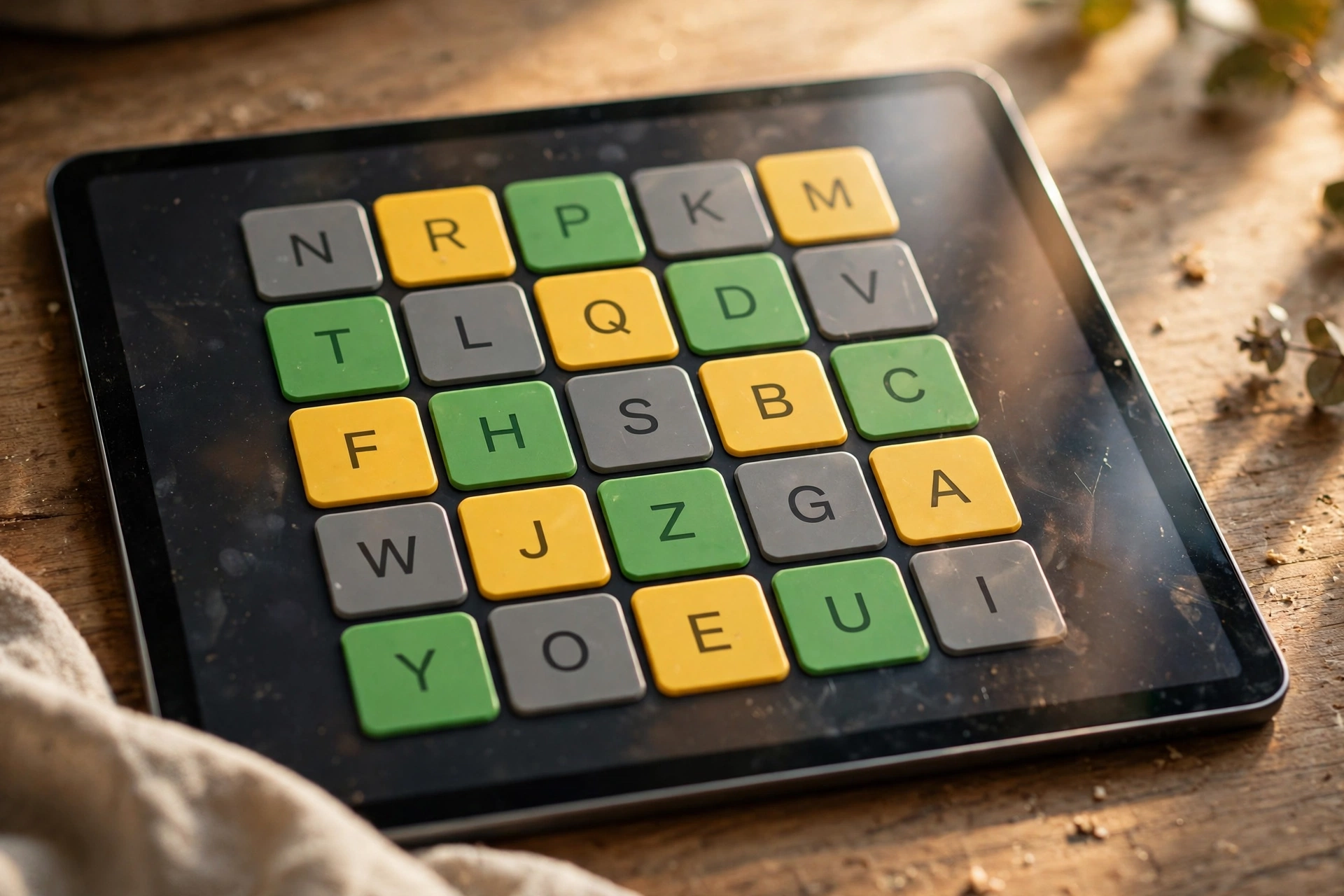
Here are the five words hidden in today’s sample board:
- Across 1 (top row): HEART
- Across 2 (middle row): OCEAN
- Across 3 (bottom row): RIVER
- Down 1 (left column): HONOR
- Down 2 (right column): TUNER
Check them against the grid. HEART runs across the top, OCEAN across the middle, RIVER across the bottom. HONOR runs down the left column, and TUNER down the right. The crossing letters match in both directions, which is the test that a Waffle board is built correctly: the H of HEART is also the H of HONOR, the T of HEART is also the T of TUNER, the O of OCEAN is also the O of HONOR, the N of OCEAN is also the N of TUNER, and the R of RIVER is also the R of both HONOR and TUNER.
Here is the solved board:
| H | E | A | R | T |
|---|---|---|---|---|
| O | U | |||
| O | C | E | A | N |
| N | E | |||
| R | I | V | E | R |
Every tile is green now. That is the win state: all five words correct, all 19 letters in their right places.
The 7-Swap Solution, Step by Step
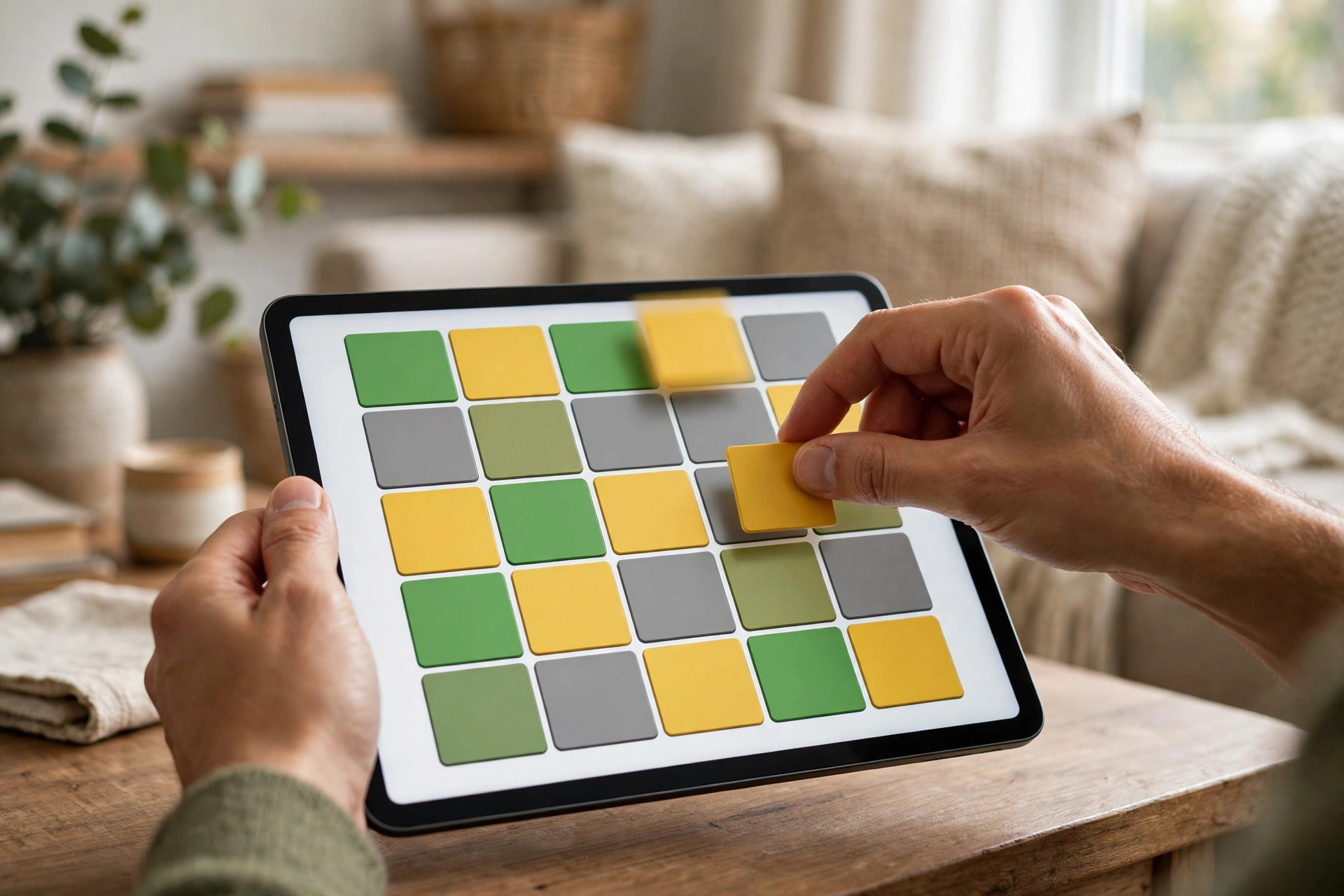
The sample solves in 7 swaps, three under the 10-swap par that the original game rewards with a top score. You have 15 swaps, so a 7-swap solve leaves 8 to spare. Follow the steps on the starting board and watch the puzzle come together: the top row first, then the corners, then the middle and bottom rows to finish.
Swap 1: A (top row, first tile) with H (top row, third tile). The H lands at the start of the top row and turns green at once, which is also the first letter of the left column word. The A lands as the third letter of HEART and turns green. One swap, two green tiles.
Swap 2: T (top row, fourth tile) with R (top row, last tile). The R lands as the fourth letter of HEART and turns green, and the T lands as the last letter and turns green. The top row is finished now: H, E, A, R, T. The T at the end is also the first letter of the right column word, so this swap helps the right column too.
Swap 3: R (second row, first tile) with O (bottom row, first tile). The O lands as the second letter of HONOR and turns green, and the R lands as the first letter of RIVER and turns green. This swap deals with the first grey tile: the R was grey for the left column, because R is not in HONOR at all, and it belonged at the start of the bottom row, while the O was grey for the bottom word, because O is not in RIVER at all, and it belonged in the left column.
Swap 4: E (second row, last tile) with U (fourth row, last tile). The U lands as the second letter of TUNER and turns green, and the E lands as the fourth letter of TUNER and turns green. This swap works entirely inside the right column, and it finishes that word in a single move, because the green N in the middle row was already in the third spot.
Swap 5: A (middle row, first tile) with O (middle row, fourth tile). The O lands as the first letter of OCEAN and turns green, and the A lands as the fourth letter of OCEAN and turns green. The middle row now reads O, I, E, A, N, with only the second letter still wrong. The O at the start is also the third letter of the left column word, so this swap helps HONOR as well.
Swap 6: I (middle row, second tile) with C (bottom row, second tile). The C lands as the second letter of OCEAN and turns green, and the I lands as the second letter of RIVER and turns green. This swap deals with the second grey tile: the I was grey for OCEAN, because I is not in OCEAN at all, and it belonged in the bottom row, while the C was grey for RIVER, because C is not in RIVER at all, and it belonged in the middle row. The middle row is finished now: O, C, E, A, N.
Swap 7: E (bottom row, third tile) with V (bottom row, fourth tile). The V lands as the third letter of RIVER and turns green, and the E lands as the fourth letter of RIVER and turns green. The bottom row is finished now: R, I, V, E, R. The left column is finished too: H, O, O, N, R spells HONOR. One swap finishes two words at once, and the board is solved.
Count the green tiles after each swap and you will see the pattern: every single swap turned two letters green. That is 14 green tiles earned in 7 swaps, on top of the 5 green tiles the board started with. That is the whole secret of a low swap count.
What This Sample Teaches You
This sample board is small and friendly, but its lessons show up on every board you will ever play.
Start with what you know. This solve began with the top row, because four of its five letters were yellow and the word was almost spelled out already. The letters A, E, H, T and R can only make a small number of real words with E second, and HEART is the most common one. On your own board, start with whichever word has the most yellow tiles and the clearest green anchors.
Trust the green tiles. Five green tiles were already in place before the first swap. A good solve never fights the green tiles. It builds around them. The green N in the middle row was the key to the whole right column, because it told you the third letter of TUNER before you knew anything else.
Yellow means “in this word, wrong spot”. The yellow H in the top row was the whole clue to HEART. The yellow V in the bottom row did the same job for RIVER, because very few five-letter words with V in them end in R. Yellow tiles are information, not mistakes. Read them before you move them.
Grey means “not in this word”, not “useless”. The R in the second row looked like a dead letter. It was the first letter of RIVER. The I in the middle row looked just as dead. It was the second letter of RIVER. The O and C in the bottom row looked dead too. They were the first two letters of OCEAN. Grey tiles belong somewhere else on the board. Follow them to their real home.
Look for double-green swaps. All seven swaps in this solve turned two letters green at once. That is what cut the solve from 14 swaps to 7. Before every swap, ask one question: can I fix two letters with this one move? If the answer is yes, make that swap first.
Crossings are where the magic happens. Six tiles on this board belong to two words at once. The H in the top left corner belongs to HEART and HONOR. The T in the top right corner belongs to HEART and TUNER. The O at the start of the middle row belongs to OCEAN and HONOR. When you fix a crossing tile, you make progress on two words at the same time.
If you want more practice with these ideas, the beginner’s guide covers the rules and the colour system from the start. To see how Waffle compares with the game that inspired it, our Waffle vs Wordle guide lays out the differences side by side. SolveWordGames explains the same 10-swap par maths in its strategy guide.
How to Play Your Own Board Today
The sample is solved, but your game is waiting. Open the Waffle game and load a fresh board. It will look different from this sample, and that is exactly the point. Use the same six habits: start where the clues are strongest, build around the green tiles, read the yellow tiles, follow the grey tiles home, look for double-green swaps, and watch the crossings.
You get 15 swaps on a standard board, and 3 hints if you get stuck. A hint places one misplaced letter into its correct spot, which is often enough to unlock the rest of the board. Use a hint when you have stared at the same board for a while and nothing is moving, not at the first sign of trouble.
There is no daily puzzle to miss and no reset time to wait for. If you finish your board and want another, load a fresh one. Our guide to when a new Waffle puzzle arrives explains why there is no midnight wait on this site. The original game resets at midnight and gives every player the same board, but here a new board is always one click away.
For a bigger challenge, try Deluxe mode, which uses a 5 by 6 grid with six words and 25 swaps. The same habits apply, but the board is bigger and the words cross in more places. You can read about all the modes on our blog, where a new sample puzzle appears every morning.
Play in a quiet moment, not in a rush, because the best solves come from looking at the board for a minute before touching a tile. Say the words out loud as you guess them, because hearing a word often tells you whether it fits the letters you have. Do not be afraid to make a wrong swap. You have 15 swaps and this board only needed 7, so you have room to experiment. A wrong swap is not a failure. It is information.
Frequently Asked Questions
How many words are in a Waffle puzzle?
A standard puzzle on this site hides five five-letter words: three across and two down. The original game hides six words, and Deluxe mode on this site hides six words on a bigger 5 by 6 grid.
What is the fewest swaps a Waffle puzzle can be solved in?
Every standard puzzle can be solved in 10 swaps on the original game, which is the par score, and most boards solve in far fewer with double-green swaps. The sample here solved in 7 swaps. On this site there is no star score, so the swap count is your own challenge to beat.
Can I play more than one Waffle puzzle a day on this site?
Yes. There is no shared daily puzzle and no waiting. Every board is generated fresh and at random, so you can play as many puzzles as you like, one after another. Finish a board, load a fresh one, and keep playing.
What do yellow tiles mean in Waffle?
A yellow letter belongs in that word but sits in the wrong spot. It needs to move to another position in the same row or column. At a crossing tile, a yellow letter belongs in one of the two words that meet there, so check both directions before you move it.
Do green tiles lock in Waffle?
Yes. Once a letter turns green, it is in its correct spot and it is locked in place. That is why green tiles are the anchors of every solve. Plan your swaps around them.
Is there a shared daily Waffle puzzle on this site?
No. Every player gets a different random board, so there is no single daily puzzle and no set of today’s answers. That is why this series publishes a clearly labelled sample puzzle each morning instead. The sample teaches the same swap logic you will use on your own board.
Conclusion
Today’s sample puzzle hid five everyday words, HEART, OCEAN, RIVER, HONOR and TUNER, behind a scrambled 5 by 5 grid. It started with five green tiles, solved in 7 swaps, and every single swap turned two letters green at once. The solve turned on six simple habits: start where the clues are strongest, trust the green tiles, read the yellow tiles, follow the grey tiles home, look for double-green swaps, and watch the crossings.
Remember that this was a sample, not today’s puzzle. Your board will have different words, and that is the fun of it. The habits are the same on every board, so take them with you. Then come back tomorrow morning for a brand new sample puzzle, with fresh words, fresh hints and a fresh step-by-step solve.