How Many Swaps Do You Get in Waffle?
Quick answer: How many swaps in Waffle? You get 15 swaps on a standard board. Every puzzle can be solved in 10 swaps at best on the original game, so the 15-swap budget leaves you five spare moves to experiment with. On this site, the standard board also gives you 15 swaps, and Deluxe gives you 25. There is no star score on this site, so the swap count is your own challenge to beat, not a score the game awards.
If you have ever stared at a Waffle board with two swaps left and three letters still out of place, you know why this question matters. The swap count is the whole game. It decides whether you can afford to experiment, whether a guess is worth the risk, and whether you solve the board or watch it end one move short. This guide answers the question properly: how many swaps you get in each mode, what the 10-swap par means, what happens when the counter hits zero, and how to save swaps so you rarely feel the pressure at all.
The Short Answer: 15 Swaps
A standard Waffle board gives you 15 swaps. That number is the same on the original game, on the clones, and on this site. Waffle Game states it plainly: “You have 15 swaps to solve the puzzle.” WordUnscrambler’s daily hints page says the same: “You get 15 swaps per puzzle. Every Waffle can be solved in as few as 10, so the extra five give you room to experiment.”
Fifteen is not a random number. It is built around the 10-swap par. Every standard puzzle is designed so that a perfect solve takes 10 swaps, which means you always start with five spare moves. Those five spares are your margin for error. You can test an idea, move a letter to see what it reveals, or fix a mistake, and still finish comfortably. What you cannot do is flail. Five spare swaps disappear fast if every move is a guess.
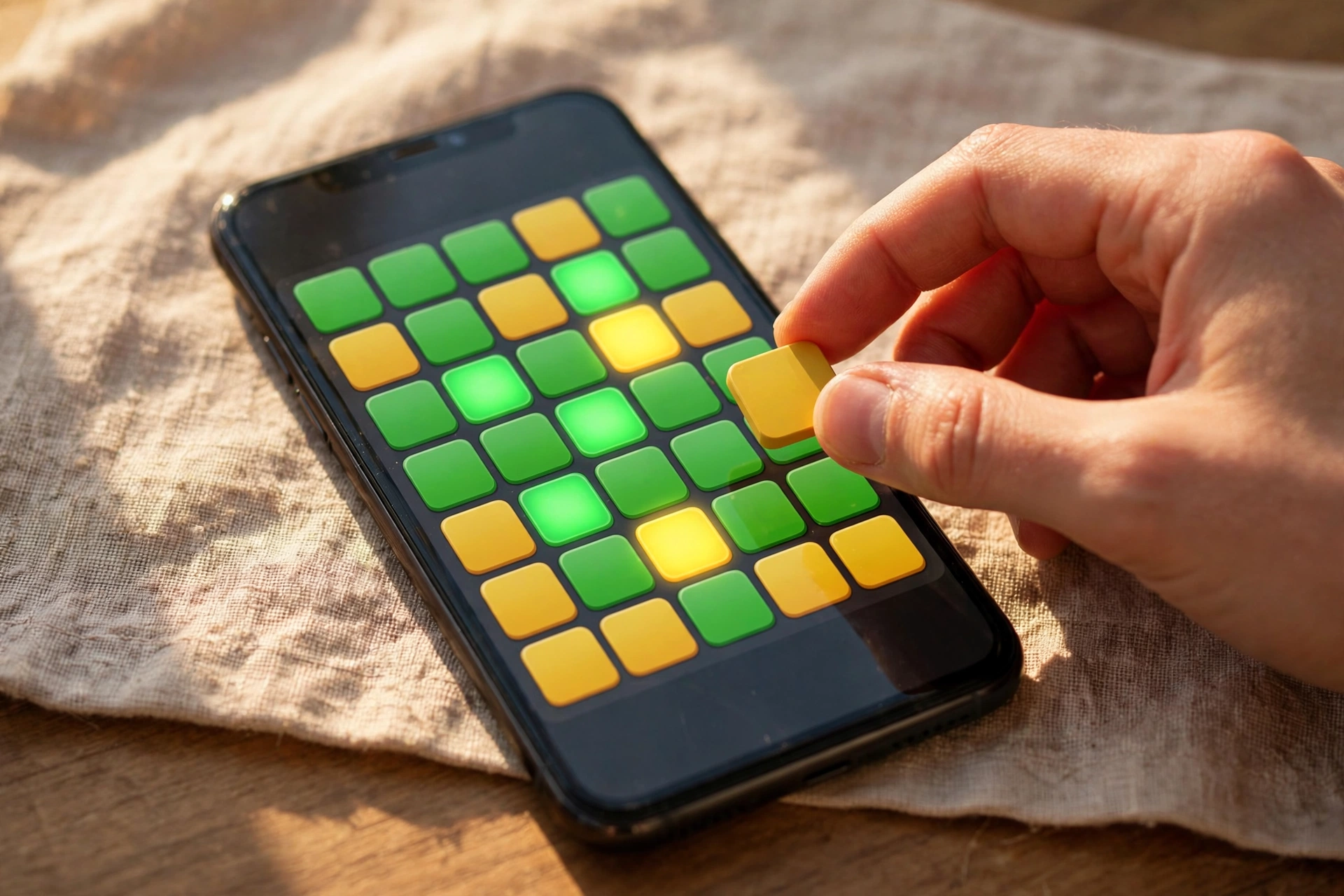
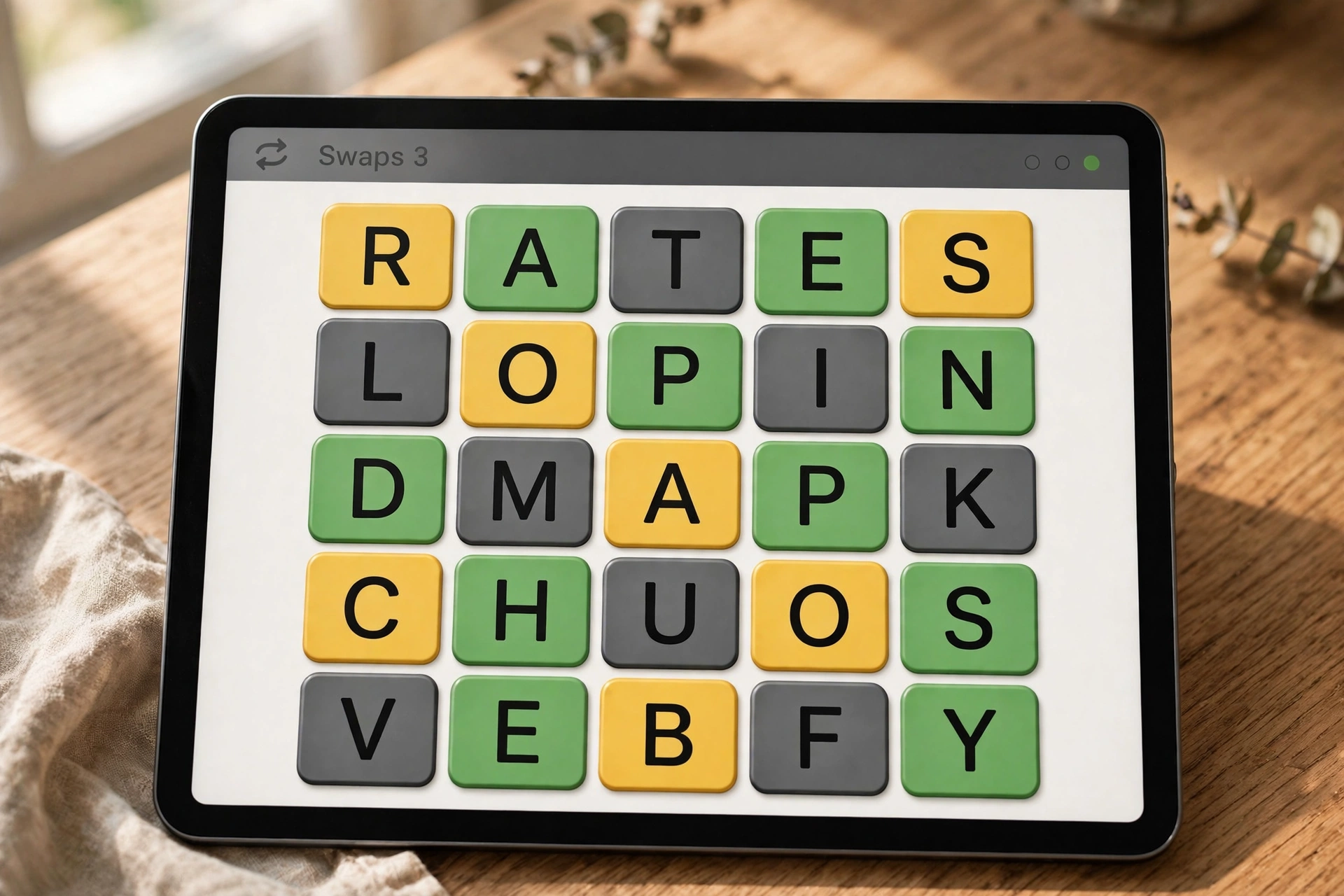
The board itself is a 5 by 5 grid hiding five five-letter words on this site, three across and two down, with 19 letter tiles in total. The original game hides six words on the same size grid, because it has a third down word. Either way, the swap budget is 15. The counter sits at the top of the screen and drops by one with every swap you make, and it never goes back up. There is no way to earn extra swaps in the middle of a puzzle, and there is no difficulty setting that changes the number. Fifteen is the budget, and the whole skill of the game is spending it well.
If you are new to the game, start with our beginner’s guide to Waffle, which explains the rules, the colours and the three modes in full. If you already know the basics, the rest of this guide is about making those 15 swaps go further.
What Counts as One Swap
A swap is simple: tap one letter, then tap a second letter, and the two exchange places. That costs one swap. It costs one swap even if the move does not improve the puzzle. It costs one swap even if you swap two letters and then swap them straight back. There is no undo button that refunds the move, and there is no free preview. Every exchange counts, which is why thinking before you tap is the single most valuable habit in the game.
A few details are worth knowing, because new players get caught out by them.
Any two letters can be swapped. The letters do not have to sit next to each other, in the same row, or in the same column. Any tile on the board can be swapped with any other tile. That freedom is what makes the puzzle solvable in 10 swaps: a letter on the far side of the board can go straight to its home in one move.
Green tiles cannot be swapped. Once a letter turns green, it is locked in its correct spot. The game will not let you move it, and that is a good thing: it stops you from wasting a swap on a letter that is already home. Our guide to what the colours mean in Waffle explains all three colours with board examples, including the lock rule.
Swapping two identical letters costs a swap and changes nothing. If the board has two O tiles and you swap them, the board looks exactly the same, but the counter still drops by one. It is the easiest wasted swap in the game, and it happens more often than you would think, usually when a player is moving fast and not reading the letters. Always check that the two letters are different before you tap.
A hint is not a swap. On this site, you get 3 hints per board. A hint places one misplaced letter into its correct spot, and it does not cost a swap. Hints and swaps are separate budgets. Use a hint when you are stuck, and save your swaps for the moves you can see clearly.
Swap Counts by Mode
The standard board is not the only board. Waffle comes in several modes, and each one has its own swap budget. The table below lists them side by side, with the figures that apply on this site first and the original game’s figures where they differ.
| Mode | Grid | Words | Swaps |
|---|---|---|---|
| Standard, this site | 5 by 5 | 5 | 15 |
| Standard, original game | 5 by 5 | 6 | 15 |
| Deluxe, this site | 5 by 6 | 6 | 25 |
| Deluxe, original game | 7 by 7 | 8 | 25 |
| Unlimited, standard board | 5 by 5 | 5 or 6 | 15 |
| Unlimited, small board | 3 by 3 | 4 | 7 |
Read the table from top to bottom and the pattern is clear. The standard game always gets 15 swaps, whatever the site. Deluxe always gets 25, because the board is bigger and has more words to untangle. The small 3 by 3 board gets only 7 swaps, because it has only four short words and a tiny grid. The swap budget scales with the size of the puzzle, and that is the whole logic behind the numbers.
Deluxe deserves a closer look, because the two versions are easy to confuse. On this site, Deluxe is a 5 by 6 grid hiding six words, three across and three down, with 25 swaps to solve it. On the original game, Deluxe is a bigger 7 by 7 grid hiding eight words, also with 25 swaps. Same swap count, different board. The 25 swaps are generous on this site’s smaller Deluxe board, which makes it a good place to practise long solves without the pressure of a tight budget.
Unlimited mode follows the same swap rules as the standard game: 15 swaps per board, fresh board every time. The only difference is that there is no daily limit. You can play board after board, and each one comes with a full 15 swaps. That makes Unlimited the best place to practise saving swaps, because a failed board costs you nothing but a fresh start. Our guide to when a new Waffle puzzle arrives explains why there is no waiting on this site and how Unlimited fits into that.
The 3 by 3 small board is the odd one out. With only 7 swaps and four short words, it plays more like a warm-up than a full puzzle. It is a good first board for a brand new player, because the small grid makes the swap logic easy to see. The figure of 7 swaps comes from the mode table on the Waffle Game site, which lists the small board alongside the standard and Deluxe boards.
The 10-Swap Par and the Star Maths
Fifteen swaps is the budget, but 10 swaps is the par. Every standard puzzle can be solved in 10 swaps at best, and no puzzle can be solved in fewer. That is not a guess. A 2025 paper on the maths of the game, “Mathematics of the NYT daily word game Waffle”, analyses the scrambles as permutations of the tiles and reports that no game can be solved in fewer than 10 swaps. The same figure appears on every serious guide site: WordUnscrambler says every puzzle can be solved in as few as 10, and SolveWordGames explains the 10-swap par maths in its strategy guide.
Why 10? The answer is in the shape of the board. A standard board has 19 tiles, and a perfect solve has to place the misplaced letters into their correct spots. The scramble is built so that the shortest possible route to the solution always takes exactly 10 swaps. Think of it this way: most letters need one move to reach home, and a few need two. The total works out to 10, every time, on every board. That is the par, and it is the same for every player on the same board.
The star maths follows directly from the par, and it belongs to the original game only. On the original game, each swap you have left when you finish earns a star. Solve in 10 swaps and you have 5 swaps left, which earns 5 stars, the top score. Solve in 11 swaps and you earn 4 stars. Solve in 12 and you earn 3. Solve in 13 and you earn 2. Solve in 14 and you earn 1. Solve in 15 and you earn none, because you used every swap you had. That is the whole system: 10 swaps is 5 stars, 15 swaps is 0 stars, and every swap in between costs exactly one star.
This matters for this site because the game here has no star-award logic. There is no star score to earn, and no star display at the end of a puzzle. The 10-swap par is still a useful target, because it tells you how efficient your solve was, but the stars themselves belong to the original game’s rules, not to this site. Our guide to getting 5 stars in Waffle explains the original game’s star system and the low-swap habits behind it, with the labelling kept honest about which game the stars belong to.
The practical lesson is simple. If you finish in 10 swaps, you played a perfect game by the original standard. If you finish in 12 or 13, you played well and used a couple of spare moves to test ideas. If you finish in 15, you used everything you had, and the puzzle still counts as solved. The number that matters most is not the star count but the trend: are your solves getting cheaper over time? If they are, you are improving. If they are not, the habits in the next sections will help.
What Happens When You Run Out of Swaps
Running out of swaps is the one way to lose a Waffle puzzle. The counter hits zero, the board freezes, and the puzzle ends unsolved. On the original game, the answers are revealed and the next puzzle arrives at the next reset. On this site, there is no reset to wait for: you simply load a fresh board and try again, because every board is generated fresh on demand.
Three things are worth knowing about the end of a puzzle.
The game warns you. The counter is always visible, and the last few swaps feel different because the number is small. Do not ignore it. When you have 3 swaps left, stop experimenting and start counting. Work out exactly which letters still need to move, and check whether 3 swaps is enough. If it is not, use a hint. A hint places a letter correctly without costing a swap, and it can turn an impossible finish into a comfortable one.
You can still solve on your last swap. A solve on swap 15 counts exactly the same as a solve on swap 10. The board turns green, the puzzle is complete, and the only difference is that you used every move you had. There is no penalty for finishing late, and no bonus for finishing early, on this site. The win is the win.
Running out is not a failure of skill, it is a failure of planning. Almost every puzzle that ends at zero swaps was lost in the first five moves, not the last five. The player spent swaps on guesses, moved letters without a plan, or chased one word while ignoring the crossings. The fix is not to play faster. It is to plan before you tap, which is what the next section is about.
How to Save Swaps: Seven Habits That Work

Saving swaps is a skill, and like any skill it comes from habits, not talent. These seven habits are the ones that cut the most swaps from an average solve. They are ordered by impact, so start with the first two and add the rest as they become natural.
1. Plan the whole solve before your first swap. Look at the board for a full minute before you touch anything. Read the colours, guess at least one word, and work out where the obvious letters belong. The best players solve half the puzzle in their heads before they make a single move. Every swap you plan in advance is a swap you do not waste on a guess.
2. Look for double-green swaps. A double-green swap is a swap that turns two letters green at once. It is the single biggest saver in the game: a solve built on double-green swaps can finish in 7 or 8 moves instead of 14. Before every swap, ask one question: can I fix two letters with this one move? If the answer is yes, make that swap first. Our daily sample puzzle on the blog shows a full 7-swap solve built entirely on double-green moves, and it is worth following step by step.
3. Solve the corners and the centre first. Corner tiles and the centre tile belong to two words at once, so fixing one of them helps two words at the same time. A corner swap is almost always a double-green swap, which is why the best solves start at the edges and work inward. The middle of a row can wait. The crossings cannot.
4. Read the colours before you move anything. Green means the letter is home and locked. Yellow means the letter belongs in that word but sits in the wrong spot. Grey means the letter does not belong in that word at all. Most wasted swaps come from moving a yellow letter into the wrong word, or from trying to force a grey letter into a word it does not belong to. Spend ten seconds reading the colours, and you will save two swaps.
5. Never swap two identical letters. Two O tiles swapped with each other change nothing on the board, but the counter still drops by one. It is the purest wasted swap in the game. Before you tap the second tile, check that the two letters are different. This sounds obvious, and it is, but it happens most often when a player is moving fast and the board is full of repeated letters.
6. Use a hint instead of a guess. On this site you get 3 hints per board, and a hint does not cost a swap. When you are stuck and the only move you can see is a guess, use a hint instead. A hint places one letter correctly, and that one correct letter often unlocks two or three more moves. A guess costs a swap and usually tells you nothing. The hint is free. The guess is not.
7. Practise in Unlimited mode. Unlimited gives you a fresh board with a full 15 swaps every time, and there is no penalty for failing. Play ten boards in a row, count your swaps on each one, and watch the number fall. The practice transfers directly to the standard board, because the swap logic is identical. If you want a bigger challenge once the standard board feels easy, try Deluxe mode, which gives you 25 swaps on a 5 by 6 grid with six words.
Swaps Versus Guesses: Waffle and Wordle
Players coming from Wordle often misunderstand the swap budget, because Wordle counts guesses and Waffle counts swaps, and the two work very differently. In Wordle, you get 6 guesses, and each guess is a whole new word typed from scratch. A wrong guess costs you a turn, but it also gives you information: the colours of five new letters. In Waffle, you get 15 swaps, and each swap moves two letters that are already on the board. A wrong swap costs you a move and gives you almost nothing, because the letters were already visible.
That difference is why Waffle feels more generous and more punishing at the same time. Fifteen moves sounds like a lot next to Wordle’s six, but each Waffle move is smaller. You are not testing a new word. You are nudging two letters into place. A Wordle guess can crack the puzzle in one stroke. A Waffle swap can only ever fix two letters, and only if you chose the right two.
The other difference is what you are spending. In Wordle, a guess is a test: you spend a turn to learn something. In Waffle, a swap is a commitment: you spend a move to place letters, and the learning should have happened before you tapped. That is why planning matters so much more in Waffle than in Wordle. A Wordle player can afford to guess. A Waffle player who guesses is spending the budget on hope.
If you play both games, the habit that transfers best is the opening read. In Wordle, the first guess sets up the colours for the whole game. In Waffle, the first minute of reading sets up the swaps for the whole board. Slow down at the start, and the rest of the game gets cheaper. Our Waffle vs Wordle guide lays out the two games side by side, with a table of the differences and a verdict for different player types.
Common Swap Mistakes That Waste Moves
Most players lose swaps to the same five mistakes. They are easy to spot once you know them, and easy to stop once you start counting.
Swapping before reading the board. The most common waste is the opening swap made in the first five seconds, before the colours have been read. The player sees two letters that look wrong and swaps them on instinct. Half the time the swap is useless, and the counter is already at 14. Read first, swap second. The board is not going anywhere.
Chasing one word and ignoring the crossings. A player fixates on the top row, spends four swaps getting it right, and then finds the down words are a mess. Every swap should be judged by what it does to both words it touches. If a swap fixes one word and breaks another, it is not a good swap. The crossings are where the savings live.
Moving a yellow letter to the wrong word. A yellow letter belongs in its word, but a crossing tile belongs to two words, and the yellow may answer to either one. Moving a letter along its row when it actually belongs in its column wastes a swap and creates a new problem. Before you move a yellow tile, check both directions. Our guide to what the colours mean in Waffle works through crossing tiles with examples.
Swapping identical letters. Two tiles with the same letter, swapped with each other, change nothing and cost one swap. It happens when a board has repeated letters, which is most boards, and the player is moving fast. Check the letters before you tap. This one mistake alone costs the average player a swap on every third board.
Saving hints for a moment that never comes. Some players refuse to use hints, treating them as a last resort, and then run out of swaps with hints still unused. A hint is not a failure. It is a free correct placement, and it does not cost a swap. If you are stuck with 4 swaps left and the board is not close, use a hint. It is there to be used, and an unused hint at the end of a failed puzzle is worth nothing.
Frequently Asked Questions
How many swaps do you get in Waffle?
You get 15 swaps on a standard Waffle board, on this site and on the original game. Deluxe mode gives you 25 swaps. The small 3 by 3 board gives you 7 swaps. Every standard puzzle can be solved in 10 swaps at best, so the 15-swap budget leaves five spare moves.
Can you solve a Waffle puzzle in fewer than 10 swaps?
On the original game, no. Every standard puzzle is designed so that the shortest possible solve takes exactly 10 swaps, and a 2025 paper on the maths of the game reports that no puzzle can be solved in fewer. Most players finish in 12 to 15 swaps, and a clean solve built on double-green swaps can finish in 7 or 8.
What happens if you run out of swaps in Waffle?
The puzzle ends unsolved and the board freezes. On the original game, the answers are revealed and the next puzzle arrives at the next reset. On this site, there is no reset to wait for: you simply load a fresh board and try again. See our guide to when a new Waffle puzzle arrives for the full explanation.
Do hints cost swaps in Waffle?
No. On this site, hints and swaps are separate budgets. You get 3 hints per board, and a hint places one misplaced letter into its correct spot without costing a swap. Use a hint when you are stuck instead of spending a swap on a guess.
How many swaps do you get in Waffle Deluxe?
You get 25 swaps in Deluxe mode. On this site, Deluxe is a 5 by 6 grid hiding six words. On the original game, Deluxe is a bigger 7 by 7 grid hiding eight words, also with 25 swaps. The extra swaps cover the bigger board and the extra words.
Do unused swaps become stars on this site?
No. The star system belongs to the original game only, where each unused swap earns a star and a solve in 10 swaps earns the top score of 5 stars. The game on this site has no star-award logic, so the swap count is your own challenge to beat. Our guide to getting 5 stars in Waffle explains the original game’s star system.
Conclusion
So, how many swaps do you get in Waffle? Fifteen on a standard board, 25 in Deluxe, and 7 on the small 3 by 3 board. Every standard puzzle can be solved in 10 swaps at best, which leaves you five spare moves to experiment with, and each unused swap earns a star on the original game only. On this site there is no star score, so the swap count is yours to chase, not a score the game awards.
The number itself is the easy part. The skill is in how you spend it. Plan before you tap, look for swaps that fix two letters at once, solve the corners first, read the colours before you move anything, and use a hint instead of a guess. Do those five things and your solves will get cheaper fast, often finishing in 11 or 12 swaps instead of 15.
Open the Waffle game now and count your swaps on the next board. Play it slowly, plan the first three moves before you touch anything, and see how many you have left at the end. Then try our daily sample puzzle and follow a 7-swap solve step by step. The budget is fixed at 15. What you do with it is up to you.