
How to Play Waffle | A Beginner’s Guide
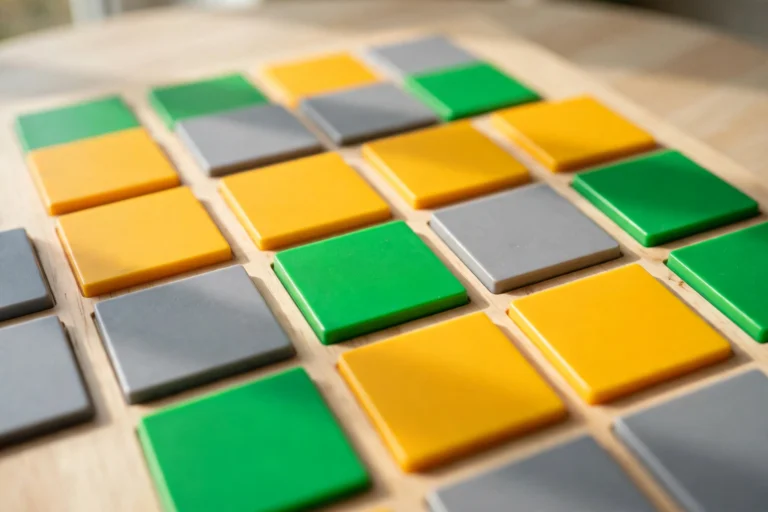
Quick answer: Waffle is a free daily word puzzle. You get a grid of letter tiles that already holds five five-letter words, all mixed up. Swap any two tiles to trade their places. Green means a letter is in the right spot, yellow means it belongs in that word but in the wrong spot, and grey means it does not belong in that word. Solve all five words in 15 swaps or fewer to win.
Waffle looks simple at first glance. A grid of letters, three colors, and one job: put everything in the right place. Most new players finish their first puzzle in a few minutes, then come back the next day because the second puzzle feels different. That is the whole appeal. The rules fit in a paragraph, but the thinking behind each swap is what keeps people playing.
This guide covers everything a beginner needs. You will learn what Waffle is, how the board works, what each color means, how the three modes differ, and how to think through your first puzzle step by step. There is a full worked example near the end, using an illustrative board, so you can see the thinking in action before you play. By the time you finish reading, you will know exactly what to do on your first board.
What Is Waffle?
Waffle is a daily word puzzle that mixes a crossword with a Wordle-style color system. It was created in February 2022 by British game maker James Robinson, who runs an independent studio called Waffle Studio in Portsmouth, UK. It arrived just as Wordle was going viral, and it grew fast. The original game grew to more than 500,000 daily players, and it is still played every day by a large audience around the world.
The idea is different from Wordle in one important way. In Wordle, you guess words letter by letter and the game tells you how close you were. In Waffle, there is no guessing at all. Every letter you need is already on the board from the start, just in the wrong place. Your job is to swap letters until every row and column spells a real word. It feels less like a vocabulary test and more like a small logic puzzle, because the answer is sitting in front of you the whole time. You only have to find it.
That is also why beginners pick it up so fast. You do not need a big vocabulary to start. You need to read colors, spot patterns, and think one swap ahead. Players who have never finished a crossword can still solve a Waffle board, and players who love crosswords will enjoy how the crossing words lock together.
On this site, you can play the daily puzzle on thewafflegame.uk for free. There is nothing to download and no account to create. The game runs in your browser on a phone, tablet, or computer.
The Board: Five Words, One Grid
The standard Waffle board is a 5 by 5 grid that hides five five-letter words. Three words run across and two run down, and they cross each other, so some tiles belong to two words at once. The grid has 19 letter tiles. Six squares stay empty, the middle three of the second row and the middle three of the fourth row, which gives the board its waffle shape.
Here is how the five words sit on the board:
| Position | Word | Direction |
|---|---|---|
| Top row | Word 1 | Across |
| Middle row | Word 2 | Across |
| Bottom row | Word 3 | Across |
| Left column | Word 4 | Down |
| Right column | Word 5 | Down |
The top, middle, and bottom rows are the three across words. The left and right columns are the two down words. The tiles where a row and a column meet are crossing tiles. A crossing tile belongs to two words at the same time, which means fixing it helps two words at once. There are six crossing tiles on a standard board: the two ends of each across row, where they meet the two down columns.
This layout matters more than it first seems. A letter that looks wrong in its row might be exactly right in its column. A word that looks nearly finished might be blocked by one tile that belongs to the crossing word. Learning to check both directions before every swap is the single most useful habit in the game, and it is the habit this guide returns to again and again.
The daily puzzle gives you 15 swaps. That is your whole budget. Every swap, good or bad, costs one move. When the counter hits zero, the puzzle ends, so each swap has to earn its place. Most boards can be solved in far fewer than 15 swaps, which leaves room for a few learning mistakes. As you get better, you will use fewer swaps, and the puzzle will start to feel like a race against your own last score rather than a race against the counter.
The Rules in 30 Seconds
If you only remember one section of this guide, remember this one:
- Swap any two letters to trade their places. Each swap uses one move.
- Finish all five words before your 15 swaps run out.
- Green means a letter is in the right place. Leave it there.
- Yellow means the letter belongs in that word, but in a different spot.
- Grey means the letter does not belong in that word. It belongs in the word crossing that square.
- You win when every row and column spells a real word.
That is the whole game. Everything else in this guide is about doing those six things well.
One more rule is worth knowing before you start. You cannot move a letter to an empty square, because there are no empty squares to move into. Every move is a swap between two tiles that are already on the board. This is why Waffle feels different from sliding puzzles. You are always trading one letter for another, and every trade has a cost on both sides.
The Colors, Explained
The color system is the heart of Waffle. Learn it once and the whole game opens up. Every tile on the board is green, yellow, or grey, and each color tells you something exact about that letter.

Green: Correct Spot
A green tile is a locked-in letter. It is in the right place in the right word. Build the rest of the word around it, and do not move it. Moving a green tile is the most common beginner mistake, and it almost always costs a move to undo. Treat every green tile as finished. Your job is to fix the tiles around it.
A green tile at a crossing is even better, because it is correct in two words at once. When you see a green crossing tile, two words are already partly solved, and you can use that letter as an anchor for both of them.
Yellow: Right Letter, Wrong Spot
A yellow tile belongs in the word on that row or column, but it sits in the wrong square. Look for an open tile in the same word where it could fit, and check the word crossing that square first. A yellow tile is a clue with an address on it. It tells you which word it belongs to. Your job is to find the right square inside that word.
Yellow tiles often come in pairs. Two yellow tiles in the same word can often simply swap with each other, and both land correctly in a single move. That is the cheapest move in the game, and the walkthrough later in this guide shows one in action.
Grey: Not in This Word
A grey tile does not belong in the word on that row or column. It belongs in the word that crosses that square. Move it toward the crossing word, not away from it. Grey is not a dead letter. It is a letter in the wrong neighborhood. Every grey tile has a home somewhere else on the board, and the color is telling you to send it across.
This is the color beginners misread most often. A grey tile does not mean the letter is useless. It means the letter belongs to the other word that shares that square. If you move grey tiles at random, you will spend swaps without fixing anything. If you move each grey tile toward its crossing word, the board starts to untangle fast.
Colorblind and Display Options
Green and yellow can be hard to tell apart for players with red-green color blindness. This game has a built-in colorblind toggle that swaps the default palette for a higher-contrast purple and gold scheme, with the same logic and the same rules. There is also a dark mode and a contrast mode in the settings. If the colors ever look unclear, open the settings menu in the game and switch the palette before you start swapping.
How to Swap Letters
Swapping is the only move in Waffle, so it is worth learning properly. Tap a tile, then tap the tile you want to trade it with. The two letters exchange places and the counter drops by one. On a touch screen you can also drag one tile onto another. On a computer, click one tile and then click the second. The board recolors itself after every swap, so read the new colors before you make the next move.
Here is the routine that good players follow on every single swap:
- Read the colors. Find the yellow and grey tiles that need to move.
- Pick the word with the fewest yellow tiles. A nearly finished word often reveals where the letters it shares belong.
- Check the crossing word before you move anything. A tile at a crossing serves two words, and fixing one word can break the other if you do not look first.
- Make the swap, then stop and read the board again. Do not plan three swaps ahead, because one swap changes the colors and can change the plan.
Speed does not help in Waffle. There is no bonus for finishing fast, and the puzzle waits for you. The players who solve boards in the fewest swaps are usually the slowest ones, because they read the board after every move instead of rushing through it.
The Three Modes
This site has three ways to play. They all use the same rules and the same colors. They differ in size, swap budget, and how often you can play.
| Mode | Grid | Words | Swaps | Best For |
|---|---|---|---|---|
| Daily Waffle | 5 by 5 | 5 | 15 | A fresh standard puzzle |
| Waffle Unlimited | 5 by 5 | 5 | 15 | Learning and practice |
| Deluxe Waffle | 5 by 6 | 6 | 25 | A bigger challenge |
Daily Waffle is the standard puzzle on a 5 by 5 grid, with 15 swaps. Every board is generated fresh, so your puzzle is yours alone. Finish one and the Next Puzzle button deals another right away, with no wait for midnight.
Waffle Unlimited removes the daily cap, so you can play puzzle after puzzle and practice as much as you like. Each Unlimited board still gives you 15 swaps, and the rules are exactly the same. Unlimited is the best place to learn, because a bad board costs you nothing. You just start another one.
Deluxe Waffle steps up to a bigger 5 by 6 grid with six words and 25 swaps, with more intersections to manage. Three words run across and three run down. The extra row and the extra word make the board harder to read, and the crossings matter even more. Try Deluxe after the standard grid starts to feel comfortable.
New players should start with a few Unlimited puzzles to learn the color system, then try the standard puzzle, and move to Deluxe when the standard grid starts to feel easy. That order builds skill without frustration, and it is how most regular players learned the game.
Hints: Three Per Puzzle
The game gives you hints for the moments when you are truly stuck. In standard mode and Unlimited mode, you get three hints per puzzle. In Deluxe mode, you get four hints per puzzle. Tap the HINT button in the game and it places one misplaced letter into its correct spot.
Use a hint when you are stuck on a single tile, not as a first resort. A hint can break a deadlock, and a deadlock is where most wasted swaps happen. If you have read the colors twice and still cannot see a useful swap, that is the right moment to use one.
Do not spend all three hints early. Save at least one for the end of the puzzle, when the board is nearly solved and one stubborn tile is blocking two words. That last hint is often the difference between finishing inside your swap budget and running out with one word left.
If you run out of ideas completely, start a fresh puzzle in Unlimited mode and try a new grid instead of burning moves on a board you have stopped reading. A fresh board is free, and it often teaches you more than grinding on a stuck one.
Your First Puzzle, Walked Through
This is the section the old version of this guide promised and never delivered. Here is a full first puzzle, worked through step by step. This is an illustrative example board, not the daily puzzle and not a real puzzle from the site. The words are real, the board follows the real rules, and every swap below is a legal move. Follow along and you will see exactly how the thinking works.
The example board hides five words. Across: SWING, OPERA, ELITE. Down: STONE, GRAPE. Here is the board as it looks when you first see it, all mixed up:
| S | P | I | T | G |
| P | R | |||
| O | W | L | R | A |
| N | T | |||
| E | E | I | N | E |
Read the colors before you touch anything. Eleven tiles are already green: the S, I, and G in the top row, the R on the right edge of the second row, the O, R, and A in the middle row, the N on the left edge of the fourth row, and the E, I, and E in the bottom row. One tile is yellow: the E in the bottom row, second from the left. Seven tiles are grey: the P and T in the top row, the P on the left edge of the second row, the W and L in the middle row, the T on the right edge of the fourth row, and the N in the bottom row.

That is a friendly starting board. More than half the tiles are already home, and the yellow tile is pointing straight at its word. Here is how to finish it in five swaps.
Swap 1: Trade the Two Misplaced Pair
Look at the top row. It reads S, P, I, T, G. It should read SWING, so the P in the second square is wrong. Now look at the middle row. It reads O, W, L, R, A. It should read OPERA, so the W in the second square is wrong. The P belongs in OPERA and the W belongs in SWING. They are sitting in each other’s homes.
Swap the P in the top row (second tile from the left) with the W in the middle row (second tile from the left). Both tiles land correctly in one move. The top row now has W in place and the middle row now has P in place. That is a pair swap, two greens for the price of one, and it is the most valuable move in the game.
Swap 2: Follow the Yellow Tile
Now look at the yellow E in the bottom row, second from the left. Yellow means it belongs in its own word but in the wrong square. The bottom row should read ELITE, and ELITE already has an E at the start and an E at the end. This E belongs in the middle row, where OPERA needs an E in its third square.
The middle row currently has an L in its third square, and that L belongs in the bottom row, where ELITE needs an L in its second square. The E and the L are another pair sitting in each other’s homes.
Swap the yellow E in the bottom row with the L in the middle row. Both land correctly. The middle row now reads OPERA, all green, and the bottom row now has its L in place. Two words are nearly done and you have used only two swaps.
Swap 3: Fix a Crossing Tile
Look at the left edge. The second row from the top has a P on the left edge, and that tile belongs to the down word STONE. STONE needs a T in that square, and the top row has a T sitting in its fourth square where an N belongs. Swap the T in the top row (fourth tile from the left) with the P on the left edge of the second row.
The T lands in STONE and turns green. The P moves to the top row for now, where it is grey, because P does not belong in SWING. That is fine. It is a staging move, not a mistake. The P will find its home in the next swap.
Swap 4: Send the Grey Tile Home
That P in the top row belongs in the down word GRAPE, on the right edge. The fourth row has a T on its right edge, and that T belongs in the bottom row, where ELITE needs a T in its fourth square. Swap the P in the top row with the T on the right edge of the fourth row.
The P lands in GRAPE and turns green. The T moves to the top row for now, where it is grey, because T does not belong in SWING. Same pattern as the last swap. One tile is home and the other is staged for the final move.
Swap 5: Close the Board
The top row now reads S, W, I, T, G, and it should read SWING. The bottom row reads E, L, I, N, E, and it should read ELITE. The T in the top row belongs in the bottom row and the N in the bottom row belongs in the top row. They are the last pair.
Swap the T in the top row (fourth tile from the left) with the N in the bottom row (fourth tile from the left). Both land correctly. The top row reads SWING, the bottom row reads ELITE, and the whole grid is green. Five swaps, five words, puzzle solved.
Here is the finished board:
| S | W | I | N | G |
| T | R | |||
| O | P | E | R | A |
| N | P | |||
| E | L | I | T | E |
Notice what happened across those five swaps. Every swap fixed at least one tile, and three of the five swaps fixed two tiles at once. Nobody moved a green tile. Nobody guessed. Each move came from reading a color and asking where that letter belonged. That is the whole skill. If you can do it on this board, you can do it on your next puzzle.
Take one more lesson from this example. Swaps 3 and 4 each left a tile sitting in a wrong spot for one move. That is normal and it is not a mistake. Sometimes a tile has to wait one move before it lands home, because the swap that fixes it needs another tile to move first. What matters is that every swap has a reason. A swap that fixes one tile and stages another is a good swap. A swap with no reason is a wasted swap.
Common Mistakes Beginners Make
Every beginner makes the same handful of mistakes. Knowing them in advance will save you swaps from your very first puzzle.
Moving a green letter to check it. A green letter is confirmed. Moving it to check something almost always costs a move to undo, and it can break two words at once if the tile sits at a crossing. Treat green tiles as fixed anchors and build outward from them.
Solving one word on its own. A word never lives alone on a Waffle board. Every word shares tiles with the words crossing it. If you only look at rows, you can fix one word and break another. Check the crossing word before every swap, and you will often half-solve it for free.
Swapping on a guess. When the board looks confusing, the temptation is to swap something, anything, just to see what happens. That swap almost always wastes a move. Read the colors again instead. There is always a clue on the board: a yellow tile with a clear home, a grey tile pointing at its crossing word, or a pair of tiles sitting in each other’s homes.
Ignoring grey letters. Grey does not mean useless. Grey tells you where a letter belongs: in the crossing word. Players who ignore grey tiles spend swaps moving letters around the wrong word. Players who follow grey tiles to their crossing word untangle the board fast.
Spending your last swaps early. If you reach the last few swaps with a word still scrambled, you have no room to recover from a mistake. Slow down in the middle of the puzzle so the end is not a scramble. Hold three or four swaps in reserve for the final fixes.
Playing Deluxe too soon. Deluxe is a bigger grid with more crossings, and it punishes the same mistakes harder. Learn the color system on the standard 5 by 5 board first. When you can finish a standard puzzle with swaps to spare, Deluxe will feel like a fair challenge instead of a wall.
For a deeper look at the color rules and the swap budget on the original game, the strategy guide at Solve Word Games explains the same system in detail, and the guide at Waffle Game covers the modes and scoring on the original. A third clear explainer of the colors and the swap rules is on AnyWordSolver.
Good Habits for Your First Week
A few small habits will carry you from your first puzzle to your first comfortable solve.
- Lock in green letters first and build outward. Start every puzzle by finding the greens and mentally setting them aside.
- Solve the word with the fewest yellow tiles first. A nearly finished word often reveals where the letters it shares belong.
- Check the crossings before every swap. A letter at a crossing serves two words at once.
- Hold three or four swaps in reserve for the end. The last fixes are easier when you are not counting down to zero.
- Play two or three Unlimited puzzles as a warm up before a standard puzzle. Unlimited mode is free practice with no stakes, and it sharpens your eye for the color patterns.
- After each puzzle, look at your swap count. Ask which swap wasted a move and what the board was telling you instead. That one question is how you improve.
- When you finish a puzzle with swaps to spare, read our guide on how to get 5 stars in Waffle to learn the swap-saving habits that turn a good solve into a great one.
You can also read more puzzle guides on the blog, learn about the site on the about page, or open the standalone game page to play without the rest of the site around it.
Frequently Asked Questions
Is Waffle free to play?
Yes. The daily puzzle, Unlimited mode, and Deluxe mode are all free on this site. There is nothing to download and no account to create. Open the site in your browser and play.
How many swaps do you get in Waffle?
You get 15 swaps on a standard 5 by 5 puzzle and 25 swaps on a Deluxe 5 by 6 puzzle. Each swap trades the places of two tiles, and the counter drops by one per swap. Unlimited mode also gives you 15 swaps per board.
What do the colors mean in Waffle?
Green means the letter is in the correct spot. Yellow means the letter belongs in that word but in the wrong spot. Grey means the letter does not belong in that word at all, and it belongs in the word crossing that square instead.
Can I play past Waffle puzzles?
No. There is no archive of past boards on this site, because every board is generated fresh and each player gets a different puzzle. Unlimited mode deals a new board every time, so you can keep practicing the same skills on fresh grids.
Is Waffle harder than Wordle?
It is different rather than harder. Wordle asks you to guess a word from nothing. Waffle gives you all the letters up front and asks you to arrange them. Many players find Waffle easier to start and harder to master, because the swap budget rewards careful thinking.
What happens if I run out of swaps?
The puzzle ends unsolved. You cannot earn extra swaps during a puzzle, and there is no way to buy more. The best fix is prevention: slow down in the middle, keep swaps in reserve, and use a hint when you are stuck instead of guessing.
Do I need to download anything to play Waffle?
No. The game runs in your browser on a phone, tablet, or computer. There is no app to install and no account to create.
Key Takeaways
- Waffle gives you all the letters up front. Your only move is swapping two tiles.
- Green means correct, yellow means right word and wrong spot, grey means the letter belongs in the crossing word.
- The standard board hides five five-letter words (three across, two down) and gives you 15 swaps.
- Deluxe is a bigger 5 by 6 board with six words and 25 swaps. Unlimited is the same standard board with no daily limit.
- Pair swaps fix two tiles in one move. They are the most valuable move in the game.
- Never move a green tile, always check the crossing word, and keep a few swaps in reserve.
- You get three hints per puzzle in standard mode and four in Deluxe. Use them when you are stuck, not as a first resort.
Ready to Play?
You now know everything you need to solve your first Waffle. Open the daily puzzle on thewafflegame.uk, study the colors, and make your first swap. Read the board, check the crossings, and make each swap count. Your first puzzle is waiting.




2 Comments