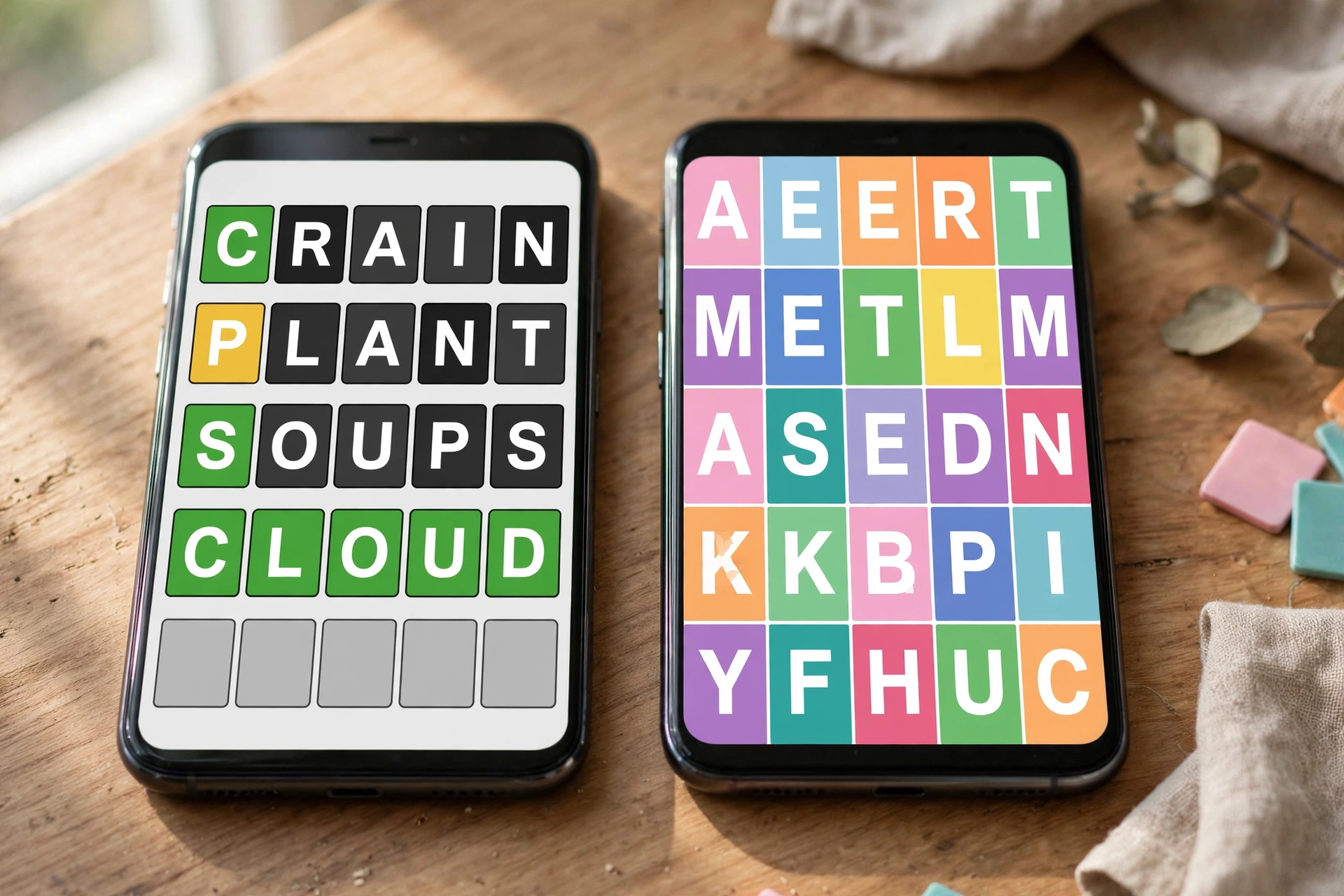
Is Waffle Harder Than Wordle| A Fair Comparison
Quick answer: Is Waffle harder than Wordle? Yes, for most players, in most of the ways that matter. Waffle asks you to solve five or six words at once on a shared grid, plan every swap against a strict limit, and hold several words in your head at the same time. Wordle asks you to guess one word in six tries, which is a simpler job, even though a tricky Wordle can still beat you. The full answer depends on which skill you are better at, so this post compares the two games fairly, side by side.
If you have played Wordle for years and just met Waffle, the first board can feel overwhelming. Six words stare back at you, letters sit in the wrong places, and you have only 15 swaps to fix them all. That feeling is normal, and it is the whole point of this comparison. By the end of this post you will know exactly where each game is harder, where each game is easier, how much time each one takes, and which game fits the way you like to play.
How Wordle Works, in Brief
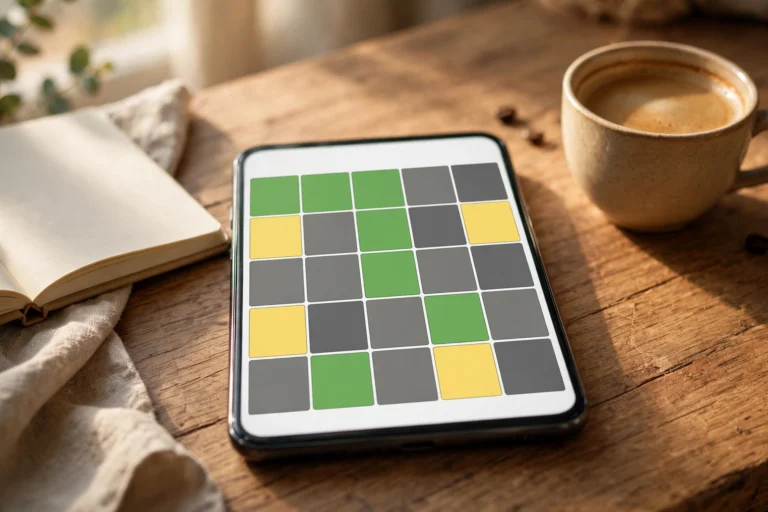
Wordle gives you one hidden five-letter word and six guesses to find it. You type a word, the game colors each letter green, yellow or grey, and you use that feedback to narrow down the answer. Green means the letter is in the right spot. Yellow means it belongs in the word but sits in the wrong spot. Grey means it is not in the word at all. If you find the word within six guesses, you win. If you run out of guesses, the game shows you the answer.
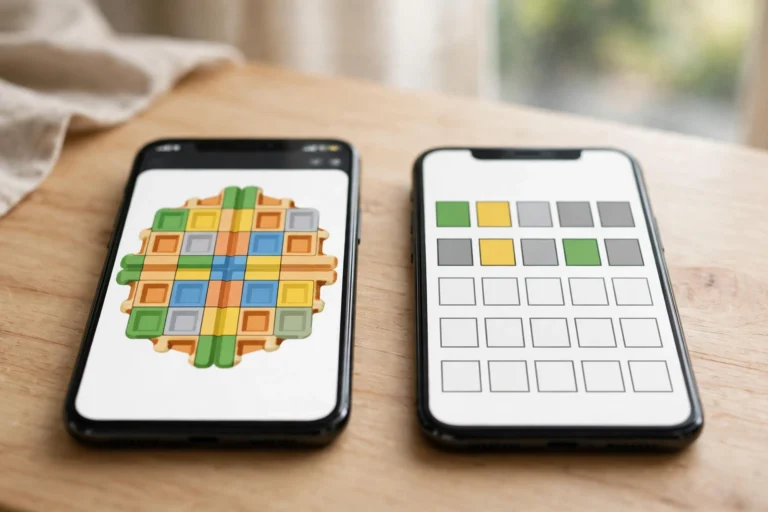
Wordle was created by Josh Wardle and is now owned by The New York Times. Every player in the world gets the same word each day, which is why friends can compare scores and why a missed word stings. The game takes about three minutes, and the skill it rewards most is vocabulary: knowing which words fit the clues, and picking good opening guesses that test common letters. Our Waffle vs Wordle comparison covers the two games side by side in more detail, including a table of the main differences.
The important thing to understand about Wordle is that you start from nothing. The board is blank. Every letter you learn comes from a guess you made, and every guess costs one of your six tries. A good opening word can hand you two or three letters at once. A bad one can leave you guessing in the dark with only a few tries left. That is the whole game: guess well, read the colors, and narrow it down before the guesses run out.
How Waffle Works, in Brief
Waffle gives you a waffle-shaped grid with all the letters already on it, in the wrong order. On this site the standard board hides five five-letter words, three across and two down, and you get 15 swaps to put them right. The original game hides six words and also gives 15 swaps. You swap two tiles at a time until every word reads correctly. Green tiles lock in place, yellow tiles belong in that word but sit in the wrong spot, and grey tiles do not belong in the word they sit in.
Waffle was created by James Robinson in February 2022, as a spin-off of Wordle. It uses the same three colors, but the job is completely different. Nothing is hidden. Every letter you need is already on the board. The puzzle is not finding the letters, it is putting them in the right order. Our beginner’s guide to Waffle walks through the rules, the colors and the game modes step by step if you want the full picture.
The original game rewards a low swap count with stars: solve in 10 swaps and you earn the top score, because every puzzle can be solved in 10. On this site there is no star score, so the swap count is your own challenge to beat. Our guide to how many swaps you get in Waffle explains the 15-swap limit, the 10-swap par, and what happens when the swaps run out.
Waffle vs Wordle at a Glance
Here is the side-by-side comparison, so you can see the differences in one place.
| Feature | Wordle | Waffle (this site) |
|---|---|---|
| Goal | Guess one hidden five-letter word | Arrange five five-letter words already on the board |
| Board | Blank, one word at a time | 5 by 5 grid, three across and two down |
| Moves | 6 guesses | 15 swaps |
| Letters | Hidden until you guess them | All 19 letters shown from the start |
| Main skill | Vocabulary and good opening guesses | Logic, planning and holding several words in mind |
| Shared daily puzzle | Yes, one word for everyone | No, every player gets a different random board |
| Time per puzzle | About 3 minutes | About 5 to 10 minutes |
| Failing | Run out of guesses | Run out of swaps |
| Best score | Solve in 2 or 3 guesses | Solve in 7 to 10 swaps |
| Streak | Daily streak on the original | No streak on this site |
The table makes the core difference clear. Wordle is a guessing game with a blank board. Waffle is a rearranging game with a full board. That single difference shapes everything else about difficulty, which is why the two games feel so different even though they share the same three colors.
Where Waffle Is Harder

Waffle is harder than Wordle in five clear ways. None of them is a mystery, and each one maps to a skill you can practise, but together they make Waffle the more demanding game for most players.
You Solve Several Words at Once
Wordle asks for one word. Waffle asks for five on this site, and six on the original game. That is not five times the work, because the words share letters at the crossings, but it is still far more to hold in your head. You cannot finish one word and forget it, because its letters belong to other words too. A swap that fixes the top row can break the left column, so every move has to be checked in two directions at once. Dailywafflegame.com compares the two games directly and puts it plainly: Waffle tasks you with six words at once, while Wordle challenges you to find a single word, and that structural difference is why Waffle needs higher mental effort.
This is the biggest single reason Waffle feels harder. Your working memory is doing more. In Wordle you track one set of clues. In Waffle you track five words, their crossing letters, and which tiles are locked green. New players often fix one word and then stare at the board, surprised that the fix broke another word. That surprise fades with practice, but the mental load never goes away completely.
You Plan Instead of Guessing
Wordle lets you guess. Even a wild guess teaches you something, because the colors tell you which letters are in the word. Waffle gives you no such safety net. Every letter is already on the board, so a bad swap teaches you almost nothing. It just costs one of your 15 swaps and moves two letters to worse spots. You have to plan before you move, not after.
That planning is a different kind of thinking. In Wordle you ask, “What word fits these clues?” In Waffle you ask, “Which two tiles belong in each other’s spots?” The second question is harder, because it needs you to see the board as a set of pairs, not as a set of letters. Our guide to getting 5 stars in Waffle explains how pairing tiles is the key skill, and why random swaps are the fastest way to run out of moves.
The Swap Limit Punishes Waste
Wordle gives you six guesses for one word, which is generous. Most players solve in three or four. Waffle gives you 15 swaps for five words, which sounds generous until you count it: three swaps per word, on average, and a single wasted swap can cost you the puzzle. Every puzzle can be solved in 10 swaps on the original game, which leaves five spare, but only if nearly every swap fixes two tiles at once. Waste two or three swaps on guesses and the board is lost.
This is where new Waffle players fail most. They swap a tile into a spot that looks right, find out it was wrong, and spend two more swaps undoing the mistake. In Wordle, a wrong guess still gives you information. In Waffle, a wrong swap gives you a mess. The pressure is different, and for many players it is higher.
Duplicate Letters Trap You
Both games have duplicate letters, but Waffle punishes them more. A Wordle guess with a repeated letter tells you quickly whether the word has one of that letter or two. In Waffle, a board can hold three copies of the same letter, each belonging to a different word, and the colors will not tell you which is which. Put two copies in the same word and you have wasted swaps that are hard to get back.
The maths backs this up. A 2026 paper on the mathematics of Waffle, published on arXiv, found that boards with many repeated letters make it hard to find the perfect unscrambling, even when you know the correct words. The paper also found that boards with no repeated letters can be hard in a different way, because the words themselves are harder to spot. Either way, duplicates are a real source of difficulty, and Waffle has more of them per puzzle than Wordle does.
There Is No Daily Puzzle to Share
This one is about the social side, not the board. Wordle gives every player the same word each day, so you can compare scores with friends, share your grid of colored squares, and talk about the same puzzle. Waffle on the original game does the same, but on this site every board is random per player, so there is no shared puzzle to compare. That does not make the board harder, but it does make the game lonelier. You cannot ask a friend how they solved today’s board, because their board was different. For players who lean on friends for hints, that is a real loss.
Where Wordle Is Harder
Fair is fair. Waffle is not harder in every way. Wordle has its own traps, and a player who is strong at Waffle can still lose a Wordle. Here are the four ways Wordle fights back.
You Start From Nothing
Waffle shows you every letter. Wordle shows you none. Your first guess is a shot in the dark, and if it comes back all grey, you have learned almost nothing except which five letters are wrong. A good opening word helps, but even the best opening word can leave you with nothing to work with. Waffle never does that to you. The letters are all there, and the puzzle is ordering them. Starting from a blank board is a kind of difficulty that Waffle simply does not have.
One Bad Guess Costs More
In Wordle you have six guesses, and each one is a big chunk of your total. Spend two guesses on words that teach you nothing, and you are already halfway to losing. In Waffle you have 15 swaps, so one bad swap is a smaller share of your budget. The stakes per move are higher in Wordle, which is why a Wordle loss often comes down to a single bad guess in the middle of the game.
Streak Pressure Is Real
Wordle has a daily streak, and losing it hurts. Many players care more about the streak than about any single puzzle, and that pressure makes the game feel harder than it is. You play carefully, you second-guess yourself, and you sometimes lose a puzzle you would have solved on a relaxed day. Waffle on this site has no streak at all, so there is nothing to lose except the puzzle in front of you. That takes the pressure off, and relaxed players play better.
Obscure Words Can Beat Anyone
Wordle sometimes picks a word you simply do not know, or a word with an unusual letter pattern, and no amount of logic will save you. Waffle words are ordinary five-letter words, and because you can see the letters, an obscure word is much less of a threat. You might not know the word, but you can still arrange the letters into it once the colors point the way. In Wordle, an unknown word is a wall. In Waffle, it is a speed bump.
Time and Effort: How Long Each Game Takes
A Wordle takes about three minutes. A Waffle takes about five to ten minutes, depending on the board and how fast you spot the pairs. That gap matters, because it changes when and how you play. Wordle fits into a coffee break. Waffle needs a proper sit-down, or at least a few unhurried minutes.
The time difference comes from the planning. In Wordle you type a guess and read the result in seconds. In Waffle you study the board, count the letters, find the pairs, and only then swap. The thinking takes longer than the moves. Players who try to rush Waffle at Wordle speed are the ones who waste swaps and lose boards. Slow down, plan three swaps ahead, and the game gets easier at once.
Neither game is a big time commitment, but Waffle asks for more of your attention while you play it. You cannot half-watch television and solve a Waffle board well. You can do that with Wordle, because the game holds only one word in your head. If your puzzle time is short and scattered, Wordle fits better. If you like a puzzle you can sink into, Waffle rewards the extra minutes.
The Learning Curve: Your First Week in Each Game
Wordle is easy to learn and stays about the same difficulty forever. Your first game teaches you the colors, your tenth game teaches you good opening words, and after that you improve slowly, mostly by growing your vocabulary. The game does not change. You do, a little at a time.
Waffle is harder to learn and keeps getting easier the longer you play. The first few boards feel confusing, because the grid is new and the swap logic is unfamiliar. Many new players burn through their 15 swaps on the first board and stare at a half-finished grid. Then something clicks. You start seeing the trade-places pairs, the corners, and the crossing tiles, and the swap count drops fast. One writer who played Waffle for a month said the first days were a struggle, with barely any swaps left, and within days they were chasing a perfect game. That arc, hard start and fast improvement, is typical of Waffle.
The practical upshot is simple. If you try Waffle once and find it hard, that tells you almost nothing about how hard it will feel in a week. Give it five boards. The first board teaches you the rules. The fifth board teaches you the method. By the tenth board you will know whether Waffle is your game or not, and you will have earned the answer.
Which Game Suits Which Player
There is no single right answer to which game is better, only which game fits you. Here is the honest guide.
Pick Wordle if you like quick games, guessing, and sharing. Wordle is three minutes, one word, and the same puzzle as your friends. It rewards a good vocabulary and a good opening word. It is the better game for a busy morning, for playing with friends, and for anyone who likes the thrill of a guess paying off.
Pick Waffle if you like logic, planning, and a puzzle you can chew on. Waffle rewards patience and pattern spotting. It is the better game for a quiet evening, for anyone who likes crosswords or Sudoku, and for players who find guessing frustrating and want all the information up front.
Play both if you like word games at all. The two games train different skills, and each one makes you better at the other. Wordle sharpens your sense of which words are common, which helps you spot Waffle words faster. Waffle sharpens your sense of letter patterns, which helps you pick better Wordle guesses. Many players keep both in their daily routine, Wordle first as a warm-up, Waffle second as the main event.
The size difference is worth noting too. Wordle is the far bigger game in search, with around 68 million searches a month against about 673,000 for Waffle, according to risingtrends.co figures from September 2026. That gap is why most players meet Wordle first. It is not a measure of quality. It is a measure of fame. Waffle is the smaller game, and for the players who love it, that is part of the charm.
How to Make Waffle Easier

If the comparison has convinced you to try Waffle, or to give it another chance, here are six habits that make the game much easier. Each one comes from the strategy guides on this site, and each one is worth practising on its own.
Start with the corners. Corner tiles belong to two words at once, so a green corner pins down two words. A yellow corner is even more useful, because it tells you about two words at the same time. Our guide on green tiles explains the lock rule and why corners matter so much.
Look for trade-places pairs first. Before any other move, scan each row and column for two tiles that belong in each other’s spots. One swap fixes both. Our daily sample puzzles solve in 7 swaps largely because they are built around these pairs, and spotting them is the fastest way to cut your swap count.
Count duplicate letters before you swap. Count how many of each letter the board holds, then work out how many each word needs. Three copies of one letter usually means three different words need one each. Count first, swap second, and you will stop wasting moves on duplicates.
Plan three swaps ahead. Do not swap a tile just because its destination looks right. Check where the tile you are moving out of that spot is going too. A good swap fixes two tiles. A bad swap fixes one and breaks another. Three swaps of planning beats fifteen swaps of guessing.
Practise in Unlimited mode. Unlimited mode gives you endless fresh boards with no stakes at all. There is no daily puzzle to lose and no streak to break, so you can experiment, make mistakes, and learn the method without pressure. Ten practice boards will teach you more than ten careful reads of a strategy guide.
Try Deluxe when standard feels easy. If the standard board starts to feel simple, our Deluxe guide explains the bigger 5 by 6 board with six words and 25 swaps. It is the natural next step, and it keeps the game challenging long after the standard board feels comfortable.
If you want to see the method in action before you play, our daily sample puzzle solves a full board in 7 swaps, step by step, with the swap logic shown for every move. It is the best place to watch the habits above working on a real board.
Frequently Asked Questions
Is Waffle harder than Wordle?
Yes, for most players. Waffle asks you to solve five or six words at once on a shared grid, plan every swap, and hold several words in your head, while Wordle asks you to guess one word in six tries. Wordle can still beat you with an obscure word, but the everyday difficulty of Waffle is higher.
Is Waffle a Wordle clone?
Waffle was inspired by Wordle and uses the same green, yellow and grey colors, but it is a different game. Wordle is a guessing game with a blank board. Waffle is a rearranging game where every letter is already on the board. The creator of Waffle is James Robinson, and the game first appeared in February 2022.
Can you fail a Waffle puzzle?
Yes. If you run out of swaps before all five words are correct, the puzzle ends unsolved. On this site you can simply load a fresh board and try again, because every board is random and there is no penalty for failing. On the original game, a failed board means waiting for the next daily puzzle.
Which game takes longer to play?
Waffle takes longer. A Wordle takes about three minutes, while a Waffle board takes about five to ten minutes, because you spend more time planning swaps than making them. Waffle rewards unhurried thinking, so it suits a longer break better than a quick one.
Is Waffle good for beginners?
Yes, but expect the first few boards to feel hard. The grid and the swap logic are unfamiliar at first, and most new players waste swaps while they learn. After about five boards the method clicks, the swap count drops fast, and the game becomes much more enjoyable. Unlimited mode is the best place to practise without pressure.
Do you need a big vocabulary to play Waffle?
Less than you need for Wordle. Waffle shows you every letter, so you do not have to think of words from nothing. You need to recognise words when you see their letters arranged, which is a different skill from recalling a word from a few clues. A strong vocabulary helps, but pattern spotting matters more.
Conclusion
So, is Waffle harder than Wordle? Yes, in the ways that matter most. It asks for more planning, more memory, and more care with every move. Five words at once, a strict swap limit, and no guessing safety net add up to a genuinely harder puzzle. Wordle fights back with a blank board, high stakes per guess, streak pressure, and the occasional obscure word, so it is not a pushover either. But on an average day, Waffle is the harder game, and the players who love it love it for exactly that reason.
The good news is that Waffle gets easier fast. The first board is confusing, the fifth board makes sense, and by the tenth board you are spotting pairs and planning swaps like a regular. If Wordle is your warm-up, let Waffle be your workout. Try a board on thewafflegame.uk today, and see for yourself which game earns your mornings.