Waffle vs Wordle: Which Word Game Should You Play?
Quick answer: Waffle and Wordle look alike but test different skills. In this Waffle vs Wordle comparison, Wordle hides one five-letter word and gives you six typed guesses to find it. Waffle shows you every letter up front on a 5 by 5 grid and asks you to rearrange six words (five words on this site) by swapping tiles within 15 moves. Wordle rewards vocabulary and recall. Waffle rewards logic, planning and spatial thinking. Both are free in your browser, both take a few minutes, and the honest answer is that most word game fans end up playing both.
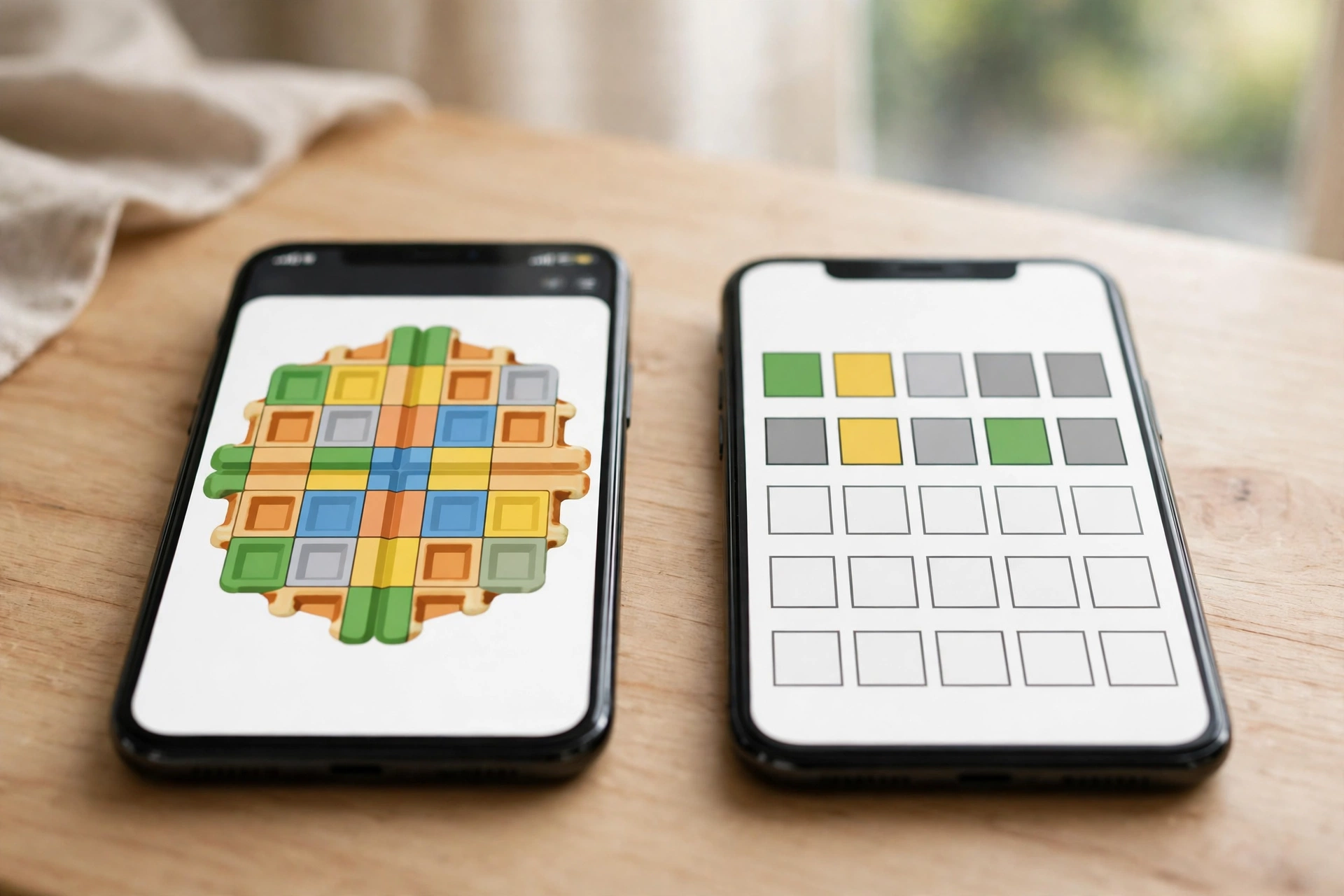
If you have played Wordle every morning for years, Waffle will feel familiar for about ten seconds and then completely different. The colours are the same. Green means right letter, right spot. Yellow means right letter, wrong spot. Grey means the letter does not belong in that word. Everything after that changes: there is nothing to guess, nothing to type, and no blank grid waiting for your first word. The letters are already there, scrambled, and your job is to tidy them up.
This guide compares the two games side by side, explains how each one works, looks at which is harder and why, and helps you pick the game that fits your brain, your schedule and your mood. Every fact about the original games comes from their own pages and guides, and every fact about the game on this site comes from how it actually plays here.
Waffle vs Wordle at a Glance
If you only want the short version, this table holds it. The sections below explain each row in plain language.
| Feature | Waffle (this site) | Wordle |
|---|---|---|
| Goal | Rearrange letters to form five words | Guess one hidden five-letter word |
| Grid | 5 by 5 waffle-shaped grid, 19 tiles | 5 columns by 6 rows, 30 boxes |
| Words per puzzle | Five (three across, two down) | One |
| Moves | 15 swaps | 6 typed guesses |
| What you do | Swap two tiles at a time | Type a full five-letter guess |
| Letters shown | All letters given up front | No letters given, you supply them |
| Colour clues | Green, yellow, grey | Green, yellow, grey |
| Daily puzzle | No shared daily puzzle, fresh boards on demand | One shared daily puzzle |
| Reset time | None, play whenever you like | New puzzle at midnight |
| Streak | No daily streak on this site | Daily streak tracked |
| Creator | James Robinson, February 2022 | Josh Wardle, October 2021 |
| Owner | Independent fan game, not NYT | The New York Times since 2022 |
| Cost | Free, no account | Free in the browser |
| Typical time | A couple of minutes | A few minutes |
Two rows in that table matter more than the rest. The first is what you actually do: guess a word, or rearrange letters. The second is the daily puzzle: Wordle gives everyone the same word each day, while the game on this site gives every player a fresh random board on demand. Keep those two differences in mind and the rest of the comparison falls into place.
How Wordle Works
Wordle is the game that started the daily puzzle wave. It was created by Josh Wardle and launched in October 2021. The New York Times acquired it in early 2022, and it has run on the NYT Games page ever since.
You start with an empty grid, five columns wide and six rows tall. You type a five-letter word as your first guess. The game colours each letter: green means the letter is in the word and in the right spot, yellow means the letter is in the word but in the wrong spot, and grey means the letter is not in the word at all. You use that information to make a better second guess, then a third, and so on. You have six guesses to find the word. Get it right and you win. Run out of guesses and the game reveals the answer.
Everyone plays the same word each day, and a new word arrives at midnight. That shared puzzle is a big part of why Wordle spread so fast: friends compare scores, share their coloured grids, and talk about the same word over breakfast. The game also tracks a daily streak, so missing a day costs you something, which is exactly why so many players never miss one.
Wordle is a guessing game at heart. Your first guess is a probe, not an answer. Good players pick a strong opener with common vowels and consonants, read the colours, and narrow the word down guess by guess. Vocabulary matters a lot, because you have to produce candidate words from memory. If you cannot think of a word that fits the clues, no amount of logic will save you.
How Waffle Works
Waffle was created by James Robinson and first appeared in February 2022, when he posted it to the r/wordle community. It takes the colour system from Wordle and turns the whole idea sideways: instead of guessing a hidden word, you untangle a scrambled grid.
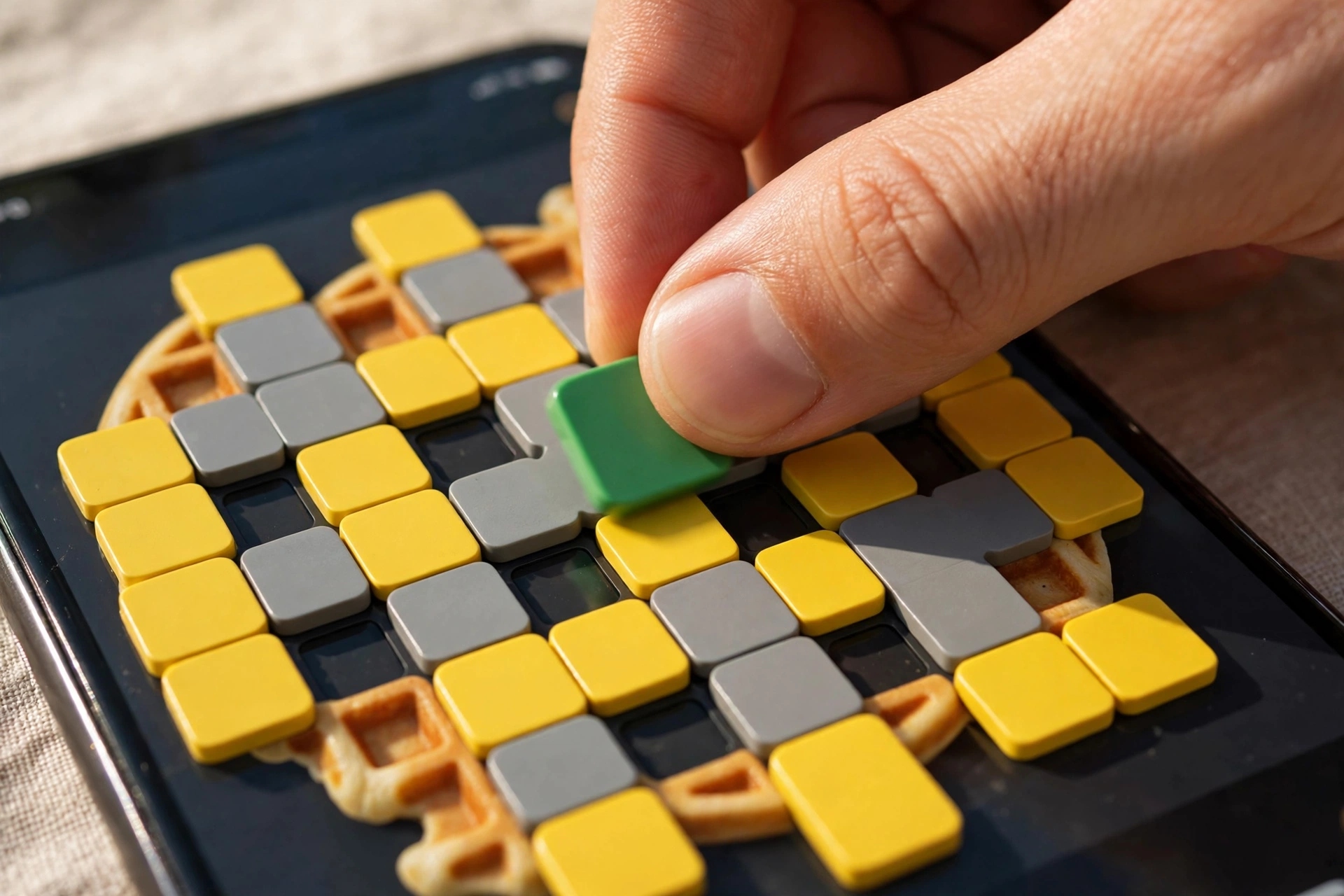
On the original game, the board is a 5 by 5 waffle-shaped grid hiding six five-letter words, three across and three down. On this site, the standard board hides five words, three across and two down, on the same 5 by 5 shape. Either way, all the letters you need are already on the board. Nothing is hidden. Your job is to swap two tiles at a time until every word reads correctly. You get 15 swaps, and a clean solve takes far fewer.
The colours work the same way as Wordle, with one difference that matters: a letter can be yellow or grey for one word and still belong in the word that crosses it. A tile at a crossing belongs to two words at once, so you have to check both directions before you move it. Green tiles are locked in place and cannot be swapped, so they become the anchors you build around.
Our beginner’s guide to Waffle walks through the full rules with a worked example, and our guide to getting 5 stars in Waffle explains swap counts and the habits that cut them down. The short version is this: corners first, trust the green tiles, read the yellow tiles, follow the grey tiles to their real homes, and look for swaps that fix two letters at once.
On the original game, a solve in 10 swaps earns the top score, and each unused swap below the 15 limit earns a star. That star maths belongs to the original game. The game on this site has no star awards and no shared daily puzzle, so there is no score to chase and no streak to protect. You play a fresh board whenever you like, and the only measure is how few swaps you needed.
The Big Differences
The table above lists the differences. This section explains what each one feels like when you actually play.
Guessing vs Rearranging
This is the real difference, and everything else follows from it. Wordle asks you to produce words from nothing. Waffle asks you to fix words that are already there. In Wordle, a blank mind is the enemy: if you cannot think of a word that fits the colours, you are stuck. In Waffle, the letters are in front of you, so you are never stuck for raw material. You are stuck because you cannot see how the letters fit together.
That changes the kind of thinking each game needs. Wordle is recall plus elimination. You remember words, test them, and cross off what does not fit. Waffle is pattern matching plus planning. You see fragments, spot the words hiding inside them, and plan swaps that help two words at once. Players who love crosswords tend to love Waffle. Players who love trivia and vocabulary quizzes tend to love Wordle.
One Word vs Five Words
Wordle is a single target. Every guess is aimed at one word, and every colour clue points at the same answer. Waffle splits your attention five ways. The top row might be nearly finished while the bottom row is still a mess, and a swap that fixes one word can break another.
That split attention is what makes Waffle feel busier. You are juggling five small puzzles that share tiles, and the crossings tie them together. It is also what makes a good Waffle solve so satisfying: one swap can turn two letters green in two different words, and the whole board can fall into place in a few moves.
Guesses vs Swaps
Wordle gives you six guesses. Waffle gives you 15 swaps. The numbers look generous on the Waffle side, but they measure different things. A Wordle guess tests a whole word at once. A Waffle swap moves two letters. A bad guess in Wordle costs you a sixth of your game. A bad swap in Waffle costs you a fifteenth, and you can often recover from it.
The swap limit still matters. A careless solve can burn through swaps fast, especially if you move letters without a plan. The skill in Waffle is not finding the words, which are usually visible after a minute of staring. The skill is finding them in the fewest moves, by choosing swaps that fix two letters instead of one.
Time and Pace
A Wordle puzzle usually takes a few minutes, sometimes longer if the word is awkward. A Waffle board usually takes a couple of minutes once you know the rules. Neither game is a long commitment, which is why both work as a morning routine or a coffee break game.
The pace feels different, though. Wordle has pauses: you type a guess, study the colours, think of the next word. Waffle is more continuous: you scan, swap, scan again, and the board changes with every move. If you like a steady rhythm with thinking time between moves, Wordle fits. If you like a puzzle that keeps moving under your fingers, Waffle fits.
The Daily Puzzle and the Streak
Wordle gives every player the same word each day, and the streak is the hook that brings people back. Miss a day and the streak resets to zero, which is a real sting for players with long runs. That shared puzzle also makes Wordle social: everyone is solving the same word, so everyone can compare.
The game on this site works differently. There is no shared daily puzzle and no midnight reset, because every board is generated fresh and at random for each player. That means there is no daily streak to protect and no single answer to compare with friends. What you gain is freedom: you can play five boards in a row, or one board at midnight, or nothing for a week, and nothing is lost. What you lose is the shared daily moment. Our blog runs a new sample puzzle every morning, which gives you a daily board to practise on, but your own game boards are always fresh and random.
Which Game Is Harder
Ask five players and you will get five answers, because the games are hard in different ways. Here is the honest breakdown.
Wordle is harder on vocabulary. You have to produce words from memory, and a word you do not know is a word you cannot guess. Unusual letter patterns, double letters and rare words can end a run fast. A player with a big vocabulary has a real edge, and a player who reads a lot will feel it.
Waffle is harder on logic and planning. The words are usually common ones, so vocabulary rarely blocks you. What blocks you is seeing how the letters connect, especially at the crossings, and planning swaps in the right order. A player who is good at crosswords, Sudoku or logic puzzles will feel at home. A player who just wants to type a word and see what happens may find Waffle fiddly at first.
Time pressure is not a factor in either game. Neither one has a clock on the standard puzzle, so you can think as long as you like. Difficulty comes from the puzzle itself, not from speed.
If you forced a verdict, most experienced players say Waffle feels harder to master, because a perfect low-swap solve needs planning that Wordle never asks for. But Wordle feels harder to survive, because one bad stretch of guesses can end your game while Waffle always lets you keep swapping until the limit runs out. Which one feels harder to you will depend on whether your weak spot is recall or planning.
Which Game Should You Play

The best answer is the boring one: play the game that matches the way your brain likes to work. The guide below is a starting point, not a rule.
Play Wordle if you: love guessing games and word recall, enjoy a shared daily puzzle with friends, like tracking a streak, prefer a slow pace with thinking time between moves, or want a game you can explain in ten seconds.
Play Waffle if you: love crosswords and logic puzzles, prefer rearranging to guessing, like a puzzle that changes with every move, want to play more than one board a day, or get frustrated when you cannot think of a word that fits.
Play both if you: like word games in general, want a five minute morning routine, or find that one game sharpens the other. Many players use Wordle to warm up their vocabulary and Waffle to warm up their logic, and the skills cross over more than you might expect. Reading colour clues fast helps in both games, and spotting common letter patterns helps in both games too.
There is also a practical point. Wordle lives on the NYT Games page, and the archive of past puzzles sits behind a Games subscription. The game on this site is free with no account and nothing to download, and you can play as many fresh boards as you like. If you want a second game that costs nothing and asks nothing of you, Waffle is an easy addition to the routine.
For a deeper comparison with the wider family of word games, the Waffle vs Wordle comparison on wafflegame.org explains the same split in its own words, and the dailywafflegame.com comparison works through both games move by move. Both are worth a read if you want a second opinion.
Can You Play Both Every Day
Yes, and a lot of players do. A simple routine that works: play Wordle first, while your brain is fresh and your vocabulary is at its sharpest. Then play a Waffle board or two as a change of pace. The two games use different mental muscles, so the second one rarely feels like more of the first.
If you only have five minutes, pick one. Wordle is the better pick when you want a single shared puzzle to talk about. Waffle is the better pick when you want to play more than once, or when you want a puzzle that is over in a couple of minutes. There is no wrong choice, and there is no prize for loyalty to one game.
One warning, though: the colour rules are the same but the habits are not. Wordle teaches you to think in whole words. Waffle teaches you to think in letters and positions. When you switch from one to the other, give yourself a board or two to adjust. The most common mistake new Waffle players make is treating it like Wordle: staring at the board waiting for a word to guess, instead of looking at the letters already there and starting to swap.
Common Mistakes When Switching Games
Players who come to Waffle from Wordle make the same three mistakes, and all three are easy to fix.
Waiting for a word to guess. In Wordle, you produce the word. In Waffle, the word is already on the board in pieces. Look at the green tiles first, then the yellow ones, and the words will usually show themselves. If you are stuck, read the first letters of the rows and columns out loud. That is often enough.
Ignoring the crossings. In Wordle, every letter belongs to one word. In Waffle, six tiles belong to two words at once. A swap that fixes a row can break a column, and a swap at a corner can fix two words at the same time. Check both directions before every swap, and prefer swaps at crossings when you have the choice.
Swapping without a plan. In Wordle, a bad guess still gives you information. In Waffle, a bad swap usually gives you nothing and costs you a move. Before each swap, ask what it will fix. If the answer is nothing, look for a better one. Our 5-star guide works through this habit in detail.
Wordle players switching the other way make one main mistake: they try to solve Waffle in their head before touching a tile. Waffle rewards moving early and learning from the colours. Make a swap, watch what turns green, and adjust. The board is the scratch paper.
Frequently Asked Questions
Is Waffle the same as Wordle?
No. Wordle hides one five-letter word and gives you six typed guesses to find it. Waffle shows you every letter up front on a 5 by 5 grid and asks you to rearrange five or six words by swapping tiles. The colour clues are the same, but the games test different skills. Wafflegame.org explains the difference the same way in its own comparison section.
Is Waffle harder than Wordle?
It depends on your strengths. Wordle is harder on vocabulary, because you have to produce words from memory. Waffle is harder on logic and planning, because you have to see how letters connect across five words and plan swaps that fix two letters at once. Most experienced players say Waffle is harder to master, while Wordle is harder to survive, because one bad stretch of guesses can end a Wordle game.
Is Waffle an NYT game?
No. Waffle was created by James Robinson and first appeared in February 2022. It is not owned or published by The New York Times. The confusion is natural, because Wordle, the game Waffle is most often compared with, has been an NYT game since the Times acquired it in 2022.
Can I play Waffle for free?
Yes. The game on this site is free, with no account and nothing to download. It runs in your browser on a phone, tablet or computer. Wordle is also free to play in the browser on the NYT Games page, although access to its archive of past puzzles needs a Games subscription. You can play the current Wordle puzzle at nytimes.com/games/wordle.
Which game is better for building vocabulary?
Wordle, by a clear margin. It forces you to produce words from memory, which is exactly how vocabulary grows. Waffle helps more with spelling patterns and letter positions, because you see how letters fit together inside real words. If vocabulary is your goal, play Wordle daily and use Waffle as a second game for logic practice.
Does Waffle have a daily puzzle like Wordle?
The original game does, with one shared board each day. The game on this site does not. Every board here is generated fresh and at random for each player, so there is no shared daily puzzle, no midnight reset and no daily streak. You can play as many boards as you like, whenever you like. Our blog publishes a new sample puzzle every morning if you want a daily board to practise on.
Conclusion
Waffle and Wordle share a colour system and a five-letter vocabulary, and almost nothing else. Wordle is a guessing game: one hidden word, six attempts, and a daily puzzle the whole world shares. Waffle is a rearranging game: every letter on show, 15 swaps, and a board that rewards planning over recall. Wordle builds vocabulary. Waffle builds logic. Wordle gives you a streak to protect. The game on this site gives you fresh boards on demand, with nothing to lose.
Neither game is the better one in any general sense. The better game is the one that fits how you like to think. If you love producing words from memory and comparing one daily puzzle with friends, Wordle is your game. If you love untangling a grid, planning swaps and watching a board fall into place, Waffle is your game. And if you cannot decide, play both. Two minutes of Waffle after your morning Wordle costs nothing, and it might turn out to be the part of the routine you look forward to most.
Open the Waffle game and try a board now, then compare it with your next Wordle. You will know within one puzzle which one suits you, and you may find, like a lot of players, that the answer is both.