Who Created Waffle? The Story Behind the Game (and Why It Is Not an NYT Game)
Quick answer: Who created Waffle? James Robinson, a software developer from Portsmouth in the UK, created Waffle in early 2022. He built it in about five days after the idea came to him while he was washing the dishes, and his wife Ness named it after the grid looked like a waffle. Waffle is not a New York Times game. It is published by his own independent studio, Waffle Studio, and it has no connection to the Times at all.
If you have ever typed “waffle nyt” or “nyt waffle game” into a search box, you are not alone. The confusion is everywhere, and this post explains exactly where it comes from, who really made the game, and how a five-day side project became one of the most played word games on the internet. It also explains what the answer means for players on this site, because thewafflegame.uk is an independent fan version of the game, not the original and not connected to the Times either.
Who Created Waffle? The Short Answer
Waffle was created by James Robinson. He is a British software developer who lives in Portsmouth, on the south coast of England, with his wife and two cats. Online he goes by the name Jessian, which is why some sites describe him as “the developer known as Jessian”. That is his username, not a different person, and the full name is James Robinson.
Here are the key facts in one place:
| Fact | Answer |
|---|---|
| Creator | James Robinson, also known as Jessian |
| Home town | Portsmouth, UK |
| First appeared | February 2022 |
| Idea date | January 27, 2022 |
| Publisher | Waffle Studio, his own independent studio |
| Owned by the New York Times | No |
| Original game site | wafflegame.net |
| This site | An independent fan version, not the original game |
Robinson had worked in software for about 15 years before Waffle, mostly building web apps and providing professional training for small businesses. He had always wanted to make a game, but Waffle was the first one he ever finished and put online. That detail matters, because it explains why the game feels the way it does: it was built fast, by one person, with a single clear idea, and it was never designed by a committee.
His wife Ness does the social media for the game, and she is the one who gave it its name. The story of the name is the story of the whole game, and it starts at a kitchen sink.
The Dishwashing Idea: How Waffle Was Born

On January 27, 2022, James Robinson was washing the dishes after dinner. He had only discovered Wordle that week, and he was thinking about whether a word game could work in a different shape. What if, instead of guessing one hidden word, you had to fit words into a grid, with each row and each column spelling out a word?
His first idea was a 4 by 4 grid, with each row and column holding a four-letter word. He sat down at the computer straight away and wrote some code to test whether enough word combinations would fit together. Within 20 minutes he had an answer: it did not really work. There were not enough combinations to make a fresh puzzle every day.
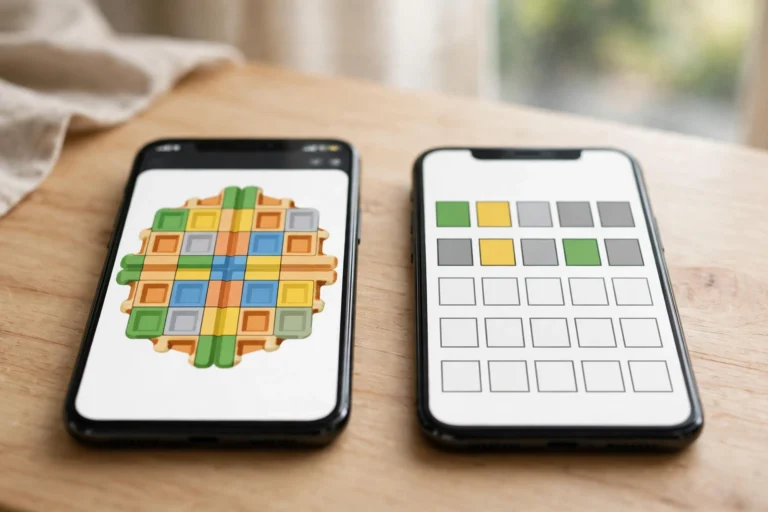
So he stretched the idea. Five-letter words, in a grid shape with gaps in it, gave far more combinations. He drew an example out on paper, a grid with some letters filled in and some squares blank, and showed it to his wife. She looked at it and said it looked like a waffle. The name was sorted on the spot.
That paper sketch is the whole origin of the game. There was no design team, no focus group and no launch plan. There was a man at a sink, a 20-minute coding test, a drawing in a notebook, and a wife who saw a breakfast food in a word grid. Robinson has told this story in an interview with WordFinder more than once, and the details stay the same every time, which is a good sign that it is the real story and not a polished legend.
The idea also had a clear inspiration, and Robinson has never hidden it. He was inspired by Josh Wardle, the creator of Wordle. He had heard a podcast in which Wardle said he had built Wordle as quickly as possible, without trying to perfect it, and just got it out there. Robinson took the same approach: build it fast, put it online, and improve it in public.
From Idea to Launch in Five Days
The speed of what happened next is hard to believe, but it is confirmed by Robinson himself in interviews. The idea came to him on January 27, 2022. By Tuesday, February 1, he had a finished game. That is five days from a thought at the sink to a playable puzzle on the internet, producing a new puzzle each day.
February 1, 2022 is a date worth remembering for another reason. It was the same day the New York Times bought Wordle. Robinson has pointed this out himself: he finished Waffle on the very day the Times bought the game that had inspired him. That coincidence is one of the main reasons people mix the two games up today, and it is worth keeping in mind as you read the rest of this post.
Within two weeks of the idea, the game was online and producing a new puzzle every day. Robinson kept working on it in public, adding features and fixing problems as players found them. The game grew by word of mouth, mostly on social media, where players shared their results with colored square emojis, just as Wordle players did.
There was no big launch, no press release and no advertising budget. The game spread because it was different enough to be interesting and familiar enough to be easy to learn. If you knew Wordle, you understood the colors at once. If you liked crosswords, you understood the grid at once. That combination is the whole trick of Waffle, and it was there from the first day.
Who Is James Robinson?
James Robinson is not a games industry veteran, and that is part of the story. He is a software developer who grew up with board games like Boggle and Scrabble, and who always wanted to make a game of his own. His dad taught him how to make games on a Commodore 64, and he even built a simple dodging game on a Psion handheld computer while he was still at school.
His working life took him into web development, where he spent about 15 years building web apps and providing professional training for small businesses. He had never made a word game before Waffle, and he had never finished any game at all. In a 2022 interview he put it plainly: he had wanted to make a game for years, any game, but he had never managed to finish one.
That background explains a lot about Waffle. It is a web game, built by a web developer, and it runs in a browser with no download and no account. It is simple on the surface and careful underneath, because the hard part is not the graphics. The hard part is generating a fresh grid every day in which six five-letter words fit together correctly, with exactly the right number of swaps to solve it. That is a programming problem, and Robinson solved it in 20 minutes on the first night.
Today he works full time on Waffle through his own company, Waffle Studio, and he calls himself the Chief Wafflemaker. His wife Ness runs the social media, and the two of them are the whole team behind the original game. He has also worked with other independent word game makers, including the creator of Squaredle and the team behind Canuckle, the Canadian Wordle variant. The Waffle community is small, friendly and mostly made of solo developers, and Robinson is one of its best known names.
One detail from his interviews is worth repeating, because it says a lot about the man. When a games industry site asked him about the business side of Waffle, the headline was his own quote: “I have turned down life-changing money.” He has been offered deals to sell the game, and he has said no. He would rather keep making it himself than hand it to a bigger company.
Why So Many People Think Waffle Is an NYT Game

If Waffle is so clearly independent, why does the question keep coming up? There are four reasons, and together they explain almost every confused search.
The first reason is timing. Waffle launched in February 2022, the same week the New York Times bought Wordle. For millions of people, February 2022 was the month Wordle became an NYT game. A new word game appearing in the same week, with the same green and yellow colors, looked like part of the same story. It was not, but the timing made the mistake easy.
The second reason is the colors. Waffle uses the same green, yellow and grey system as Wordle. Green means a letter is in the right spot, yellow means it belongs in the word but sits in the wrong spot, and grey means it does not belong in that word. That system is so closely linked to Wordle in most players’ minds that any game using it feels like a Times game. Our guide to what the colors mean in Waffle explains the system in full, and it works the same way on this site.
The third reason is the daily puzzle format. Like Wordle, the original Waffle gives every player the same puzzle each day, with a new one arriving at midnight. That shared daily rhythm is the signature of the NYT Games collection, which also includes Connections, Spelling Bee, the Mini Crossword and Strands. A daily word puzzle with a midnight reset feels like an NYT game, even when it is not one.
The fourth reason is the copycats. Dozens of clone sites call their games “Waffle NYT” or “Waffle Game New York Times” in their titles, because those phrases get search traffic. Some of them even describe Waffle as part of the NYT Games collection, which is simply wrong. When a search result calls it an NYT game often enough, players start to believe it. Even a maths paper about the game, published on arXiv in 2025, carries the title “Mathematics of the NYT daily word game Waffle”, which shows how deep the confusion runs. The paper itself says James Robinson created Waffle in 2022, but its title still labels it an NYT game.
None of these four reasons is evidence. They are all coincidences and lookalikes, and they all fall apart once you check who actually owns and publishes the game.
Is Waffle an NYT Game? No, and Here Is the Proof
The short answer is no. Waffle is not owned, published or operated by the New York Times. It was created by James Robinson, it is published by his own independent studio, Waffle Studio, and it has no connection to the Times.
Here is the proof, point by point. The original game lives at wafflegame.net, not on nytimes.com. Its publisher is listed as Waffle Studio, a company Robinson runs himself in Portsmouth. The New York Times Games collection lists Wordle, Connections, Spelling Bee, the Mini Crossword, Strands and a handful of others. Waffle is not on that list, and it has never been on it.
The business deals tell the same story. Robinson struck a deal with Amazon that gives Prime subscribers an exclusive daily Waffle game. That is a deal between Waffle Studio and Amazon, not a deal with the Times. If Waffle belonged to the Times, Amazon would not be able to offer an exclusive version of it.
The Times, for its part, has never claimed Waffle. It bought Wordle in early 2022 for a reported seven-figure sum, and it has bought nothing like Waffle since. Robinson, meanwhile, has turned down offers to sell Waffle, which only makes sense if he owns it. You cannot turn down life-changing money for something that belongs to someone else.
If you want to play the original game, go to wafflegame.net. If you want to play on this site, stay here. The game on this site is an independent fan version, built with the same rules but with its own random boards, and it is not the original game and not connected to the Times either.
What Happened After Launch
Waffle did not stay a small side project for long. By 2024 the game was reported to have reached around 500,000 daily players, and by August 2023 more than 170 million Waffles had been completed, according to PocketGamer. Those numbers put it far behind Wordle, which has millions of daily players, but they make it one of the most successful independent word games ever made.
The Amazon Prime deal was a turning point. Prime subscribers got their own exclusive daily Waffle game, which brought the game to an audience that had never heard of it. Robinson has described the deal as a big moment for a one-person studio, and it showed that a solo developer could strike the kind of deal usually reserved for much bigger companies.
He has also kept building. In 2023 he launched another daily game called Giffle, which is built around GIFs from TV shows, and he has worked on new word games since. The original Waffle has grown too, with new modes added over time. The Deluxe mode, a bigger 7 by 7 grid with eight seven-letter words, was already on his list of plans in 2022, and it is now part of the original game. Our Deluxe guide explains how Deluxe works on this site, where it uses a 5 by 6 grid with six words and 25 swaps.
The game has also become a small case study in how to grow without selling out. Robinson works on it full time now, through Waffle Studio, and he has kept control of it. He has turned down acquisition offers, he has kept the game free to play in a browser, and he has kept the daily puzzle free. That is unusual in a market where most successful games get bought, paywalled or filled with ads, and it is one of the reasons players trust it.
Waffle vs Wordle: Same Roots, Different Games
Waffle and Wordle share a creator’s inspiration and a color system, but they are different games made by different people and owned by different companies. The table below makes the difference plain.
| Waffle | Wordle | |
|---|---|---|
| Creator | James Robinson | Josh Wardle |
| Launched | February 2022 | 2021 |
| Owner today | Waffle Studio (independent) | The New York Times |
| Goal | Rearrange letters into six five-letter words | Guess one hidden five-letter word |
| Grid | 5 by 5 waffle-shaped grid, 21 tiles | Six rows of five blank boxes |
| Moves | 15 swaps, 10 swaps is par | Six guesses |
| Letters shown | All letters are on the board from the start | No letters are shown, you guess them |
| Daily puzzle | Same board for everyone each day (original game) | Same word for everyone each day |
| Archive | Full archive of past puzzles on the original game | Past puzzles need an NYT Games subscription |
The comparison matters because it clears up the confusion in a different way. If Waffle were an NYT game, it would sit next to Wordle in the NYT Games app, with the same subscription and the same archive rules. It does not. It lives on its own site, with its own archive, its own apps and its own rules. Our full comparison, Waffle vs Wordle: which word game should you play, goes deeper into which game suits which kind of player, and our post on whether Waffle is harder than Wordle looks at the difficulty question from both sides.
One more difference is worth noting for players on this site. The original Waffle has a shared daily puzzle and a full archive of past puzzles, which you can replay. This site does not. Every board here is generated fresh and at random, so there is no shared daily puzzle and no archive to replay. Our post on whether you can play past Waffle puzzles answers that question honestly, and our post on when a new Waffle puzzle arrives explains why there is no midnight wait on this site. The difference comes from the design of this site, not from the original game, and it is worth knowing before you go looking for a puzzle number that does not exist here.
How to Play the Original Style Game on This Site
Knowing who made Waffle is useful, but the best way to understand the game is to play it. The version on this site follows the same rules as the original, with three modes: Daily, Unlimited and Deluxe. The standard board hides five five-letter words, three across and two down, and you get 15 swaps to solve it. Deluxe hides six words on a bigger 5 by 6 grid, and you get 25 swaps.
If you are new, start with our beginner’s guide to Waffle, which walks through the rules, the colors and the three modes in plain language. Then try today’s sample puzzle, which gives you a real board to practise on, with hints first and a full step-by-step solution underneath. The sample teaches the same swap logic you will use on your own board, and it is a good warm-up before you play for real.
If you want the extra modes, our guide to the 90-second Challenge, Number Waffle and Waffle Royale explains the three modes that belong to the original game only, so you know what to look for if you visit wafflegame.net. On this site, Daily, Unlimited and Deluxe are the modes you will find, and Unlimited is the best place to practise, because it gives you a fresh board every time you want one.
The game is free, it needs no account and no download, and it runs in your browser on a phone or a computer. That was true of Robinson’s original from the first day, and it is true of this site too. It is one of the reasons the game spread so fast, and it is one of the reasons it is still growing.
Frequently Asked Questions
Who created Waffle?
James Robinson, a software developer from Portsmouth in the UK, created Waffle. He came up with the idea on January 27, 2022, and had the game finished and online by February 1, 2022. He runs it through his own independent studio, Waffle Studio.
When was Waffle created?
Waffle first appeared in February 2022. The idea came to James Robinson while he was washing the dishes on January 27, 2022, and the game was finished five days later, on February 1, 2022. That was the same day the New York Times bought Wordle.
Is Waffle a New York Times game?
No. Waffle is not owned, published or operated by the New York Times. It was created by James Robinson and is published by his independent studio, Waffle Studio. The confusion comes from the timing, the shared color system with Wordle, and clone sites that use NYT in their titles.
Did James Robinson sell Waffle?
No. He has turned down offers to sell the game, including what he has described as life-changing money. He works on Waffle full time through Waffle Studio, and he has kept control of it since launch.
What is Waffle Studio?
Waffle Studio is the independent company James Robinson runs in Portsmouth, UK. It publishes the original Waffle game and its mobile apps, along with his other games, including Giffle. His wife Ness handles the social media for the studio.
How many people play Waffle?
By 2024 the game was reported to have reached around 500,000 daily players, and by August 2023 more than 170 million Waffles had been completed. The original game also has a deal with Amazon that gives Prime subscribers an exclusive daily puzzle.
Is there a Waffle app?
The original game has iOS and Android apps published by Waffle Studio, and it also runs free in a browser at wafflegame.net. This site is a browser-only fan version with no app and no download needed.
Why is it called Waffle?
The grid looks like a waffle. James Robinson drew the first board on paper, with some letters filled in and some squares blank, and his wife Ness said it looked like a waffle as soon as she saw it. The name was decided on the spot.
Conclusion
Waffle was created by James Robinson, a software developer from Portsmouth who had always wanted to make a game and finally did it in five days in early 2022. The idea came to him while he was washing the dishes, the grid came from a sketch on paper, and the name came from his wife, who saw a waffle in the shape. It is not a New York Times game, it never was, and the confusion comes from timing, shared colors and copycat sites, not from any real connection.
That independence is part of what makes the game worth playing. One person built it, one small studio runs it, and the creator turned down the money to sell it. The result is a game that is still free, still simple and still growing, more than four years after a thought at a kitchen sink.
If you want to see what he built, the best next step is to play it. Open the game on this site, load a fresh board, and try the method from our guides. The board will be different from anyone else’s, the words will be yours alone, and the five swaps that solve it will be yours to find.