Waffle Sample Puzzle and Hints for Today, November 18, 2026
Quick answer: Looking for waffle hints today? This post gives you a sample Waffle puzzle for November 18, 2026, with spoiler-free hints for all five words. It is not the puzzle you will see today, because every player gets a different board. It hides SWEET, ALONG, EAGER, SNAKE and TIGER, starts with five green tiles, and solves in 7 swaps.
Before we go any further, let us be clear about what this post is. It is a sample puzzle. It is not today’s puzzle from the game, and it is not a list of today’s answers. The five words in this post were picked by us, and the board was built by us, so that you can practise with a real board, real hints and a real solution. When you open the game yourself, you will see a completely different board with completely different words.
If you are brand new to Waffle, our beginner’s guide to Waffle walks you through the rules, the colors and the three game modes in plain language. If you already know how to play, jump straight to the board below. Yesterday’s sample puzzle hides a different set of five words and solves in a different way, so it makes good extra practice.
Why This Is a Sample Puzzle, Not Today’s Answers
Search the web for Waffle answers and you will find plenty of sites that publish one set of words each morning. GGRecon publishes a fresh answers post every morning, and that makes sense for the original game, where every player in the world gets the same board on the same day.
That approach does not work on this site, and it would be wrong to pretend that it does. On thewafflegame.uk, there is no shared daily puzzle. There is no puzzle number to look up, no midnight reset, and no single board that every player sees. Each time you load the game, it builds a brand new board from a random set of words. Your board belongs to you alone, your friend’s board will be different, and a reload gives you yet another board. That is a strength, not a weakness, because you never have to wait until tomorrow to play again.
So why publish a daily sample puzzle at all? Three reasons. First, it gives you a real puzzle to practise on, with hints that do not spoil the fun and a solution to check at the end. Second, it teaches the swap logic in a way that transfers to any board. Third, it gives you a daily habit, a fresh puzzle with your morning coffee.
Every post in this series follows the same honest format: one sample board, five words chosen by us, hints first, then the full solution behind a clear spoiler warning. Nothing here is ever presented as today’s answers, because on this site, today’s answers do not exist as one set of words.
How the Sample Board Works
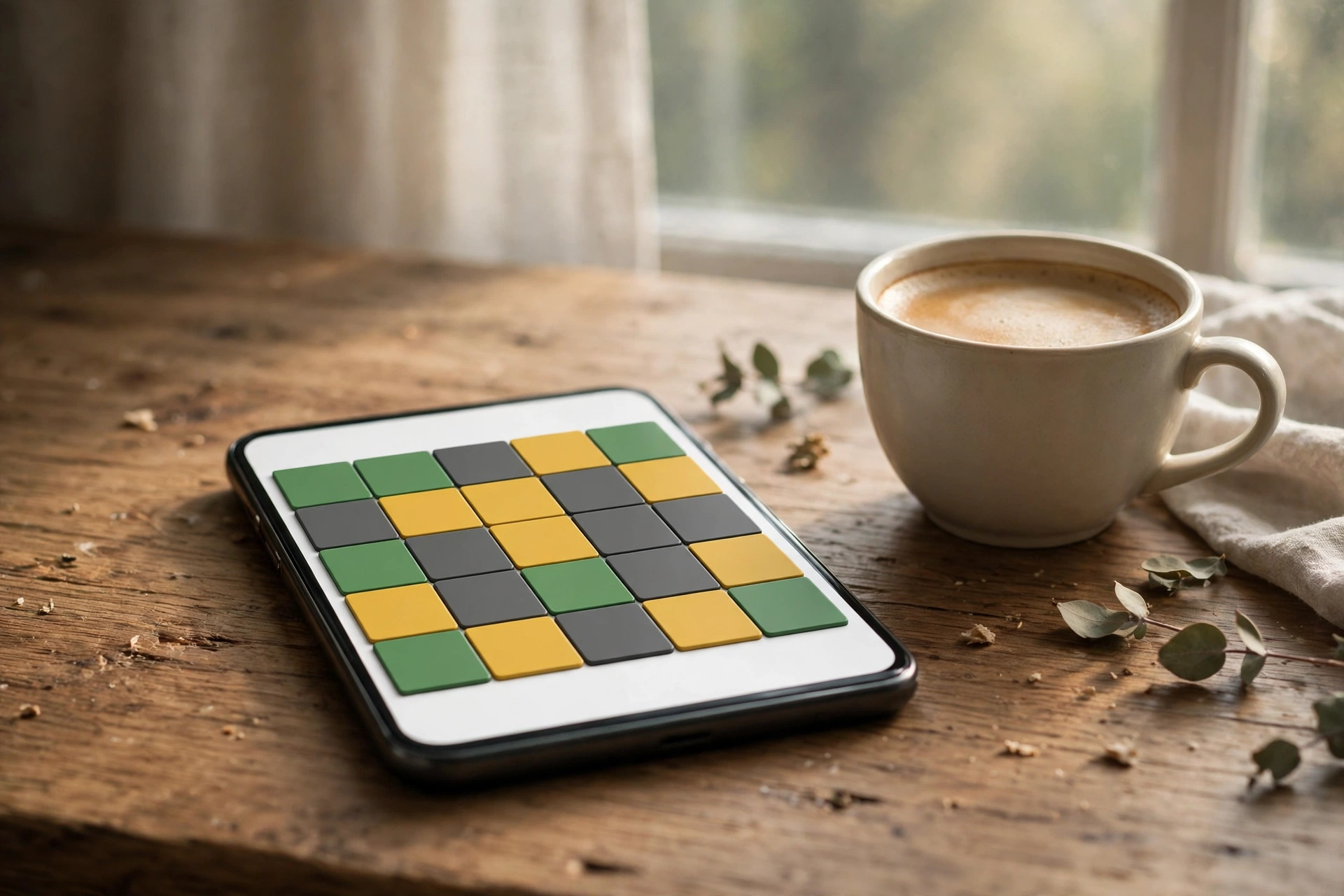
The sample board follows the exact rules of the standard game on this site. It is a 5 by 5 grid that hides five five-letter words: three across and two down. You get 15 swaps to solve it. Green means a letter is in the right spot, yellow means it belongs in that word but sits in the wrong spot, and grey means it does not belong in that word. Green tiles lock in place, so every plan starts from them.
The three across words run along the top, middle and bottom rows. The two down words run along the left and right columns. Six tiles sit where a row and a column cross, so those tiles belong to two words at the same time. Fixing a crossing tile helps two words at once, which is why the corners matter so much. Our guide to getting 5 stars in Waffle explains how swap counts work.
The starting board already has five green tiles in place. That is deliberate: this sample is built to teach, so it starts with enough anchors to show you how to read the board. A normal board might start with four green tiles, or six. The method is the same either way.
Here is the starting board. Read it row by row, from the top down.
| S | E | W | N | T |
|---|---|---|---|---|
| E | A | |||
| I | N | O | L | K |
| G | A | |||
| E | E | E | G | R |
The empty squares are not missing tiles. The grid only has 19 letter tiles, and the six blank squares are the gaps that give the board its waffle shape. The second and fourth rows hold letters only in the first and last columns, because those are the down words.
Before you look at the hints, take a minute to study the board yourself. The green S in the top left corner starts two words at once. The green O in the very centre of the board belongs to the middle row only, because there is no down word through the centre column. The green E in the bottom left corner starts the bottom row and the left column. See if you can guess even one of the five words before reading on. That first guess is the most useful skill in Waffle.
What the Colors Tell You on This Board
If the colors still feel confusing, the beginner’s guide explains all three in detail, and WordUnscrambler shows the same color rules on its daily hints page. Here is the short version, applied to this exact board.
The five green tiles are S in the top left corner, T in the top right corner, O in the centre, E in the bottom left corner, and R in the bottom right corner. Those five letters never move. They are the anchors of the whole solve, and every swap you plan should start from them. Notice that four of the five greens sit on crossings, where a row and a column meet, so each one pins down two words at once. The centre O is the exception: it sits in the middle row only, because there is no down word through the centre column. That is normal in Waffle, and it is why the centre tile is less powerful than the corners.
The top row is the friendliest row on this board. Two of its letters are yellow, E and W, and they only need to trade places with each other. The E sits where the W belongs, and the W sits where the E belongs. One swap fixes both of them, and the top row is more than half solved. When two tiles in the same word belong in each other’s spots, the swap is free in a sense, because neither tile has to travel anywhere else. Look for these trade-places pairs before you plan anything fancy. The middle row has one too: the N and the L in the middle row belong in each other’s spots as well.
The rest of the yellow tiles are E in the second row, N in the middle row, L in the middle row, E in the bottom row, E in the bottom row, and G in the bottom row. Each one belongs in its row or column word but sits in the wrong spot. The E in the second row is a good example of how to read a yellow tile in a down word. It sits in the left column, so it belongs in the left column word. It does not belong in any row word, because the second row has no across word. That narrows its home to one word, which is a gift.
The six grey tiles are N in the top row, A in the second row, I in the middle row, K in the middle row, G in the fourth row, and A in the fourth row. Grey never means a letter is useless. It means the letter does not belong in the word it is sitting in. Here is the twist this board teaches: a grey tile can belong to a word it does not even touch. The N in the top right corner is grey for the top row, but it belongs in the left column. The G in the fourth row is grey for the left column, but it belongs in the middle row. The A in the fourth row is grey for the right column, but it belongs in the bottom row. Grey means wrong word, not wrong letter, and sometimes the right word is two rows away.
One more pattern to spot before you move on: there are five E tiles on this board, and each one has a different home. That is the duplicate letter trap in its purest form. One E belongs in the top row, one E belongs in the left column, one E belongs in the right column, and two E tiles belong in the bottom row, in different spots. If you assume two E tiles belong in the same word, you will waste swaps. Count the letters first, then place them. Our guide to what the colors mean in Waffle covers the duplicate letter trap in full, with more board examples.
Hints for the Sample Puzzle (Spoiler Free)
These hints give you a clue for each word without giving the word away. Each hint tells you the starting letter and a plain English clue. Try to solve the board from the hints alone before you scroll to the solution.
Across Word 1 (Top Row): Starts With S
A sugary taste, like candy or cake. Five letters, and it ends in T. The green S at the start and the green T at the end frame the whole word, and the E and W in the middle only need to trade places.
Across Word 2 (Middle Row): Starts With A
Moving forward together, in the same direction. Five letters, and it ends in G. The green O in the centre is the third letter, and the N and L in the row only need to trade places.
Across Word 3 (Bottom Row): Starts With E
Keen and excited to do something. Five letters, and it ends in R. The green E at the start and the green R at the end frame the whole word.
Down Word 1 (Left Column): Starts With S
A legless reptile that slithers along the ground. Five letters, and it ends in E. The green S at the top and the green E at the bottom frame the whole word.
Down Word 2 (Right Column): Starts With T
A big striped wild cat. Five letters, and it ends in R. The green T at the top and the green R at the bottom frame the whole word.
Spoiler Warning: Full Sample Solution Below
Stop here if you want to keep solving. Everything below this line reveals the five sample words, the solved board, and the full 7-swap solution. There is no going back once you read it.
The Five Sample Words
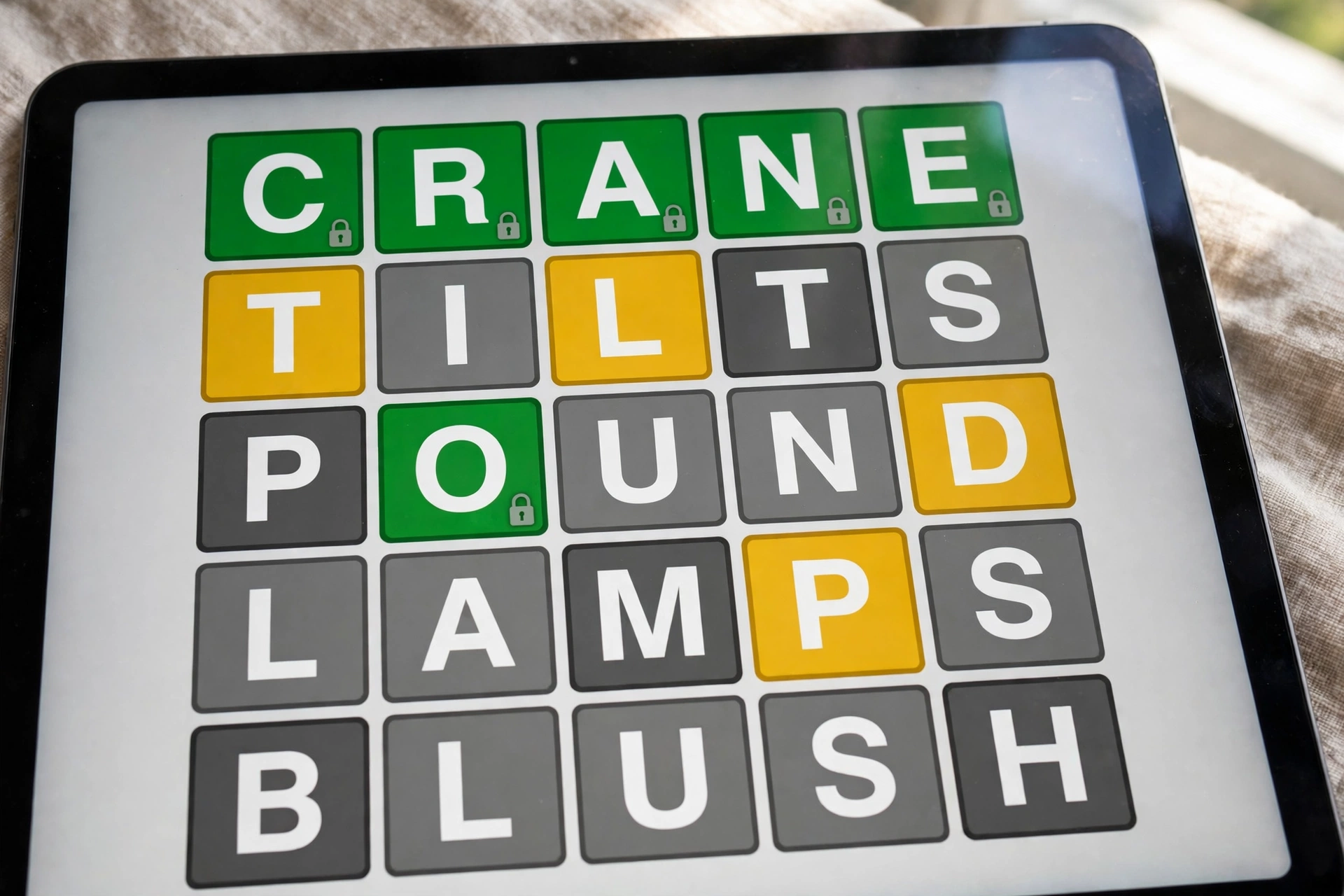
Here are the five words hidden in today’s sample board:
- Across 1 (top row): SWEET
- Across 2 (middle row): ALONG
- Across 3 (bottom row): EAGER
- Down 1 (left column): SNAKE
- Down 2 (right column): TIGER
Check them against the grid. SWEET runs across the top, ALONG across the middle, EAGER across the bottom. SNAKE runs down the left column, and TIGER down the right. The crossing letters match in both directions, which is the test that a Waffle board is built correctly: the S of SWEET is also the S of SNAKE, the T of SWEET is also the T of TIGER, the A of ALONG is also the A of SNAKE, the G of ALONG is also the G of TIGER, the E of EAGER is also the last letter of SNAKE, and the R of EAGER is also the last letter of TIGER.
Here is the solved board:
| S | W | E | E | T |
|---|---|---|---|---|
| N | I | |||
| A | L | O | N | G |
| K | E | |||
| E | A | G | E | R |
Every tile is green now. That is the win state: all five words correct, all 19 letters in their right places.
The 7-Swap Solution, Step by Step

The sample solves in 7 swaps, three under the 10-swap par that the original game rewards with a top score. You have 15 swaps, so a 7-swap solve leaves 8 to spare. Follow the steps on the starting board and watch the puzzle come together: the two trade-places pairs first, then the grey tiles finding their faraway homes, then the bottom row to finish.
Swap 1: E (top row, second tile) with W (top row, third tile). The W lands as the second letter of SWEET and turns green, and the E lands as the third letter of SWEET and turns green. One swap, two green tiles, and the top row is already more than half solved. This is the trade-places pair. Neither tile had to travel anywhere except into the spot the other one was leaving. When you see two tiles in the same word that belong in each other’s spots, take that swap first. It is the cheapest move on the board.
Swap 2: N (middle row, second tile) with L (middle row, fourth tile). The L lands as the second letter of ALONG and turns green, and the N lands as the fourth letter of ALONG and turns green. The middle row is finished except for its first and last letters, and both of those are grey tiles that belong to other words. This is the second trade-places pair on the board, and it shows the same lesson as swap 1: two yellow tiles in the same word, swapped with each other, is the cheapest move in the game.
Swap 3: A (second row, last tile) with I (middle row, first tile). The A lands as the first letter of ALONG and turns green, and the I lands as the second letter of TIGER and turns green. The middle row is finished now: A, L, O, N, G. The A was grey for the right column word, because A is not in TIGER, but it belonged in the middle row. The I was grey for the middle row word, because I is not in ALONG, but it belonged in the right column. Two grey tiles, one swap, two words helped. This is the most satisfying kind of swap in Waffle, because it rescues two letters that looked useless.
Swap 4: N (top row, last tile) with E (second row, first tile). The N lands as the second letter of SNAKE and turns green, and the E lands as the fourth letter of SWEET and turns green. The top row is finished now: S, W, E, E, T. The N was grey for the top row word, because N is not in SWEET, yet its real home was the left column, two rows below where it started. If you had written off that N as a spare letter, you would never have finished the left column. Grey tiles deserve a second look, because the word they belong to might be nowhere near where they sit.
Swap 5: K (middle row, last tile) with G (fourth row, first tile). The K lands as the fourth letter of SNAKE and turns green, and the G lands as the last letter of ALONG and turns green. The left column is finished except for its last letter, which is already green. The K was grey for both words it sat in, the middle row and the right column, yet its real home was the left column. The G was grey for the left column, yet its real home was the middle row. One swap moves a grey tile into a word it does not touch in the starting board, and that is the whole lesson of this puzzle in a single move.
Swap 6: A (fourth row, last tile) with E (bottom row, second tile). The A lands as the second letter of EAGER and turns green, and the E lands as the fourth letter of TIGER and turns green. The right column is finished now: T, I, G, E, R. The A was grey for the right column word, because A is not in TIGER, but it belonged in the bottom row. The E was yellow for the bottom row word, because E is in EAGER, but it sat in the wrong spot. Two tiles that looked like they belonged nowhere turn out to belong in each other’s words.
Swap 7: E (bottom row, third tile) with G (bottom row, fourth tile). The G lands as the third letter of EAGER and turns green, and the E lands as the fourth letter of EAGER and turns green. The bottom row is finished now: E, A, G, E, R. One swap finishes the last word, and the board is solved. The left column is finished too, because the green E at the start of the bottom row was always the last letter of SNAKE.
Count the green tiles after each swap and you will see the pattern: every single swap turned two letters green. That is 14 green tiles earned in 7 swaps, on top of the 5 green tiles the board started with. That is the whole secret of a low swap count.
What This Sample Teaches You
This board teaches five lessons that transfer to every board you will ever play. Learn them here, on a board where the answers are printed below, and they will be waiting for you when your own board is a mystery.
First, look for trade-places pairs before you do anything else. Three of the seven swaps in this solve were pairs of tiles that belonged in each other’s spots: E and W in the top row, N and L in the middle row, and E and G in the bottom row. Each pair cost one swap and fixed two tiles. Before your first swap, scan every row and column for two tiles that look swapped with each other. If you find one, take it. It is the cheapest move in the game, and it often unlocks the rest of the board. Our guide to how many swaps you get in Waffle explains why two-tile swaps are the key to a low total.
Second, a grey tile can belong to a word it does not touch. The N in the top right corner belonged in the left column. The K in the middle row belonged in the left column. The G in the fourth row belonged in the middle row. The A in the fourth row belonged in the bottom row. None of those tiles sat in the word they belonged to, so all four showed grey. If you treat a grey tile as a dead letter, you will never find its home, and you will run out of swaps guessing. Ask where a grey letter could live, not whether it matters. The answer is often two rows away.
Third, count duplicate letters before you place them. Five E tiles shared this board, and each one had a different home. The top row needed one E, the left column needed one E, the right column needed one E, and the bottom row needed two E tiles, in different spots. A player who tried to put two E tiles in the same word would have wasted at least two swaps. Before your first swap, count how many of each letter the board holds and how many each word needs. It takes ten seconds, and it saves stars. Our guide on green tiles explains how locked tiles help you count what is left.
Fourth, plan swaps that fix two tiles at once. Every swap in this solve turned two letters green. That is not luck. It happened because each swap paired two tiles that belonged in each other’s spots, or two grey tiles that belonged in each other’s words. Before you swap, check both tiles. If a swap fixes one tile and moves the other tile to a random spot, it is probably a wasted swap. Wait until you can see the pair.
Fifth, crossings do double work. The green S in the top left corner pinned down the first letter of SWEET and the first letter of SNAKE. The green T in the top right corner pinned down the last letter of SWEET and the first letter of TIGER. The green E in the bottom left corner pinned down the first letter of EAGER and the last letter of SNAKE. The green R in the bottom right corner pinned down the last letter of EAGER and the last letter of TIGER. When you plan a swap, always check the crossing. A tile that sits where two words meet is worth twice as much as a tile that sits in one word only.
How to Play Your Own Board Today
The sample is solved, but your board is waiting. Here is how to take these five lessons into the game.
Open thewafflegame.uk and load a fresh board. Before you touch anything, read the board the way this post read the sample. Count the green tiles and note where they sit. Look for trade-places pairs, two tiles in the same word that belong in each other’s spots. Count duplicate letters and work out how many each word needs. Then plan your first three swaps before you make the first one.
If you run out of swaps on your own board, do not worry. There is no penalty for trying again, because a fresh board is one tap away. Unlimited mode gives you endless fresh boards to practise on, and our Deluxe guide explains the bigger 5 by 6 board when the standard board starts to feel easy. Dailydle lists the same core rules for the original game, including the 15-swap limit and the 10-swap par, if you want a second opinion on how the scoring works.
If you get stuck on your own board, come back to this sample and re-read the solve. The words are different, but the method is the same: read the colors, count the letters, find the pairs, and swap two tiles at a time. Most boards on this site solve in 7 to 9 swaps once the method clicks.
Frequently Asked Questions
How many words are in a Waffle puzzle?
A standard puzzle on this site hides five five-letter words: three across and two down. The original game hides six words, and Deluxe mode on this site hides six words on a bigger 5 by 6 grid.
What is the fewest swaps a Waffle puzzle can be solved in?
Every standard puzzle can be solved in 10 swaps on the original game, which is the par score, and most boards solve in far fewer with double-green swaps. The sample here solved in 7 swaps. On this site there is no star score, so the swap count is your own challenge to beat.
Can I play more than one Waffle puzzle a day on this site?
Yes. There is no shared daily puzzle and no waiting. Every board is generated fresh and at random, so you can play as many puzzles as you like, one after another. Finish a board, load a fresh one, and keep playing.
What do grey tiles mean in Waffle?
A grey letter does not belong in the word it is sitting in, but it may belong in a different word on the board. On this sample, a grey N belonged in the left column and a grey G belonged in the middle row, even though neither tile sat in those words. Always ask where a grey letter could live before you give up on it.
Do green tiles lock in Waffle?
Yes. Once a letter turns green, it is in its correct spot and it is locked in place. That is why green tiles are the anchors of every solve. Plan your swaps around them.
Is there a shared daily Waffle puzzle on this site?
No. Every player gets a different random board, so there is no single daily puzzle and no set of today’s answers. That is why this series publishes a clearly labelled sample puzzle each morning instead. The sample teaches the same swap logic you will use on your own board.
Conclusion
Today’s sample puzzle hid five everyday words, SWEET, ALONG, EAGER, SNAKE and TIGER, behind a scrambled 5 by 5 grid. It started with five green tiles, solved in 7 swaps, and every single swap turned two letters green at once. The solve turned on five simple habits: spot trade-places pairs first, remember that a grey tile can belong to a word it does not touch, count duplicate letters before placing them, plan swaps that fix two tiles at once, and use the crossings for double value.
Remember that this was a sample, not today’s puzzle. Your board will have different words, and that is the fun of it. The habits are the same on every board, so take them with you. Then come back tomorrow morning for a brand new sample puzzle, with fresh words, fresh hints and a fresh step-by-step solve.