
What Happens If You Run Out of Moves in Waffle?
Quick answer: If you run out of moves in Waffle, the puzzle ends unsolved. On the original game, the correct answers are revealed, you earn no stars, and your daily streak stops, with a new puzzle waiting at the next reset. On this site, the cost is far smaller: there is no star score, no streak and no reset to lose, so a failed board costs you one board and nothing else, and a fresh board is one tap away.
That is the short version. The rest of this guide explains exactly what you see when the counter hits zero, how the ending differs between the original game and this site, whether you can undo a swap or restart the same puzzle, and the seven habits that keep you from running out in the first place.
What Running Out of Moves Means
Waffle gives you a fixed number of swaps for each puzzle, and every swap costs one move, whether it helps or not. The counter ticks down from 15 on a standard board, and when it reaches zero with words still unsolved, the puzzle is over. You cannot make a 16th swap. The board stops accepting moves, and the round ends.
This is the part new players misunderstand most. Running out of moves does not mean the game deletes your progress or locks you out for the day. It means that one board is finished, unsolved, and the game shows you what the answers were. The distinction matters, because the fear of running out makes many players freeze up and play too carefully, which wastes just as many swaps as playing too fast.
The swap limit is the whole tension of the game. Without it, Waffle would be a sorting exercise: you could swap tiles at random until the words appeared. With it, every swap has to earn its place. Our guide to how many swaps you get in Waffle explains the 15-swap budget in full, including why 10 swaps is the par score on the original game.
The Swap Counter: 15 Swaps and Why It Runs Out
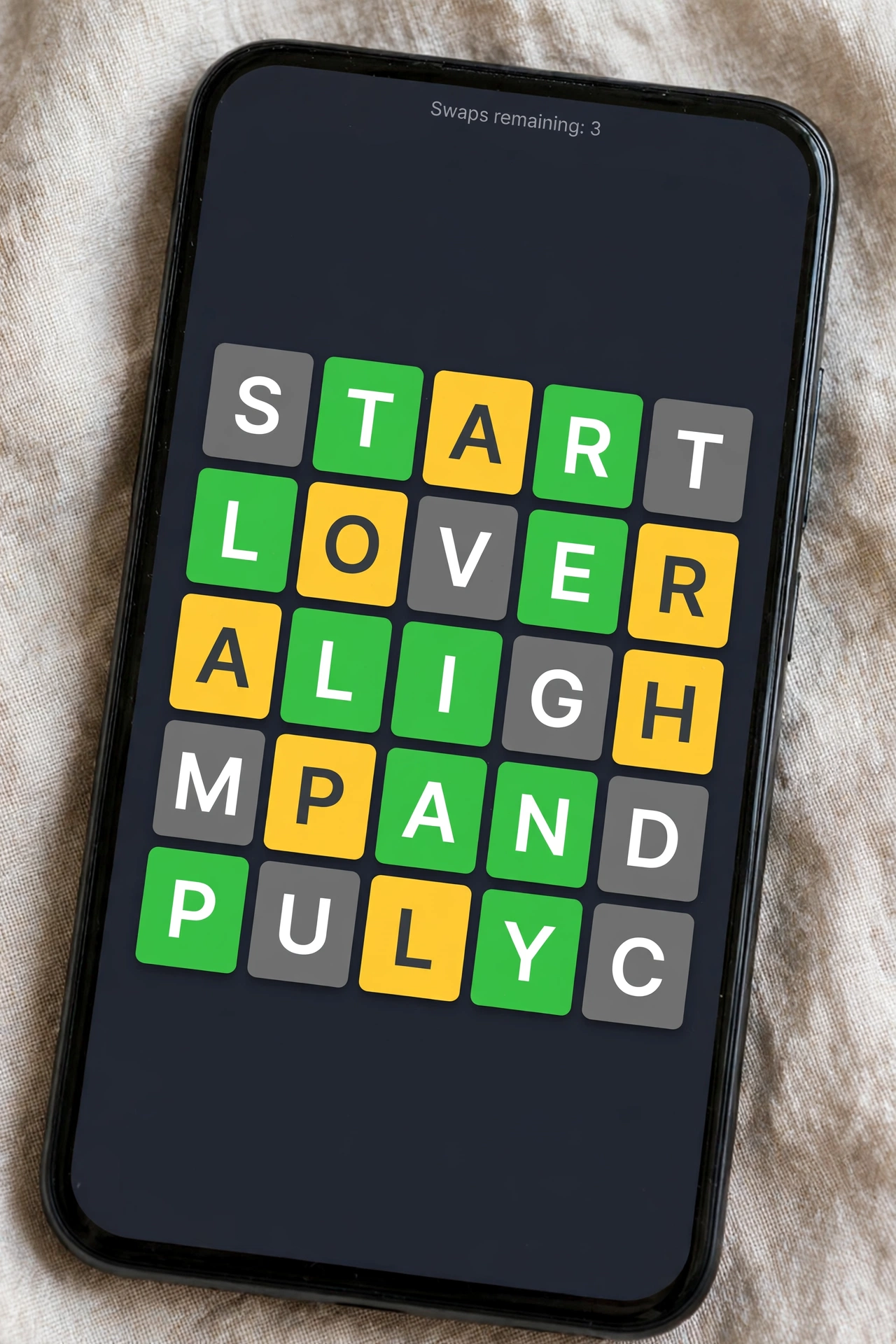
The counter is the number under the grid, and it always shows how many swaps you have left. It starts at 15 on a standard board and drops by one after every swap, good or bad. Swapping two identical letters costs a swap and changes nothing, which is the most expensive mistake in the game, and our guide to duplicate letters in Waffle explains that trap in detail.
Here is the swap budget for every mode, on this site and on the original game. The two are not the same, so check which column you are reading.
| Mode | Grid | Words | Swap limit |
|---|---|---|---|
| Standard (this site) | 5 by 5 | 5 | 15 |
| Unlimited (this site) | 5 by 5 | 5 | 15 |
| Deluxe (this site) | 5 by 6 | 6 | 25 |
| Daily (original game) | 5 by 5 | 6 | 15 |
| Unlimited 5 by 5 (original game) | 5 by 5 | 6 | 15 |
| Unlimited 3 by 3 (original game) | 3 by 3 | 4 | 7 |
| Deluxe (original game) | 7 by 7 | 8 | 25 |
| Number Waffle (original game) | 5 by 5 | 6 | 20 |
| Waffle Royale (original game) | 5 by 5 | 6 | 20 |
Two things stand out in that table. First, the standard board on this site hides five words, not six, because this site’s grid has two down words instead of three, so the same 15 swaps stretch a little further here. Second, the Deluxe board on this site is a 5 by 6 grid with six words, while the original game’s Deluxe is a much bigger 7 by 7 grid with eight words, and both get 25 swaps. Our Deluxe guide walks through this site’s bigger board in full.
Why do players run out? The counter only gives you five spare swaps above the 10-swap par, so five wasted swaps is all it takes to fail. The usual causes are easy to name: swapping without a plan, moving tiles one at a time instead of in pairs, chasing a single word while the rest of the board waits, ignoring duplicate letters, and swapping two identical letters by accident. Each of those wastes one swap on its own, and two of them together will usually end the puzzle. The fix is not to play faster. It is to plan before you touch the board, which is what the habits section below is for.
What You See When the Counter Hits Zero
On the original game, the ending is clearly documented. The wafflegame.org FAQ answers it directly: if all 15 swaps are used without solving every word, the puzzle ends and the correct answers are revealed, and a new puzzle becomes available at the next daily reset. Other guides describe the same ending in their own words: the board greys out, the puzzle ends for that attempt, and the solution is shown so you can see the words you missed. The round is over for the day on the original game, because there is only one shared daily puzzle, and the next one arrives at midnight.
That ending has three parts, and each one matters. First, the answers are revealed, so you can see exactly which words you missed and where the letters you needed were hiding. Second, you earn no stars, because stars are the swaps you did not use, and you used all of them. Third, your daily streak stops, because the streak only moves when you solve that day’s shared puzzle. Our guide to getting 5 stars in Waffle explains the star maths in full: 10 swaps earns 5 stars on the original game, and 15 swaps earns none, though the puzzle still counts as solved if you finish in time.
On this site, the ending is simpler, because there is less to lose. Running out of swaps ends that board, and that is all it ends. There is no star score to lose, no streak to break, and no daily puzzle to wait for. The practical result is the same in every case: that board is over, and a fresh board is one tap away. Our guide to when a new Waffle puzzle arrives explains why there is no reset time on this site at all, because boards are generated fresh on demand.
The honest difference is this: on the original game, running out of moves costs you the day. On this site, it costs you one board. That is why the fear of running out is worth unlearning here. A failed board is not a failed day. It is a lesson, and the next board is already waiting.
Does Running Out of Moves Break Your Streak?
On the original game, yes. The streak only moves when you solve that day’s shared puzzle, so a puzzle that ends unsolved breaks the run. That is the real sting of running out on the original game, and it is why daily players guard their last few swaps so carefully. A streak of thirty days can end on a single careless swap, and there is no way to buy it back.
On this site, there is no streak to break, because there is no streak at all. The homepage never mentions a streak, the win screen shows your swap count and a share button, and nothing tracks how many days in a row you have played. Our guide to how the daily streak works in Waffle explains this in full: the streak rules you read about online belong to the original game only, and they do not apply here.
That changes the strategy completely. On the original game, the last three swaps are precious, because they protect a streak. On this site, the last three swaps are just three swaps. You should still try to solve the board, because solving is the fun of it, but you should not play scared. A player who is afraid to spend a swap will often spend more swaps in the end, because hesitation leads to half-plans and half-plans lead to wasted moves. Play to solve the board, not to protect a number that does not exist here.
Can You Undo a Swap or Get Swaps Back?
No. There is no undo button in Waffle, and there is no way to earn swaps back inside a puzzle. Once you swap two tiles, the board keeps the new arrangement, the counter drops by one, and the move is final. Every swap costs one move, whether it helps or not, so a swap you regret still costs you. That is the rule on the original game and on this site, and it is the reason planning matters more than speed.
There is one exception, and it belongs to a clone, not to this site or the original game. Satordle’s Waffle guide describes a Reset button that puts the grid back to its opening position with a full allowance, so you can try the same board again from scratch. That is a feature of their version of the game, and it is worth knowing about if you play there, but do not expect it here. On this site, the way back from a bad swap is not a reset button. It is a fresh board, and Unlimited mode gives you as many fresh boards as you want.
The same honesty applies to restarting the same puzzle. On the original game, you cannot replay the daily puzzle once it ends, solved or unsolved, until the next day. The archive lets you replay past daily puzzles, but the current day’s board is done once it is done. On this site, there is no archive and no shared daily puzzle, so there is nothing to replay, but there is also nothing to wait for. Every board is generated fresh and at random, so the next board is a new puzzle, not a repeat of the one you just failed. Our guide to past Waffle puzzles answers the archive question in full.
If you are stuck mid-puzzle and tempted to reload the page hoping for a do-over, do not bother. Reloading does not give you your swaps back, and on the original game your progress is saved in the browser, so the board comes back exactly where you left it. The only way out of a bad position is forward: read the board again, find the pair you missed, and spend your remaining swaps on purpose.
Why Players Run Out: The Five Wasted Swaps
Most failed boards are not lost on the last swap. They are lost on the first five. Here are the five ways players waste swaps, in the order they usually appear.
First, swapping without a plan. The most common mistake is to swap the first pair that looks right, before reading the whole board. A swap that fixes one tile and moves the other tile to a random spot is a wasted swap, even if the first tile turns green. The fix is to plan your first three swaps before you make the first one, and to check both tiles in every swap before you commit.
Second, chasing one word. A player who falls in love with the top row will spend four swaps finishing it while the other four words wait. Waffle rewards balance, because a swap that fixes two tiles in two different words is worth twice as much as a swap that fixes one word. Our guide to solving the corners first explains why the crossing tiles matter more than any single row.
Third, ignoring duplicate letters. A board with two T tiles needs both of them, in two different words, and a player who tries to put both T tiles in one word will waste at least two swaps. Before your first swap, count how many of each letter the board holds and how many each word needs. It takes ten seconds, and it saves swaps.
Fourth, swapping two identical letters. This is the most expensive mistake in the game, because it costs a swap and changes nothing. Two identical letters in the wrong spots look like they need swapping, but swapping them leaves the board exactly as it was. The clone guides warn about this directly, and our duplicate-letters guide works through an example where two S tiles sit in the wrong places and swapping them achieves nothing.
Fifth, moving a tile that is already home. Green tiles lock in place, so you cannot move them by accident, but a yellow tile that is one spot away from home is almost as dangerous. A player who swaps a yellow tile into a spot that is not its home has spent a swap to make the board worse. The fix is to ask, for every tile you touch, where exactly it belongs, and to wait until you can see the pair.
Any one of these wastes a single swap. Two of them together will usually end the puzzle, because five spare swaps is all you have. The good news is that all five are fixable with the same habit: stop, read the board, and plan before you swap.
How to Avoid Running Out: 7 Habits That Save Swaps

These seven habits are the difference between finishing with swaps to spare and watching the counter hit zero. They work on every board, on this site and on the original game.
1. Read the colors before you touch anything. Count the green tiles and note where they sit, because they are the anchors of the whole solve. Then count the yellow tiles in each word, because a word that is mostly yellow is nearly solved. Then look at the grey tiles last, because they are the ones most players ignore, and they are often the key. Our guide to what the colors mean in Waffle covers each color with board examples.
2. Find the trade-places pairs first. Two tiles in the same word that belong in each other’s spots are the cheapest move on the board: one swap, two green tiles. Scan every row and column for a pair before you do anything else. Our daily sample puzzles solve in 7 swaps almost every day, and most of those swaps are trade-places pairs.
3. Start at the corners. Corner tiles belong to two words at once, so fixing a corner helps two words. The centre tile does the same on the middle row. A swap that fixes a crossing tile is worth twice as much as a swap that fixes a tile in one word only. Corners first is the single most cited strategy tip in the game, and it is the reason the corners guide exists.
4. Count duplicate letters before you place them. If the board holds two of a letter, work out which word each copy belongs to before you move either one. A player who places both copies in the same word has wasted at least two swaps, and probably the puzzle.
5. Save your last two swaps. When the counter shows two swaps left, stop and re-read the whole board before you spend them. Two swaps can fix four tiles if they are the right two swaps, and they can fix nothing if they are the wrong ones. The last two swaps are the ones that decide whether the puzzle ends solved or unsolved, so spend them on purpose.
6. Practise in Unlimited mode. Unlimited mode gives you endless fresh boards with the same 15-swap budget, and a failed board there costs you nothing at all. Use it to practise the habits above until they are automatic, then take them to the board that counts. Two or three warm-up boards before a serious attempt will save more swaps than any tip in this guide.
7. Walk away from a stuck board. If you have five swaps left and no idea what to do, close the game for a minute and come back. A fresh look at a stuck board will often show you the pair you missed, because your eyes were locked on the wrong word. This is not superstition. It is how pattern recognition works: a short break resets the pattern you were stuck in, and the board looks new again.
The 10-Swap Par and the Star Maths
On the original game, every standard puzzle can be solved in 10 swaps at best, and no puzzle can be solved in fewer. That number is the par behind the star scoring, and it is why you get five spare swaps out of 15. A 2025 maths paper on Waffle analyzes the scrambles as permutations of the tiles and reports that no game can be solved in fewer than 10 swaps, which is the reason the budget is set where it is.
The star maths follows directly from the par. Each swap you have left when you solve the puzzle earns a star, up to a maximum of five. Solving in 10 swaps, the minimum, earns five stars. Solving in 11 earns four, in 12 earns three, in 13 earns two, in 14 earns one, and using all 15 earns none, though the puzzle still counts as solved. PuzzlerPlaza puts it plainly: running out of swaps ends the game with no stars.
All of this belongs to the original game only. On this site there is no star score, so the swap count is your own challenge to beat. A 7-swap solve here is still a 7-swap solve, and it is still worth celebrating, but no stars are awarded for it, and no stars are lost when you run out. The par is still a useful target, because a board that solves in 10 swaps or fewer is a board you read well, but it is a personal target, not a score the game keeps.
| Swaps used (original game) | Stars earned |
|---|---|
| 10 | 5 |
| 11 | 4 |
| 12 | 3 |
| 13 | 2 |
| 14 | 1 |
| 15, solved | 0 |
| 15, unsolved | 0, puzzle ends |
What to Do Right After You Run Out
Running out of moves feels bad for about ten seconds, and then it is useful, if you use it right. Here is what to do with a failed board instead of closing the tab in frustration.
First, look at the revealed answers. The game shows you the words you missed, so study them. Which word did you miss? Which letters were hiding in the wrong word? Most failed boards come down to one word, and one letter in that word that you never placed. Find it, and you will find the mistake.
Second, spot the missed pair. Every failed board has a pair you did not see: two tiles that belonged in each other’s spots, or two grey tiles that belonged in each other’s words. Work out which pair it was. That pair is the lesson, and it is worth more than the board you lost.
Third, play one board in Unlimited mode right away. The lesson is fresh, so use it while it is fresh. A single practice board after a failure will teach you more than ten boards played on autopilot, because you are looking for the specific mistake you just made.
Fourth, try the daily sample puzzle. The sample series solves a fresh board step by step every morning, with the swap logic shown, so you can watch the habits in this guide being used on a real board. Today’s sample is linked in the habits section above, and yesterday’s sample is good extra practice.
Fifth, do not chase the loss. The worst thing you can do after running out is to play the next board angry and fast, trying to win the swaps back. Swaps do not work that way. Play the next board slowly, plan your first three swaps, and let the habits do the work.
Frequently Asked Questions
What happens if I run out of moves in Waffle?
The puzzle ends unsolved. On the original game, the correct answers are revealed, you earn no stars, and your daily streak stops, with a new puzzle at the next reset. On this site, the board simply ends, and a fresh board is one tap away, because there is no star score, no streak and no reset to lose.
Do I lose my streak if I run out of moves?
On the original game, yes, because the streak only moves when you solve that day’s shared puzzle. On this site, there is no streak at all, so there is nothing to lose. The streak rules you read about online belong to the original game only.
Can I restart the same puzzle after running out?
Not on the original game, where the daily puzzle is done once it ends, though the archive lets you replay past daily puzzles. On this site, there is no archive and no shared daily puzzle, so there is nothing to replay, but a fresh board is one tap away.
Can I undo a swap in Waffle?
No. Every swap is final, and the counter drops by one whether the swap helps or not. There is no undo button and no way to earn swaps back inside a puzzle. Plan before you swap.
How many swaps do I get in Waffle?
You get 15 swaps on a standard board, on this site and on the original game. Deluxe gives you 25 swaps on both. Every puzzle can be solved in 10 swaps at best on the original game, so you have five spare swaps to work with.
Does running out of moves work the same way in Deluxe?
The ending is the same, but the budget is bigger. Deluxe gives you 25 swaps instead of 15, and the board is bigger, with six words on this site and eight on the original game. Run out on Deluxe and the puzzle ends unsolved, the same as on a standard board.
Is there any penalty for running out of moves on this site?
No. There is no star score, no streak and no daily puzzle to lose, so a failed board costs you one board and nothing else. Load a fresh board and try again, or practise in Unlimited mode first.
Conclusion
Running out of moves in Waffle ends the puzzle unsolved, and on the original game it also reveals the answers, earns you no stars, and stops your daily streak until the next reset. On this site, the ending is far gentler: the board ends, and that is all, because there is no star score, no streak and no reset to lose. A fresh board is one tap away, and Unlimited mode gives you as many practice boards as you want.
The swap counter only gives you five spare swaps above the 10-swap par, so five wasted swaps is all it takes to fail. The seven habits in this guide, read the colors, find the trade-places pairs, start at the corners, count duplicate letters, save your last two swaps, practise in Unlimited, and walk away from a stuck board, are the difference between finishing with swaps to spare and watching the counter hit zero. Learn them here, use them on your next board, and the next time the counter runs low, you will know exactly what to do.