What Do the Colours Mean in Waffle? Green, Yellow and Grey Explained
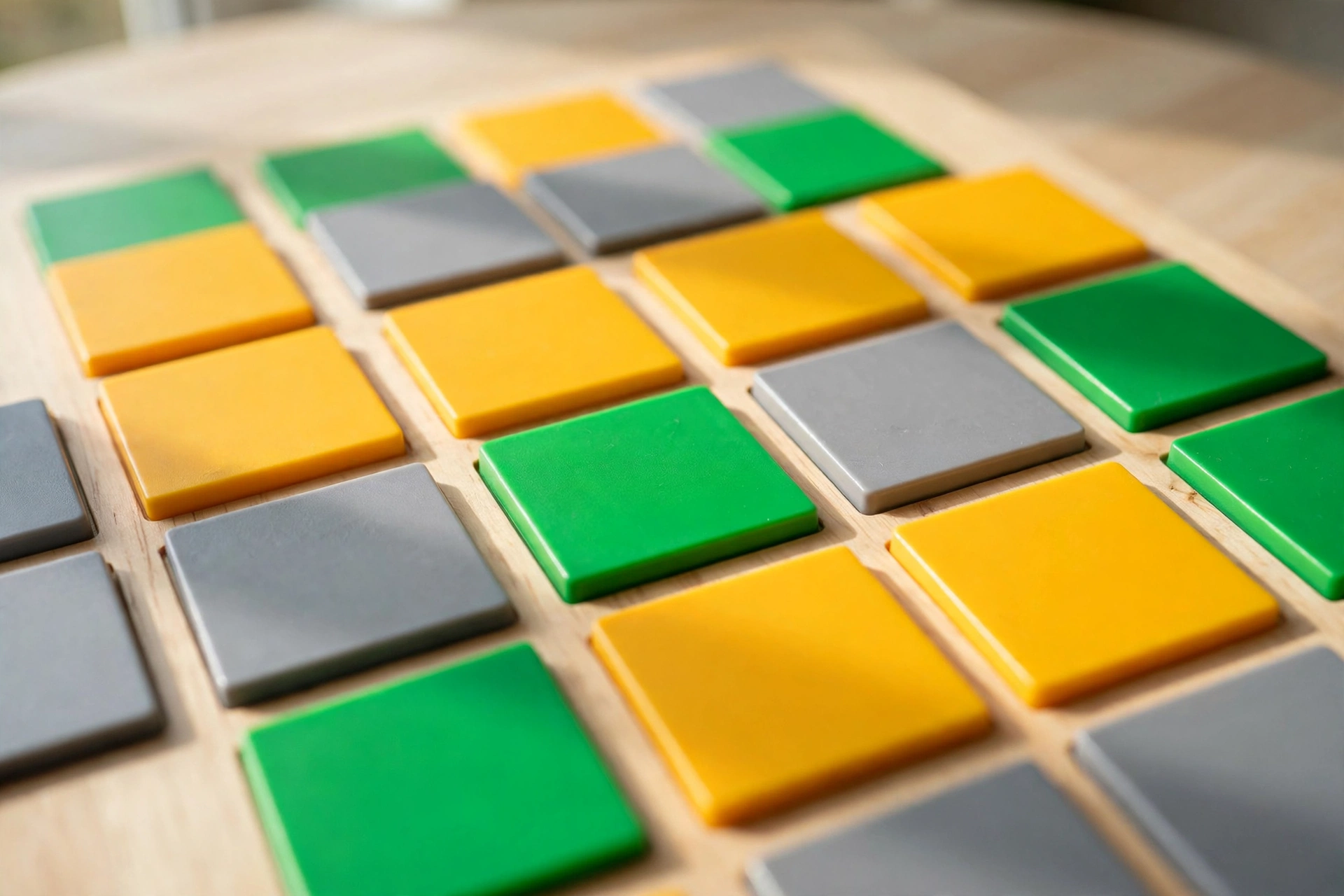
Quick answer: In Waffle, green means the letter is in the right spot and locked in place, yellow means the letter belongs in that word but sits in the wrong spot, and grey means the letter does not belong in that word at all. The whole game is reading those three colours and swapping tiles until every letter turns green. If you can read the colours, you can solve the board.
The colours are the only feedback the game gives you. There are no hints written on the board, no arrows pointing at the right answer, and no score until the puzzle ends. Just 19 tiles in three colours. New players often stare at the board and wonder what they are supposed to do next, and the answer is always the same: read the colours first, swap second.
This guide explains each colour in depth, with board examples from real puzzles, the traps that catch beginners, and the special cases that the short guides skip. By the end, you will read a Waffle board the way an experienced player does: at a glance, with a plan already forming before your first swap.
If you have never played before, start with our beginner’s guide to Waffle, which covers the rules, the board and the modes. If you already play, this guide is the deep dive that turns colour reading from a guess into a skill.
The Three Colours at a Glance
Here is the whole system in one table. Keep it open while you play your first few boards, and it will become second nature fast.
| Colour | What it means | Can the tile move? | What to do next |
|---|---|---|---|
| Green | The letter is in the right spot | No, it is locked | Build the word around it |
| Yellow | The letter belongs in this word, but in the wrong spot | Yes | Slide it along its row or column |
| Grey | The letter does not belong in this word | Yes | Move it to the word it really belongs to |
Three colours, three meanings, three actions. Everything else in this guide is detail and practice. But the detail matters, because each colour has edge cases that can cost you swaps if you read them wrong.
One important note before we start. Waffle borrows its colour system from Wordle, and the meanings are the same in both games. Green is right, yellow is close, grey is wrong. Word Waffle’s guide puts it in one line: green is the right spot, yellow is the right word in the wrong cell, and grey is not in the word. The difference is what you do with that information. In Wordle, you type a new guess and the game colours it for you. In Waffle, every letter you need is already on the board, and you move the letters yourself. The colours tell you where each letter belongs, and your job is to put it there. That difference is why colour reading matters even more in Waffle than in Wordle. In Wordle, a wrong guess costs one guess out of six. In Waffle, a wrong swap costs one move out of fifteen, and a careless swap can undo a green tile’s neighbours. Read first, swap second.
Green Means the Letter Is Home
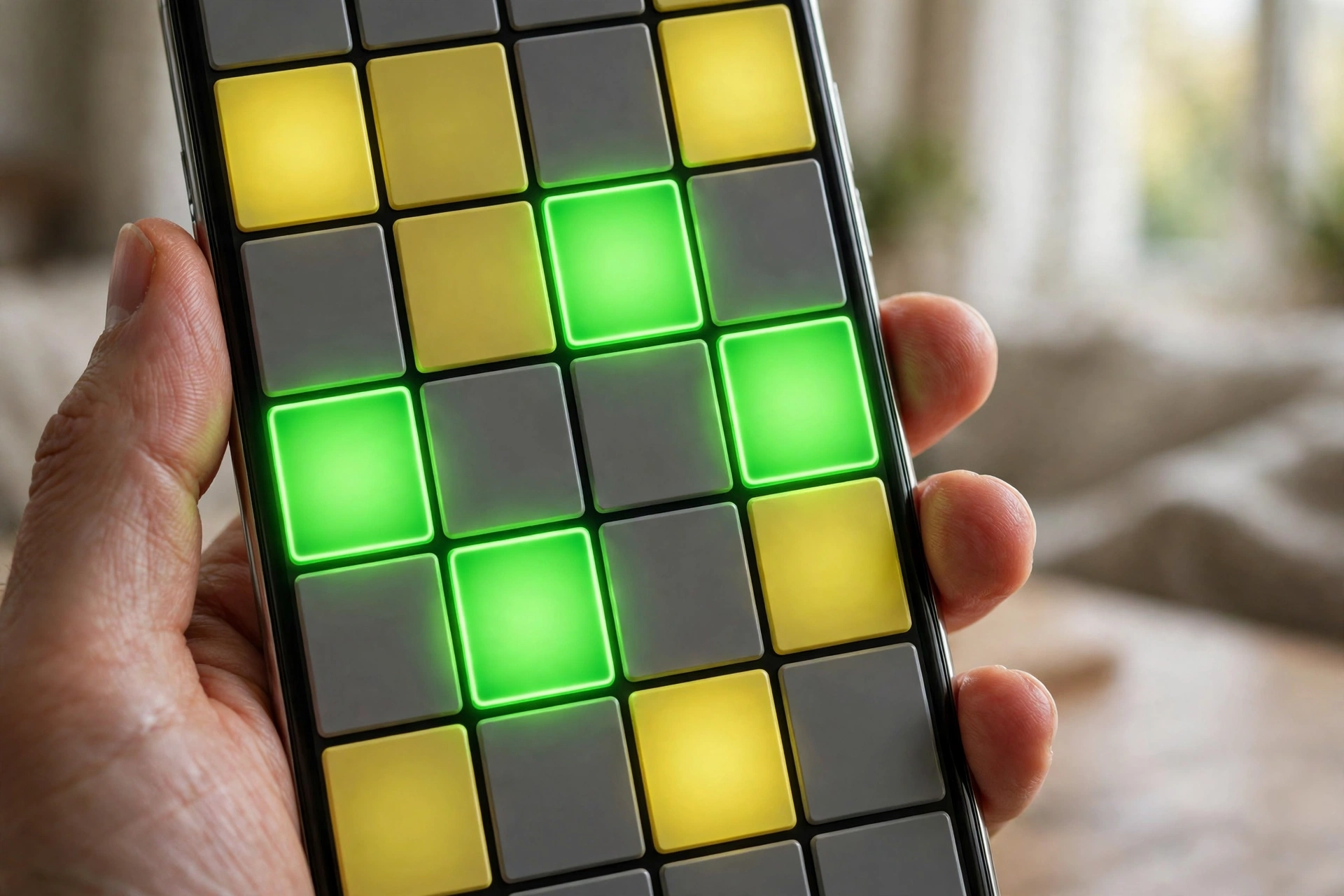
A green tile is a finished tile. The letter sits in its correct final position, in both the row word and the column word if it sits at a crossing. It cannot be swapped, and it will not move for the rest of the puzzle. The game locks it in place so you can build around it without fear of breaking it.
Green tiles are the anchors of every solve. A good player looks at the green tiles first and asks what words they spell. A single green letter in the middle of a row can suggest a whole word. Two green letters side by side almost solve a word on their own. Three green letters in a row leave only two letters to find, and the answer usually jumps out.
Take a simple example. Imagine the middle row of a board shows the letters C, L, O, U, D, and the L and the O are green. You know the word is five letters long, the second letter is L, and the third letter is O. The word starts with C or a letter that fits before L, and it ends with two letters after O. The pattern is _ L O _ _. Even before you check the other tiles, your brain starts offering words: CLOUD, FLOOD, GLOBE. The yellow and grey tiles on the board will rule out two of them fast. That is how green tiles work. They do not just mark progress. They narrow the search until the answer has nowhere to hide.
Green tiles are most valuable at the corners and the centre of the board. A corner tile belongs to two words at once, so a green corner fixes one letter in two words with a single tile. The centre tile of the board is the same: it sits where the middle row and the middle of the grid cross, so it anchors two words. Our guide to getting 5 stars in Waffle explains why corners-first solving saves swaps, and it starts with exactly this idea.
There is one mistake beginners make with green tiles, and it is worth naming. A green tile tells you the letter is right, but it does not tell you the whole word. Players see a green T in the middle of a row and assume the word is something with T in the middle, then stop reading the other tiles. The green tile is a clue, not a conclusion. Always read the yellow and grey tiles in the same row before you decide what the word is. A green tile plus a yellow tile is far more information than a green tile on its own.
What green does not mean
Green does not mean the word is finished. A row can have three green letters and still be wrong in the other two spots. Green does not mean the letter appears only once, either. A word can have two of the same letter, and both can turn green in their own spots. Green means one thing only: this letter, in this square, is correct. Nothing more, nothing less.
Yellow Means the Right Word, Wrong Spot
A yellow tile is the most useful tile on the board and the most misunderstood. It means the letter belongs in that word, but it sits in the wrong position. The letter needs to move to another spot in the same row or column. It does not need to leave the word. It just needs to slide along.
Yellow tiles are information. Each one tells you a letter that the word contains, which is a powerful clue. If a row has three yellow tiles, you know three of the word’s five letters before you have solved anything. The only question is their order, and the green tiles in the row usually answer that.
Take another example. Imagine the top row shows S, T, O, N, E, and the N is yellow while the rest are grey or green. The yellow N tells you the top word contains N, but not in the fourth spot. If the second and third spots are already green with T and O, the word looks like _ T O _ _, and N has to go in the first or the last spot. That leaves a small set of words, and the crossing tiles will narrow it further. A single yellow tile, read properly, can cut the possibilities from hundreds to a handful.
The classic beginner mistake with yellow tiles is moving them out of their word. A player sees a yellow letter, assumes it belongs somewhere else on the board, and swaps it into a different row or column. That wastes a swap and loses information. A yellow letter belongs in its current word. The only job is to find its spot inside that word. Check the open tiles in the same row or column first. The right spot is almost always one of them.
There is a second yellow trap, and it is subtler. A yellow letter at a crossing tile belongs to one of the two words that meet there, but you may not know which one. The original game’s help text warns about this directly: a yellow letter at a junction could be part of either word. The way to tell is to look at the other tiles in both words. If the row already has its full set of letters and the column is still missing one, the yellow letter probably belongs to the column. If the column is nearly complete and the row is not, it probably belongs to the row. When in doubt, leave the crossing tile alone and solve the rest of the board first. The answer will reveal itself as the other letters fall into place.
Yellow and duplicate letters
Duplicate letters make yellow tiles trickier, and this is where even experienced players slip. Suppose a word contains only one S, but the board shows two S tiles in that row, and one of them is yellow. The yellow S tells you the word contains S, but it does not tell you which S tile is the real one. Swapping the wrong S into place will not turn it green, and you will have spent a swap to learn nothing.
The original game’s help text describes this exact situation: a highlighted letter means the word contains that letter, not that the tile belongs there, and a word may contain only one S even if two S tiles are highlighted. The practical rule is simple. When a word has duplicate yellow letters, fix the other letters first. The duplicates will sort themselves out once the rest of the word is clear. Never swap two identical letters with each other. It costs a swap and changes nothing on the board, because the letters are the same. That is the most wasted move in Waffle, and the game will not warn you before you make it.
Grey Means Not in This Word
A grey tile is the colour players fear most, and that fear is misplaced. Grey does not mean the letter is useless. It means the letter does not belong in that particular word. It almost always belongs somewhere else on the board, usually in the word that crosses the same square.
Read that again, because it is the single most important sentence in this guide. Grey means “not in this word”, not “not on the board”. Every letter on the board belongs to at least one word. A grey letter is a letter that belongs to a different word from the one you are looking at. Your job is to find its real home.
Here is a real example from our daily sample puzzle. The top left corner of the board showed an A, coloured grey for the top row. A beginner would read that A as a dead letter. But A was the fourth letter of BREAD, the bottom row word. The same board had a C in the top right corner, grey for the top row, which turned out to be the first letter of CLOUD, the middle row word. Both letters looked dead. Both were essential. The grey colour was not telling us to ignore them. It was telling us to look at the crossing word.
Grey tiles are also the best way to rule words out. If a row shows a grey R, the word in that row does not contain R. That kills every candidate word with an R in it. Two or three grey tiles in a row can cut a long list of possible words down to one or two. Experienced players read grey tiles as elimination clues, not as failures. Each grey tile removes wrong answers, and removing wrong answers is how you find the right one.
Grey at a crossing tile
A grey tile at a crossing is a strong clue about both words. If a corner tile is grey, it does not belong in the row word or the column word. Wait, that is not quite right. A tile has one colour, and at a crossing, the colour reflects the tile’s position in the board as a whole. In practice, a grey crossing tile means the letter is not in either of the two words that meet there, which tells you to look further away, at the other crossing tiles in the same row or column. The practical habit is the same: when a tile is grey, ask where else on the board that letter could live, and check the crossing word first.
Grey versus white
Some guides call the third colour white instead of grey. On this site, the tiles are grey. The meaning is identical. If you read a guide that talks about white tiles, it means the same thing: the letter is not in that word. Do not let the different name confuse you. Green, yellow and grey on this site are green, yellow and white in those guides.
How the Colours Change After Every Swap
The colours are not fixed. After every swap, the game rechecks the whole board and repaints any tile whose status changed. A yellow tile can turn green when it lands in its right spot. A grey tile can turn yellow when it moves into a word that contains it. A green tile never changes, because it is locked.
This is why you should pause after each swap and read the board again. A swap that turns one tile green often changes the colour of a neighbour too. A grey tile that moves into its real word may turn yellow, which tells you it is close. A yellow tile that moves to the wrong spot stays yellow, which tells you to try another spot in the same word.
The repaint is also why a careless swap can hurt. Swapping a tile out of a word that contains it will turn it grey in its new spot, and you will have lost the information it was giving you. Before every swap, ask two questions. First, will this swap turn at least one tile green? Second, will it turn any yellow tile grey? If the answer to the first question is no, do not make the swap. If the answer to the second question is yes, find a different swap. A good swap fixes a tile without breaking one.
Reading the Colours on Deluxe and Other Modes
The colour system works the same way in every mode on this site. The standard game uses a 5 by 5 grid with five words and 15 swaps. Deluxe uses a 5 by 6 grid with six words and 25 swaps. The colours mean the same thing on both boards, and the same reading habits apply. The only difference is scale: a Deluxe board has more tiles, more words, and more chances to misread a colour, so slow down and read the board twice before your first swap.
Unlimited mode also uses the same colours, on 5 by 5 and 3 by 3 boards. The 3 by 3 board is a smaller, faster puzzle with shorter words, and it is a good place to practise colour reading if the standard board feels hard. The colours do not change. Only the board gets smaller.
The 90-second Challenge, Number Waffle and the other extra modes use the same three colours too, with numbers instead of letters in Number Waffle. The logic is identical: green is right, yellow is close, grey is wrong. Learn the system once and it works everywhere on the site.
Common Colour Mistakes and How to Fix Them
Most lost swaps in Waffle come from misreading a colour, not from a lack of vocabulary. Here are the five mistakes that cost beginners the most swaps, and the fix for each one.
Mistake 1: Moving a yellow letter out of its word. A yellow letter belongs in its current word. It only needs to move within that row or column. The fix: before you swap a yellow tile, check the empty and grey spots in the same word first. The right spot is there.
Mistake 2: Ignoring a grey letter. A grey letter belongs somewhere else on the board, usually in the crossing word. The fix: when a tile is grey, ask which word it really belongs to, and check the crossing word before you forget about it.
Mistake 3: Swapping two identical letters. Two tiles with the same letter are interchangeable. Swapping them changes nothing and costs a swap. The fix: if two tiles show the same letter, leave them both alone until the rest of the word is clear.
Mistake 4: Guessing a word from one green tile. A single green letter suggests a word, but it does not prove it. The fix: read the yellow and grey tiles in the same row before you commit to a word. They rule out most guesses.
Mistake 5: Swapping before reading the whole board. Players see one obvious move and take it, then realise it broke a yellow tile elsewhere. The fix: read all five words before your first swap. A minute of reading saves several swaps later.
If you catch yourself making one of these mistakes, do not worry. Every Waffle player makes them, and the fix is always the same: slow down, read the colours again, and swap with a reason. The game gives you 15 swaps. You do not need to rush.
A Colour Reading Drill You Can Do in Two Minutes

Here is a quick drill that builds colour reading fast. Open the Waffle game and load a fresh board. Before you make a single swap, do three things.
First, count the green tiles and say each green letter out loud, with its word. “T in the top row, O in the top row, N in the right column.” This forces you to see the anchors instead of glossing over them.
Second, list the yellow tiles and say which word each one belongs to. “B belongs in the left column word, U belongs in the middle row word.” This stops you from moving yellow letters out of their words later.
Third, list the grey tiles and guess where each one really belongs. “A is grey in the top row, so it probably belongs to the bottom row.” You will guess wrong sometimes, and that is fine. The habit of asking the question is what matters.
Now make your first swap, and repeat the drill. Count the green tiles again. List the yellow tiles again. Guess the grey tiles again. After three or four boards, you will notice the drill getting faster. After ten boards, you will do it without thinking. That is the moment colour reading becomes a skill instead of a chore.
You can also practise with our daily sample puzzle, which comes with a full step-by-step solution. Read the starting board, run the drill, then compare your plan with the 9-swap solution in the post. The sample is a safe place to make mistakes, because the solution is printed right there.
Frequently Asked Questions
What do the yellow letters mean in Waffle?
A yellow letter belongs in that word but sits in the wrong spot. It needs to move to another position in the same row or column. At a crossing tile, a yellow letter belongs in one of the two words that meet there, so check both directions before you move it. GroupGames101 answers this question the same way in its FAQ, and it is the most asked question about the game.
What does a green letter mean in Waffle?
A green letter is in its correct final position. It is locked in place and cannot be swapped. Green tiles are the anchors of the board: build every word around them, and never waste a swap trying to move one.
What does a grey letter mean in Waffle?
A grey letter does not belong in that particular word. It almost always belongs somewhere else on the board, usually in the word that crosses the same square. Grey means “not in this word”, never “not on the board”. Some guides call this colour white, but the meaning is the same.
Are green tiles locked in Waffle?
Yes. Once a letter turns green, it stays where it is for the rest of the puzzle. You cannot swap a green tile, and no later swap can move it. That is why experienced players plan every swap around the green tiles first.
Why did my yellow letter turn grey after a swap?
Because the letter does not belong in the word you moved it to. Yellow means the letter belongs in its old word, not in every word. If you swap a yellow tile into a different row or column, it will turn grey, because it is not in that new word. Move it back, or move it to a different spot in its original word.
Do the colours work the same way in Wordle?
Yes, the three colours mean the same thing in Wordle and in Waffle. Green is the right spot, yellow is the right word but the wrong spot, and grey is not in the word. The difference is the game around them. Wordle asks you to guess a new word each turn, while Waffle gives you all the letters up front and asks you to rearrange them. The Nerdschalk guide to Waffle explains the shared system clearly for players coming from Wordle.
Is there a colour blind mode in Waffle?
Yes. Green and yellow can be hard to tell apart with red-green colour blindness, so the game on this site has a built-in toggle that swaps the default palette for a higher-contrast purple and gold scheme. The logic stays exactly the same: one colour means right, one means close, one means wrong. Only the colours change. If you struggle to tell green from yellow, turn the toggle on before you play.
Conclusion
Three colours run the whole game. Green means the letter is home, locked in place, and ready to build around. Yellow means the letter belongs in that word but sits in the wrong spot, so slide it along its row or column. Grey means the letter does not belong in that word, so follow it to the word it really belongs to, usually the one crossing the same square.
The players who solve Waffle boards in the fewest swaps are not the players with the biggest vocabularies. They are the players who read the colours carefully, who never move a yellow letter out of its word, who never ignore a grey letter, and who never spend a swap that fixes nothing. That skill takes a few boards to learn and a few dozen to master, and it starts with the drill in this guide: count the green tiles, name the yellow tiles, and guess the grey tiles before every swap.
Open the game and try it on a fresh board. If you want a worked example first, our daily sample puzzle solves a full board in 9 swaps with every colour explained along the way. And if you are still learning the rules, the beginner’s guide covers the board, the swaps and the modes from the start. You can read more colour and strategy guides on our blog as the series grows.