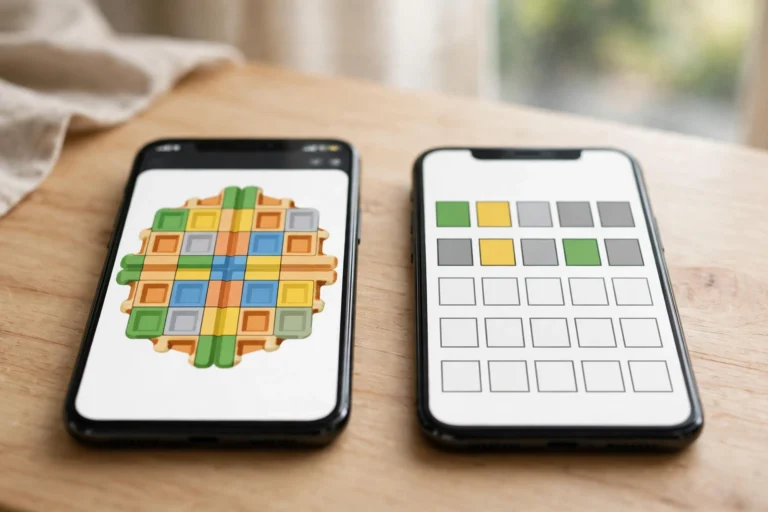
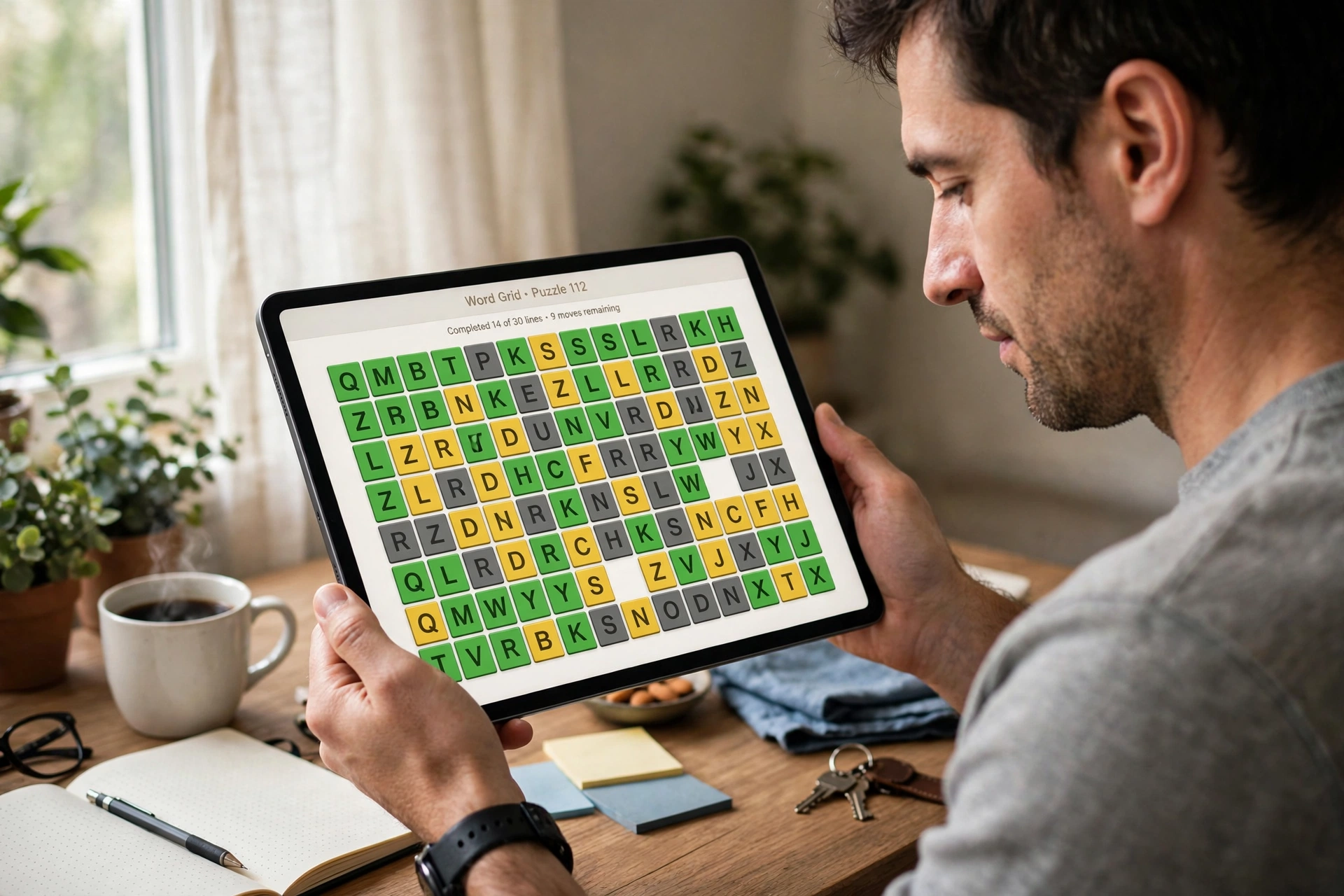
Deluxe Waffle Guide | Bigger Grid, 25 Swaps, and How to Win
Quick answer: Deluxe Waffle is the bigger, harder version of Waffle on this site. It uses a 5 by 6 grid with six words, three across and three down, and gives you 25 swaps instead of 15, plus 4 hints instead of 3. The colors work exactly the same way, green means right spot, yellow means right word wrong spot, grey means wrong word. There is no reset time and no star score on this site, so the swap count on the win screen is your own challenge to beat. The original game runs a different Deluxe, a weekly 7 by 7 grid with eight seven-letter words, and this guide covers both so you never mix them up.
If you can finish standard puzzles with swaps to spare, Deluxe is your next step. It is the same game you already know, stretched across a bigger board with more words crossing in more places. That sounds like a small change, but it changes how you have to think. On a standard board you can often solve one word at a time. On Deluxe, every swap touches more words, so planning two or three moves ahead stops being optional.
If you are new to the game, start with our beginner’s guide to Waffle first. It covers the rules, the colors and all three modes in plain language. If you already play the standard board, this guide will show you exactly what Deluxe changes, what it never changes, and how to win on the bigger grid.
What Is Deluxe Waffle?
Deluxe Waffle is the hard mode of Waffle. It takes the standard puzzle and makes it bigger in every direction: a bigger grid, more words, more crossings, more swaps and more hints. The goal never changes. Swap the letters until every row and column spells a real word, before your swap counter hits zero.
On this site, Deluxe uses a 5 by 6 grid with six words: three across and three down. You get 25 swaps and 4 hints. The board holds 24 letter tiles, against 19 on the standard board, and nine tiles sit where a row and a column cross, against six on the standard board. Those extra crossings are the whole story of Deluxe. More crossings mean more shared letters, more clues at any moment, and more ways for one careless swap to create a fresh problem in a word you were not thinking about.
The colors work exactly as they do on the standard board. Green means the letter is in the right spot and locked in place. Yellow means it belongs in that word but sits in the wrong spot. Grey means it does not belong in that word, and usually belongs in the word that crosses the same square. Our guide to what the colors mean in Waffle explains the green, yellow and grey feedback in detail, with board examples for each color.
Deluxe is free, with no account and no download, just like the rest of the site. It runs in your browser on desktop, laptop, tablet and phone. You can play it as many times as you like, because every board is generated fresh and at random. There is no weekly schedule here and no waiting for a new board. Finish a Deluxe puzzle and the next one is ready right away.
That last point matters, because Deluxe on the original game works very differently. The original game’s Deluxe is a weekly puzzle: one shared 7 by 7 board, eight seven-letter words, 25 swaps, and a new board every Monday. Players across the world solve the same Deluxe board in the same week, and their results can be compared. On this site, your Deluxe board is yours alone, and a reload gives you a different one. Both versions are called Deluxe, but they are different puzzles. The rest of this guide keeps them clearly apart.
Deluxe vs Standard: What Actually Changes
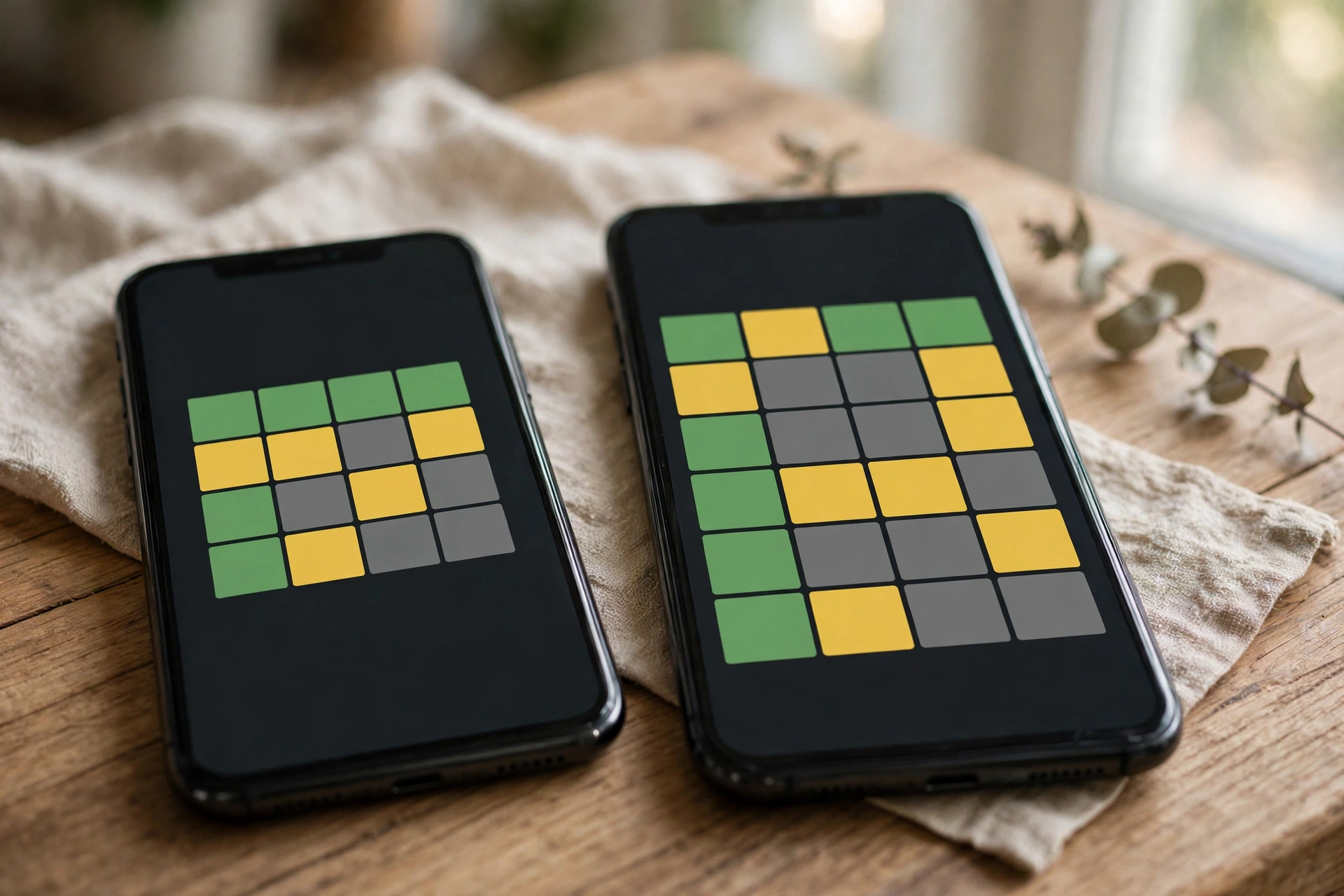
The fastest way to understand Deluxe is to put it next to the standard puzzle and see what is identical and what is different. On this site, the two modes are closer than most players expect, and the table below shows why.
| Detail | Standard | Deluxe |
|---|---|---|
| Grid | 5 by 5 | 5 by 6 |
| Words | 5 (3 across, 2 down) | 6 (3 across, 3 down) |
| Letter tiles | 19 | 24 |
| Crossing tiles | 6 | 9 |
| Swap limit | 15 | 25 |
| Hints | 3 | 4 |
| Colors | Green, yellow, grey | Green, yellow, grey |
| Board source | Fresh random board | Fresh random board |
| Reset time | None | None |
| Star score | None | None |
| Best for | Learning the color system | A harder challenge |
Read the table from top to bottom and the pattern is clear: nothing about the rules changes. The colors are the same, the swap mechanic is the same, and the hints work the same way. What changes is only the size. One more word, five more tiles, three more crossings, ten more swaps and one more hint.
That closeness is good news and bad news at the same time. The good news is that nothing you learned on the standard board goes to waste. The bad news is that the bigger board punishes the same mistakes harder. A rushed swap on a standard board costs you one move and maybe one word. A rushed swap on Deluxe can disturb two or three words at once, because more letters sit at crossings. Our guide to how many swaps you get in Waffle covers the 15-swap standard board and the 25-swap Deluxe board in detail.
One more difference is worth naming. On the standard board, you can sometimes brute force your way through: swap fast, read the new colors, swap again. On Deluxe, that approach runs out of swaps. Twenty-five sounds generous until you count the words. Six words means more letters to place, and every wrong swap is a move you will miss at the end. Deluxe rewards patience in a way the standard board does not demand.
This Site’s Deluxe vs the Original Game’s Deluxe
Deluxe exists on more than one Waffle site, and the versions are not the same. If you search the web for Deluxe guides, most of what you find describes the original game’s version, not this site’s. Here is the comparison in one place, so you never mix them up.
| Detail | This site (thewafflegame.uk) | Original game (wafflegame.net) |
|---|---|---|
| Grid | 5 by 6 | 7 by 7 |
| Words | 6 (3 across, 3 down) | 8 (4 across, 4 down), seven letters each |
| Letter tiles | 24 | 40 |
| Crossing tiles | 9 | 16 |
| Swap limit | 25 | 25 |
| Hints | 4 | Varies by site |
| Schedule | Fresh board on demand, no reset | Weekly, new board every Monday |
| Shared board | No, every player gets a different board | Yes, every player gets the same weekly board |
| Star score | None | Yes, 20 swaps or fewer earns 5 stars |
| Puzzle number | None | Yes, weekly numbers (game 233 ran November 9 to 15, 2026) |
The original game’s Deluxe is a much bigger puzzle. A 7 by 7 grid with eight seven-letter words and 40 letter tiles is nearly twice the size of this site’s Deluxe. Sixteen tiles sit at crossings, so almost half the board does double duty. The Deluxe page on wafflegame.co.uk puts it plainly: on that board there is no such thing as a free move, because sixteen letters are doing two jobs at once.
The star maths belongs to the original game only. The Deluxe guide on waffledailywordgame.com explains it clearly: every Deluxe grid on that site can be solved in exactly 20 swaps, so you have 5 to spare, and each spare swap left at the end is a star. Finish in 20 or fewer and you earn all five stars. That scoring does not exist on this site. There is no star award logic here, so never treat 20 swaps as a target set by this game. Your target here is simpler: finish the board before the counter hits zero, and use as few swaps as you can.
The weekly schedule belongs to the original game only, too. PuzzlesBay publishes a fresh Deluxe answers page every week, and its current page covers game 233, running November 9 to 15, 2026, with the next board arriving on Monday. On this site there is no weekly board to wait for, no Monday reset, and no puzzle number to look up. A Deluxe board is always one tap away, any day of the week.
Why does this matter? Because most Deluxe strategy guides on the web are written for the 7 by 7 board. Their tips about seven-letter words, sixteen crossings and the 20-swap star target do not apply to this site’s 5 by 6 board. The thinking habits transfer, but the numbers do not. Read any Deluxe guide with one question in mind: which version is this about?
How to Play Deluxe on This Site
Playing Deluxe takes the same four steps as the standard game, with a bigger board to manage. Here is the whole process, start to finish.
Step 1: Open the game and choose Deluxe. Go to thewafflegame.uk on any device. The game lists three modes: Daily, Unlimited and Deluxe. Pick Deluxe. A fresh 5 by 6 board appears at once, with 25 swaps and 4 hints, ready to play.
Step 2: Read the board before you touch a tile. Count the green tiles first. They are locked in place, and they are the frame everything else has to fit around. Then read the yellow tiles, because each one tells you a letter that belongs in its word. Then look at the grey tiles, because each one tells you a letter that belongs somewhere else, usually in the word that crosses the same square. On a Deluxe board this reading step matters more than on a standard board, because there are more tiles to track and more crossings to check.
Step 3: Swap two tiles at a time. Tap a tile, then tap another tile to trade places, or drag one tile directly onto another. Every swap counts as one move, so make it count. Green tiles are locked, so clicking one does nothing. Build around them instead of moving them.
Step 4: Finish before the counter hits zero. Fix the whole grid before your swap counter reaches zero. When you solve the puzzle, the win screen tells you how many swaps you used. If you run out of moves, an Out of Swaps panel appears, and you can tap Show Solution to reveal the correct grid and read a short definition for each answer word. Then tap Next Puzzle for a fresh board. Running out of moves never locks you out. A new puzzle is always one tap away.
That is the whole process. The controls are the same as the standard game, and the win and lose screens work the same way. The difference is all in the thinking: a bigger board, more words, and less room for careless swaps.
How the Colors Work on a Bigger Board
The color rules never change, but a bigger board gives them more room to confuse you. Here is how each color behaves on Deluxe, with the traps that catch players who jump up from the standard board.
Green tiles are finished, and on Deluxe there are usually more of them at the start. A standard board might start with four or five green tiles. A Deluxe board, with 24 tiles instead of 19, often starts with six or seven. That sounds helpful, and it is, but only if you use them. Map out which word each green tile belongs to before your first swap. A green tile at a crossing anchors two words at once, so it narrows two words down in a single glance.
Yellow tiles are the most useful color, and on Deluxe there are more of them. A yellow letter belongs in its word but sits in the wrong spot. With longer words in one direction and more tiles per word, a yellow tile has more possible homes than on a standard board. Narrow it down by crossing the yellow candidates against what you already know about the intersecting word. If a yellow tile sits at a crossing, check both words before you move it. The answer is often in the word you were not looking at.
Grey tiles do not belong in that word at all. On Deluxe, grey tiles are easy to ignore, because there are so many tiles competing for your attention. Do not ignore them. A grey tile belongs somewhere else on the board, usually in the word that crosses the same square. Follow every grey tile to its real home, because the letter it carries is often the key to a word that looks stuck.
Duplicate letters cause more trouble on Deluxe than on the standard board. Longer words and more tiles mean more chances for the same letter to appear twice. Remember the two rules from the homepage: the colors do not count copies, so a spare copy of a letter still shows yellow even when the word needs only one copy, and swapping two identical letters changes nothing on the board. Check before you move either one. Work out which words need that letter and where, then let the colors confirm it. Our daily sample puzzle shows a board with three copies of one letter, each with a different home, which is exactly the trap Deluxe sets most often.
One habit ties all of this together: read the board in words, not in tiles. Do not look at 24 separate tiles. Look at six words, and ask what each word still needs. A word with four green tiles needs one swap. A word with no green tiles needs a plan. That shift, from tiles to words, is the single biggest adjustment when you move to Deluxe.
The 25-Swap Budget: How to Spend It
Twenty-five swaps sounds generous. It is ten more than the standard board gives you. But Deluxe also gives you more to do: one extra word, five extra tiles and three extra crossings. The budget only feels generous if you spend it well. Here is how to think about it.
A good Deluxe solve uses pair swaps. A pair swap is one move that lands two letters in their correct spots at the same time. On a standard board, a 7-swap solve of a 14-tile scramble is the model: every swap fixes two letters. On Deluxe, the same maths applies at a bigger scale. If a board starts with 6 green tiles, 18 tiles still need placing, and 9 pair swaps would finish it. You have 25, so you have room for mistakes, but not unlimited room. Every single-letter swap you make is a pair swap you did not find.
Spend the first few swaps on the crossings. A crossing tile belongs to two words, so fixing one makes progress on two words at the same time. The nine crossing tiles on a Deluxe board are the highest-value tiles on the grid. Fix them early and the rest of the board opens up. Leave them for last and you will spend your final swaps untangling words that a single early crossing swap would have solved.
Keep a reserve. Do not spend your last five swaps on guesses. The last few swaps are the ones that finish the board, and they only work if the board is already nearly solved. Aim to reach the final three or four words with at least five swaps left. If you reach the endgame with two swaps left and two words unfinished, you have spent too much in the opening.
Count your swaps out loud as you play. It sounds simple, but it stops the most common Deluxe failure: looking up at the counter and finding it at zero with two words left. After every fifth swap, stop and read the board again. Are you ahead of the plan or behind it? If you have used 10 swaps and only two words are finished, slow down. The board is telling you that your plan needs work, not more speed.
The original game’s 20-swap star target is a useful benchmark for thinking, even though it does not apply here. On the original 7 by 7 Deluxe, 20 swaps is par, and each swap under 20 is a star. On this site, set your own par: finish a Deluxe board in 15 swaps or fewer, and you are solving it well. Finish in 12 or fewer, and you are solving it the way the best players do. Those numbers are goals to chase, not rules the game sets. The game only asks you to finish before the counter hits zero.
Deluxe Strategy That Actually Works

Strategy on Deluxe is the same set of habits you use on the standard board, applied with more discipline. Here are the six that matter most, in the order you should use them.
1. Count the greens before you move. Deluxe usually starts you off with a decent number of letters already locked in. Read those first. They are the frame everything else has to fit around. Map each green tile to its word before your first swap, and note which words have the most green. Those words are your starting points.
2. Go for the crossing squares. Nine tiles on this board sit in an across word and a down word at the same time. Fixing one is worth about two normal swaps, and on a 25-swap budget that is the whole game. Start your solve by looking at the crossings, not at the edges. If a crossing tile is green, two words are already anchored. If it is yellow, ask which of its two words it belongs to.
3. Finish the word that is closest. Find the word with the most green in it and complete that one first. Every letter you lock down takes options away from the words crossing it, which makes the rest easier. A finished word is not just one word done. It is three crossing letters confirmed for the words that meet it.
4. Save your swaps early. Early moves are the cheap ones, while the board is still open and the crossings are still free. Build a cushion before the board gets hard. If you can finish two words in your first six swaps, you have 19 left for four words, and the pressure is gone. If you spend ten swaps on the first word, the rest of the board will feel like a countdown.
5. Think in pairs, not single swaps. Before every swap, ask one question: can I fix two letters with this one move? Look for two yellow tiles in the same word that belong in each other’s places. Look for a grey tile in one word that belongs in the word it crosses. When you find a pair, make that swap first. A board that takes 18 single-letter swaps takes 9 pair swaps, and the difference is the gap between a struggle and a smooth solve.
6. Plan two or three moves ahead. On a standard board you can often solve one swap at a time. On Deluxe, that stops working. Before you make a swap, picture what the board will look like after it. Will the next swap be obvious, or will you have to think again? If the next swap is obvious, make the first one. If it is not, look for a different first swap. Planning ahead is what separates a Deluxe solve from a standard solve.
These six habits stack. Count the greens, fix the crossings, finish the closest word, save your swaps, think in pairs, and plan ahead. None of them is hard on its own. Together, they turn a board that looks overwhelming into a board that solves itself one pair at a time.
Hints on Deluxe: 4 Hints, Use Them Late
You get 4 hints on a Deluxe puzzle, one more than the 3 on a standard puzzle. A hint places one misplaced letter into its correct spot, which is often enough to unlock the rest of the board. The extra hint is there because the board is bigger and the stuck points come more often.
Use your hints late, not early. The best time to use one is when you are down to your last few swaps and one word still will not settle, or when two yellow letters keep trading places without landing. A single correct letter late in the puzzle is often the difference between solving it and running out of moves. A hint spent in the first five swaps is a hint you will miss in the last five.
There is one more good moment for a hint: when a crossing tile has you stuck. If a tile belongs to two words and you cannot decide which word it serves, a hint settles the question at once, and the answer unlocks both words. That is the highest-value hint on a Deluxe board, because it resolves two words for the price of one.
Do not use a hint to check a guess. If you think you know where a letter goes, make the swap. Swaps are cheaper than hints, because you have 25 of them and only 4 hints. Save the hints for the moments when the board has genuinely stopped making sense.
When Should You Switch to Deluxe?
Deluxe is the next step, not the first step. Jump in too early and the bigger board will punish the same mistakes Unlimited would have fixed. Here is a simple readiness check. If you can answer yes to all four, you are ready.
You finish most standard boards with swaps to spare. If your standard solves regularly end with 5 or more swaps left, your swap discipline is ready for a bigger board. If you usually finish with 1 or 2 left, stay on the standard board a little longer.
You can read a board’s colors without stopping to think. Green, yellow and grey should feel automatic. If you still have to remind yourself what yellow means, Deluxe will add confusion faster than it adds fun.
You solve corners first without being told. The corners-first habit is the core Deluxe skill, because crossings matter more on the bigger board. If you already start your standard solves at the crossings, you are already thinking the Deluxe way.
You can find a pair swap most of the time. Before every swap on the standard board, you ask whether one move can fix two letters. If that question is already a habit, Deluxe will reward it. If it is not, practise it on Unlimited first. Our Unlimited guide has five drills that build exactly this skill, and they transfer directly to Deluxe.
If you answered no to any of the four, do not worry. Spend a week on Unlimited, play a few boards a day, and check again. Deluxe will still be there. The board does not expire, and there is no weekly schedule to miss. When the standard board starts to feel routine, step up.
Common Mistakes on Deluxe
Deluxe forgives a lot, because 25 swaps feels like plenty. That forgiveness hides a few bad habits. Watch for these five.
Rushing because the budget feels big. Twenty-five swaps makes it tempting to swap fast and think later. That is the fastest way to burn the budget on a board that needed 12. Slow down. Read the colors before every swap, even when the counter still shows 20.
Solving one word in isolation. Every letter touches more than one word, so tunnel vision on a row can create a fresh problem in the word it crosses. On Deluxe, with nine crossings, that problem shows up faster and costs more to fix. Check the crossing word before every swap.
Ignoring grey tiles. A grey tile looks like a dead letter, but it belongs somewhere else on the board, usually in the word that crosses the same square. Players who ignore grey tiles keep trying to force them into the wrong word, and they waste swaps doing it. Follow every grey tile to its real home.
Wasting hints early. You get 4 hints on Deluxe, which feels generous. It is not. A hint spent in the opening is a hint you will miss in the endgame, when one correct letter is the difference between solving and running out of moves. Save them for the moments that matter.
Chasing the original game’s star target. Twenty swaps or fewer earns 5 stars on the original game’s Deluxe, but there is no star score on this site. Do not beat yourself up for finishing in 21 swaps, and do not treat 20 as a pass mark the game sets. Your target is to finish before the counter hits zero, and to use fewer swaps next time.
If any of these sound familiar, the fix is the same in every case: slow down, read the board, and let the colors tell you what to do. Our guide to getting 5 stars in Waffle explains the corners-first habit in detail, with a worked example, and our Waffle vs Wordle guide explains why Waffle rewards logic over guessing.
Frequently Asked Questions
What is Deluxe Waffle?
Deluxe Waffle is the bigger, harder version of Waffle. On this site it uses a 5 by 6 grid with six words, three across and three down, and gives you 25 swaps and 4 hints. The original game runs a different Deluxe, a weekly 7 by 7 grid with eight seven-letter words.
How many swaps do you get in Deluxe Waffle?
On this site, 25 swaps. That is 10 more than the standard 15-swap limit, which makes sense given how many more words are packed into the bigger grid. The original game’s Deluxe also gives 25 swaps.
Is Deluxe Waffle weekly?
On the original game, yes. Its Deluxe board is a weekly puzzle that resets every Monday, and every player gets the same board. On this site, no. Every Deluxe board is generated fresh and at random, so a new board is one tap away at any time, any day of the week.
How many stars do you need in Deluxe Waffle?
On the original game, finishing in 20 swaps or fewer earns all five stars, with each spare swap counting as one star. On this site there is no star score at all, so the swap count on the win screen is your own challenge to beat.
Is Deluxe Waffle harder than the standard game?
Yes. The board is bigger, with six words instead of five, 24 tiles instead of 19, and nine crossing tiles instead of six. The colors and the rules are identical, but the bigger board punishes rushed swaps and rewards planning two or three moves ahead.
How many hints do you get in Deluxe Waffle?
On this site, 4 hints, one more than the 3 on a standard puzzle. A hint places one misplaced letter into its correct spot. Use them late, when one word will not settle or two yellow letters keep trading places.
Can I play Deluxe Waffle on my phone?
Yes. It runs in your phone browser with no app to install. Tap a tile, then tap another tile to swap them, or drag one tile directly onto another. The bigger board fits any phone screen.
Conclusion
Deluxe Waffle is the same game you already know, stretched across a bigger board. The grid grows to 5 by 6, the words grow to six, the crossings grow to nine, the swaps grow to 25, and the hints grow to 4. The colors never change, the goal never changes, and the habits that win on the standard board are the habits that win here, applied with more discipline.
Remember which Deluxe you are playing. On this site, boards are fresh and random, there is no weekly schedule, no Monday reset, and no star score. On the original game, Deluxe is a weekly 7 by 7 puzzle where 20 swaps or fewer earns five stars. Both versions reward the same thinking, but their numbers are different, so read any Deluxe guide with that question in mind.
When the standard board starts to feel routine, step up. Count the greens, fix the crossings, finish the closest word, save your swaps, think in pairs, and plan ahead. Open the Waffle game and play your first Deluxe board now.