
90 Second Challenge Number Waffle and Waffle Royale Explained
Quick answer: The waffle 90 second challenge gives you 90 seconds to solve as many Waffle boards as you can, with the timer starting on your first swap. Number Waffle swaps letters for numbers, and you must arrange 1 to 7 in every row and column within 20 swaps. Waffle Royale is a premium daily puzzle that only supporters of the original game can play. All three are modes on the original game at wafflegame.net, not on this site, where the modes are Daily, Unlimited and Deluxe.
That last sentence matters, so let us say it again in plain words. If you open thewafflegame.uk, you will find three modes: Daily, Unlimited and Deluxe. You will not find a 90-second timer mode, a numbers mode, or a Royale mode there. The three modes in this guide live on the original game, which was created by James Robinson and is published by Waffle Studio. This guide explains all three exactly as the original game describes them, and it ends with what to play on this site instead, so you can practise the same skills here.
If you are still learning the basic game, read our beginner’s guide to Waffle first. It covers the colors, the swaps and the three modes on this site. Then come back here when you want something faster, stranger, or harder.
The Three Extra Modes at a Glance
The original game keeps its classic daily puzzle front and centre, and it puts the extra modes behind the same menu. Here is the short version of each one before we go deep.
| Mode | What You Do | Limit | How Often | Who Can Play |
|---|---|---|---|---|
| 90-Second Challenge | Solve as many Waffle boards as you can | 90 seconds | Any time | Everyone, free |
| Number Waffle | Arrange numbers 1 to 7 in every row and column | 20 swaps | Every day | Everyone, free |
| Waffle Royale | A premium daily puzzle | Not published | Every day | Supporters only |
The 90-second challenge is the only one of the three with a clock. Number Waffle is the only one with numbers instead of letters. Royale is the only one behind a paywall of sorts, and that paywall is a donation, not a subscription. Each mode tests a different skill, which is why players who get bored of the standard puzzle usually try them in that order: speed first, numbers second, Royale last. Insider Gaming’s guide to the game lists the same three modes, with Number Waffle and Royale as daily modes and the challenge available any time.
One more fact to keep straight. The star maths that most guides quote, 10 swaps is 5 stars and 15 swaps is 0 stars, belongs to the original game. This site does not award stars, so here the number that matters is simply how few swaps you needed. Our guide to getting 5 stars in Waffle explains how that scoring works on the original game and why it does not apply here.
The 90-Second Challenge: As Many Waffles as You Can
The 90-second challenge is the simplest mode to understand and the hardest to master. The original game describes it in one line: solve as many Waffles as you can in 90 seconds. Your time starts when you make your first swap, and you can make as many swaps as you like. The screen shows a counter that reads WAFFLES SOLVED, and it climbs by one every time you finish a board.
That is the whole rule set, and the whole appeal. There is no swap limit per board in the challenge, because the clock is the limit. There is no penalty for a slow board except the time it eats. There is no waiting for a new board, because the next one appears as soon as you finish the one in front of you. It is Waffle turned into a sprint.
How a Challenge Run Actually Plays
You start with a full board and a timer that reads 90 seconds, or 01:30. Nothing happens until your first swap. That matters more than it sounds. You can study the board for as long as you like before you touch a tile, because the clock has not started. Use that free time. Read the colors, count the green tiles, and find the trade-places pairs before you make your first move. Our guide on how many swaps you get in Waffle explains why pair swaps are the cheapest moves in the game, and they matter twice as much when the clock is running.
Once you swap, the timer runs. From here on, every second counts, and the game changes in three ways. First, you stop planning three moves ahead and start taking the obvious move in front of you. A pair swap that fixes two tiles is still the best move, but a single good swap beats a perfect plan that takes ten seconds to find. Second, you stop reading every color on the board and start reading only the word you are working on. Tunnel vision is a mistake in the standard game, but in a 90-second sprint it is a survival skill, because finishing one board fast is worth more than solving one board beautifully. Third, you accept that some boards will be slow. A board with no obvious pairs and a duplicate letter trap can eat 30 seconds on its own. There is no skip button described in the rules, so you finish the board in front of you or you watch the clock run out on it.
When the timer hits zero, the run ends and the counter shows how many boards you solved. That number is your score. There is no published leaderboard in the rules, and no star rating for a challenge run. The score is yours to beat next time, and that is the whole game.
How to Get Faster Without Getting Sloppy
Speed in the challenge comes from the same habits as the standard game, just done faster. The first habit is reading the board before the clock starts. Those free seconds before your first swap are the only planning time you get, so spend them well. Find the green tiles, find the pairs, and decide your first three swaps before you touch anything.
The second habit is swapping in pairs. When two yellow tiles in one word sit in each other’s places, swapping them fixes both at once, which is the cheapest move on any board. In the standard game that saves swaps. In the challenge it saves seconds, because one move fixes two tiles and you never have to come back to that word. If you only learn one speed skill, learn this one.
The third habit is trusting the colors instead of re-reading them. A green tile is locked and correct, so never look at it again. A yellow tile belongs in its word, so it only needs a new spot inside that word. A grey tile belongs somewhere else, so move it out and let the word it crosses tell you where it goes. Players who re-check green tiles waste the most time, because green tiles never change.
The fourth habit is keeping your hands on the board. On a phone, tap two tiles to swap them. On a desktop, drag one tile onto another. Either way, the move is one gesture, and the fastest players make the next move while they are still reading the result of the last one. That sounds rushed, and it is, but the challenge rewards it. A swap that fixes one tile now is better than a swap that fixes two tiles after a five-second think.
The fifth habit is knowing when to slow down. A duplicate letter trap, where the same letter appears twice and only one copy belongs in a word, is the classic way to lose ten seconds in the challenge. If two identical letters are both yellow in the same word, stop and count before you swap either one. Our guide to what the colors mean in Waffle covers the duplicate trap in full, with board examples. One careful second there saves a wasted swap and the seconds it costs to undo it.
Who the Challenge Suits
The challenge suits players who already solve standard boards comfortably and want pressure instead of a puzzle. If you still need 14 swaps to finish a standard board, the challenge will feel like panic, not fun. If you regularly finish in 8 or 9 swaps, the challenge is the next step, because your hands already know the moves and the clock just makes them faster. It also suits players who like short sessions. A run lasts 90 seconds, so it fits into a coffee queue or a bus stop in a way that a slow Deluxe board does not.
Number Waffle: Numbers Instead of Letters
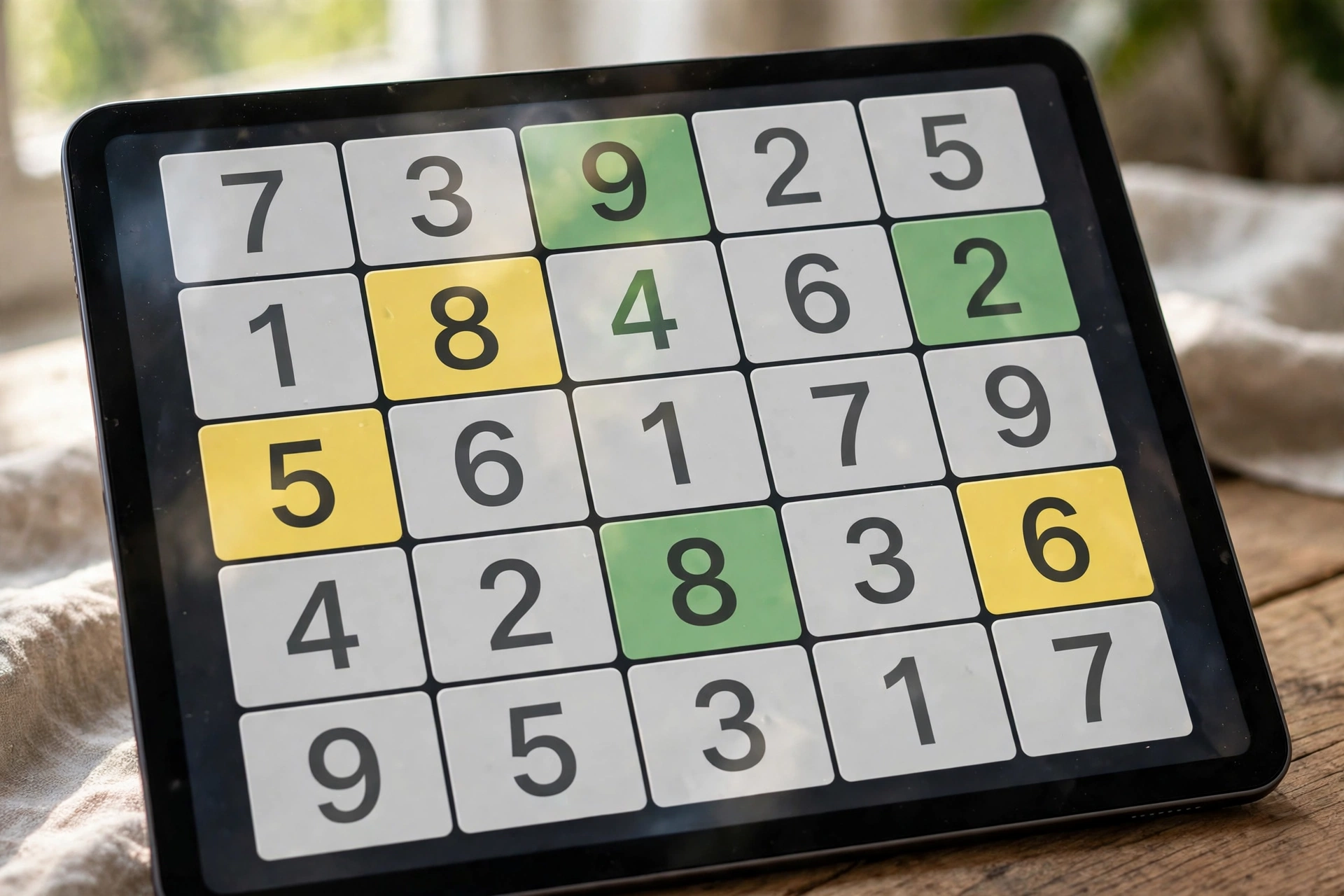
Number Waffle is the strangest of the three modes, because it drops words entirely. The original game describes it like this: solve the Number Waffle in 20 swaps or fewer. Every Number Waffle can be solved in a minimum of 15 swaps. You earn a star for every swap you have remaining after the Number Waffle has been solved. Rearrange the numbers so that every row and every column contains the numbers 1 to 7 in any order. The circles contain the sum of the numbers that they are pointing to.
Read that again, because the goal is completely different from the word game. There are no words, no letters, and no colors that mean right word or wrong word. There are only numbers, rows, columns, and sums. If you like Sudoku, you will recognise the shape of the puzzle at once. If you only like word games, Number Waffle will feel like a different game wearing a Waffle costume, and that is a fair description.
How the Board Works
The Number Waffle board is a 7 by 7 grid, bigger than the 5 by 5 word board. Every row and every column must end up holding the numbers 1 to 7, each number exactly once, in any order. That is the win condition. The numbers start scrambled, and you swap two numbers at a time, just like swapping two letters in the word game. You have 20 swaps, and every puzzle can be solved in 15, so you have 5 spare swaps to play with. A star is earned for every swap you have left when the board is solved, which is the same star maths as the word game: finish in 15 swaps and you earn 5 stars.
The circles are the clue system. Each circle sits beside a row or a column and holds the sum of the numbers it points to. That is the only extra information the board gives you. Dailydle’s Number Waffle page lists the same limits: 20 swaps, solvable in 15, and a star for every swap left over. The original game gives an example row of 2, 7, 5, 4, 6, 1, 3, which adds up to 28, and it notes that in the example the 7 and the 4 are in their correct places while the other numbers are not, so those cells must hold different numbers. The colors work the same way as the word game: a number in its correct place is highlighted, and the rest need moving.
How to Read the Sum Clues
The sum clues are the whole puzzle. A row of the numbers 1 to 7 always adds up to 28, because 1 plus 2 plus 3 plus 4 plus 5 plus 6 plus 7 is 28. So a circle that points to a full row should read 28 when the row is solved. A circle that points to part of a row, or to a set of cells, reads the sum of just those cells. That gives you arithmetic to work with instead of vocabulary.
Here is how that helps in practice. If a circle says the numbers it points to add up to 10, and it points to two cells, then those two cells must hold numbers that add to 10, like 3 and 7, or 4 and 6, or 5 and 5. But 5 and 5 is impossible, because each number appears only once in a row, so the pair must be 3 and 7, or 4 and 6. That narrows two cells to four possible numbers in one step. If a circle says a single cell adds up to 7, then that cell is 7, and you have placed a number without swapping anything yet.
The same logic works backwards. If a row already holds a 7 and a 6, and the circle for the remaining cells reads 15, then the missing numbers must add to 15, which limits them to combinations like 1 and 14, which is impossible, or 2 and 13, which is impossible, or 3 and 12, which is impossible, so the row must be wrong somewhere. That kind of check catches a mistake before you spend swaps on it. It is slow, careful work, and it is the opposite of the 90-second challenge. Number Waffle rewards patience, not speed.
Number Waffle Strategy in Five Steps
First, lock in the numbers the colors already confirm. A number in its correct place is the same as a green letter in the word game: leave it alone and build around it. The original game’s example has the 7 and the 4 already correct, and those two numbers anchor the whole row.
Second, use the sums to place the big numbers. The numbers 6 and 7 are the hardest to hide, because they change any sum they touch by a lot. If a circle reads a small total, the big numbers cannot be in the cells it points to. If a circle reads a large total, at least one big number must be there. Work from the extremes inward.
Third, treat each row and column like a Sudoku line. Every row needs 1 to 7 exactly once, and every column needs the same. If a row already has a 3, then no other cell in that row can be 3, and the 3 in that row also blocks the 3 in its column. That is the same crossing logic as the word game, where a tile at a crossing belongs to two words at once. Our Deluxe guide explains crossing logic on a bigger board, and the same thinking applies here.
Fourth, spend your spare swaps on certainty, not on guesses. You have 20 swaps and the puzzle needs 15, so you can afford 5 swaps that turn out to be wrong. That sounds generous, and it is, but a wrong swap in Number Waffle is harder to spot than a wrong swap in the word game, because there are no yellow tiles telling you a number belongs in the row. Only the sums tell you, and a sum only speaks after you do the arithmetic. So check the sums before you swap, not after.
Fifth, finish the rows with the most numbers already placed. A row with five numbers correct needs only two swaps to finish, and those two swaps are usually a pair trade, the same cheap move as the word game. A row with two numbers correct needs five swaps and a lot of arithmetic. Always work the fullest row first, because it gives you the most information for the least effort.
Who Number Waffle Suits
Number Waffle suits players who like Sudoku, arithmetic, or logic puzzles more than word games. It suits players who found the word game too much about vocabulary and want a puzzle where every clue is a number. It does not suit players who want a quick game, because a Number Waffle board takes longer than a word board, and the arithmetic slows everyone down at first. Give it three or four boards before you judge it. The sums start to read like words after a while, and the speed comes with practice.
Waffle Royale: The Supporters Only Daily Puzzle
Waffle Royale is the most mysterious of the three modes, and the mystery is deliberate. The original game’s own page says it plainly: “My sincere apologies. The Waffle Royale is only available to supporters. Please consider supporting us with a one-off donation to get access to this daily treat!” The mode’s own tagline is just as short: “Enjoy the premium daily treat.”
That is almost everything the original game says about Royale in public. It is a daily puzzle, like the classic daily Waffle. It is premium, which means it is not part of the free game. And it is only for supporters, which means players who have made a one-off donation to Waffle Studio. There is no subscription price published on the page, no list of what makes the Royale board different from the standard board, and no sample board to look at without access.
What We Know, and What We Do Not Know
What we know is this. Royale is a daily puzzle, so it changes once a day like the classic game. It is only for supporters, so free players cannot open it. Access comes from a one-off donation, not a monthly payment. And the original game calls it a daily treat, which suggests it is a nicer or harder version of the standard puzzle rather than a different game entirely.
What we do not know, and will not guess, is the board size, the word count, the swap limit, or the star scoring for Royale. None of that is published on the public page, and inventing it would be wrong. If you see another site claiming to know Royale’s exact rules, treat that claim with care unless it links to the original game’s own page. The honest answer is that Royale’s details are only visible to supporters, and this guide will not pretend otherwise.
Is Royale Worth a Donation?
That is a personal call, and it depends on what you want. If you play Waffle every day and you want to support the maker, James Robinson, then a one-off donation buys you a daily puzzle that most players never see, and it supports the game you already enjoy. If you only want more puzzles to play, then the free modes give you plenty: the standard daily puzzle, unlimited boards, Deluxe, the 90-second challenge, and Number Waffle. Royale is a treat, not a necessity, and the original game describes it that way itself.
One thing to note for players on this site: there is no Royale mode on thewafflegame.uk, and no donation link for it here. This site is an independent fan version, not the original game, and it is not connected to Waffle Studio. A donation to the original game does not unlock anything on this site, and playing here does not give you access to Royale there. The two are separate.
Puzzle Packs: Ten Waffles at a Time
There is one more extra on the original game’s menu that players often miss: puzzle packs. The original game describes them like this: “Welcome to our special puzzle packs. Each pack contains ten Waffles to scoff. Achieve five stars in every Waffle to reach 100% completion!”
A puzzle pack is ten standard Waffle boards in a row, played one after another. Each board uses the same rules as the classic game: 15 swaps, solvable in 10, a star for every swap left over. To finish a pack at 100 percent, you need 5 stars on all ten boards, which means solving every board in 10 swaps or fewer. That is a serious challenge. A single 5-star board is a good day for most players. Ten in a row is a test of consistency, not luck.
Puzzle packs suit players who have finished the daily puzzle and want more of the same, without the pressure of a timer or the arithmetic of Number Waffle. They are also the best way to practise for the 90-second challenge, because ten boards in a row builds the same speed and pattern recognition, just without the clock. If you can clear a pack with an average of 12 swaps per board, you are ready for the challenge. If you average 14, keep practising in Unlimited mode first.
Which Extra Mode Should You Play First?
The three modes test different skills, so the right first mode depends on what you are good at and what you want to improve. Here is a simple way to choose.
If you want speed and excitement, start with the 90-second challenge. It uses the exact same board and rules as the standard game, so there is nothing new to learn, only a clock to beat. It is the easiest extra mode to start and the hardest to master, because the skill ceiling is your own reaction time.
If you want a new kind of thinking, start with Number Waffle. It drops words entirely, so your vocabulary does not matter, only your arithmetic and your logic. It is slower than the word game, and the first few boards feel strange, but it is the most different of the three, and that is its charm.
If you want something exclusive, consider Royale, but only after you have played the free modes for a while. A donation for a daily puzzle you cannot preview is a leap of faith, and the free game already gives you five modes to enjoy. Support the maker because you love the game, not because you expect Royale to change how you play.
If you want a long session with a clear goal, try a puzzle pack. Ten boards at 5 stars each is the most demanding goal on the original game, and finishing a pack at 100 percent is a better badge than any single fast time.
What to Play on This Site Instead
None of the three modes in this guide exist on this site, so here is the honest map of what does. Thewafflegame.uk has three modes: Daily, Unlimited and Deluxe. Daily is a 5 by 5 board with five words and 15 swaps. Unlimited is the same board, as many times as you like, with a fresh board every time. Deluxe is a bigger 5 by 6 board with six words and 25 swaps. There is no shared daily puzzle here, no midnight reset, and no star score, so every board is yours alone and the swap count is your own challenge.
If the 90-second challenge tempted you, the closest practice here is Unlimited mode. Play ten boards in a row and time yourself with your phone. It is not the same as a built-in timer, but it builds the same speed, and you can set your own target, like ten boards in fifteen minutes. Our Unlimited guide explains how to use it for practice without touching any streak, and it answers the question players ask most: whether Unlimited affects your daily progress.
If Number Waffle tempted you, the closest practice here is Deluxe mode. It is still a word game, not a numbers game, but the bigger board forces the same kind of planning: more crossings, more words to track at once, and more reason to plan two or three swaps ahead. Our Deluxe guide walks through the 5 by 6 board and the 25-swap limit in full.
If Royale tempted you, there is no equivalent here, and we will not invent one. The closest thing is the daily sample puzzle series on this blog, which gives you a fresh board with hints and a full solution every morning. Yesterday’s sample puzzle is a good place to start, and today’s sample is live now.
And if you just want to get better at the standard game before trying any extra mode, read our guide on when a new puzzle arrives. It explains the one fact that surprises new players most: there is no midnight wait on this site, because every board is generated fresh on demand.
Frequently Asked Questions
Is the 90-second challenge free to play?
Yes. The 90-second challenge is free on the original game at wafflegame.net. You get 90 seconds, the timer starts on your first swap, and you solve as many Waffle boards as you can. There is no swap limit per board in the challenge, because the clock is the limit.
How many swaps do you get in Number Waffle?
You get 20 swaps, and every Number Waffle can be solved in 15 swaps, so you have 5 spare swaps. You earn a star for every swap you have left when the board is solved. The goal is to arrange the numbers 1 to 7 in every row and column, using the sum circles as clues.
What do the circles mean in Number Waffle?
Each circle holds the sum of the numbers it points to. A full row of the numbers 1 to 7 always adds up to 28, so the circles tell you which numbers belong in a set of cells by arithmetic. Use the sums to narrow down where the big numbers like 6 and 7 must go.
Can I play Waffle Royale for free?
No. Waffle Royale is only available to supporters of the original game, and access comes from a one-off donation to Waffle Studio. The original game’s own page says so plainly. There is no free way to open it, and no Royale mode on this site.
Are the 90-second challenge and Number Waffle on this site?
No. This site has three modes: Daily, Unlimited and Deluxe. The 90-second challenge, Number Waffle, Waffle Royale and puzzle packs are modes on the original game at wafflegame.net. You can practise the same skills here in Unlimited and Deluxe mode, but the extra modes themselves live on the original game.
Do the extra modes affect your daily streak?
On the original game, only the shared daily puzzle moves the streak, so the extra modes do not affect it. On this site there is no streak at all, because there is no shared daily puzzle and every board is generated fresh. Playing Unlimited or Deluxe here never touches anything, because there is nothing to touch.
Conclusion
The original Waffle game has three extra modes beyond the classic daily puzzle, and each one tests a different skill. The 90-second challenge tests speed: 90 seconds, as many boards as you can, timer starting on your first swap. Number Waffle tests arithmetic: numbers 1 to 7 in every row and column, 20 swaps, sum circles as your only clues. Waffle Royale tests nothing except your willingness to support the maker, because it is a premium daily puzzle for supporters only, unlocked by a one-off donation. Puzzle packs add a fourth challenge for the patient: ten boards, 5 stars each, 100 percent completion.
None of the four exist on this site, and that is worth saying one last time, because a guide that pretends otherwise would be wrong. This site has Daily, Unlimited and Deluxe, and those three modes are enough to learn every skill the extra modes demand: speed in Unlimited, planning in Deluxe, and patience in both. Try the extra modes on the original game when you are ready, and come back here to practise. Fresh boards will keep coming, and the habits you build here, reading the board first, counting what each word needs, and spending swaps only on pairs, travel with you to every mode.