Waffle Tips | 10 Tips to Master Daily Word Swaps
Quick Answer
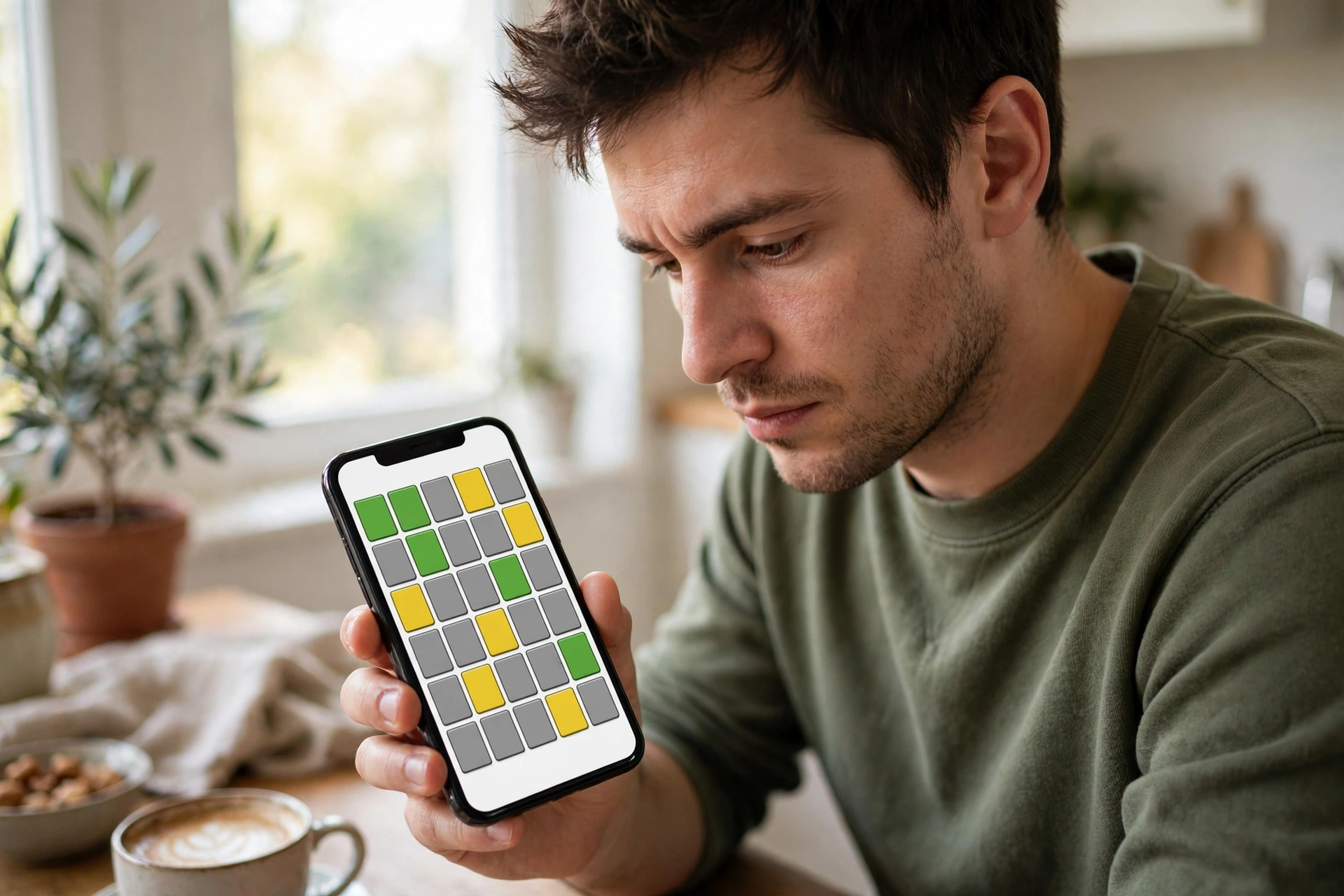
These waffle tips help you solve the 5-word board in fewer swaps. Scan the whole board first, trust your green tiles, trade pairs that belong in each other’s spots, solve the corners early, and name each word before you move letters. With those habits, plus smart practice in Unlimited mode, most boards feel calmer, clearer, and much easier to finish.
Introduction
If Waffle sometimes feels like a pile of mixed up letters, you are not alone. The board looks small, but every letter pulls in two directions at once. It has to fit an across word and, in some spots, a down word too. One careless swap can fix one word and break another. That is why good players do not rush. They look, they plan, and then they move with a reason.
These waffle tips are written for the board you actually play here on thewafflegame.uk. That matters, because a lot of advice online describes a different board. Many guides describe the original game, which has six words, 21 tiles, and nine crossings. This site has five words, 19 tiles, and six crossings. The habits still rhyme, but the shape is different, so the plan has to fit this shape.
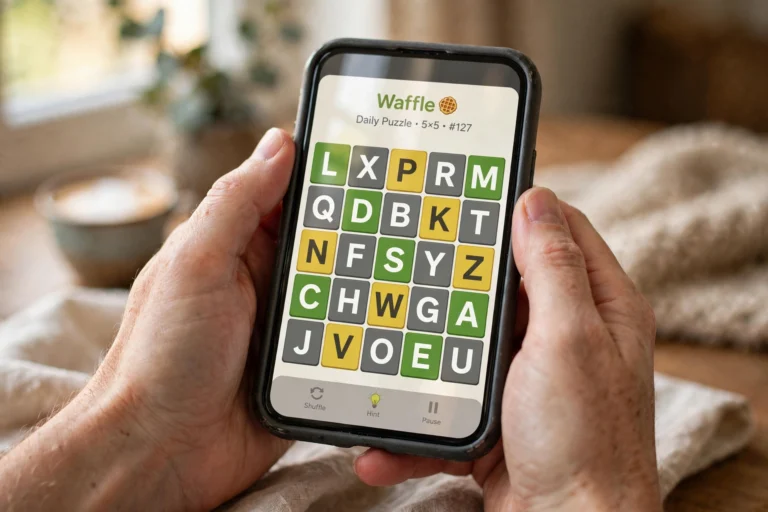
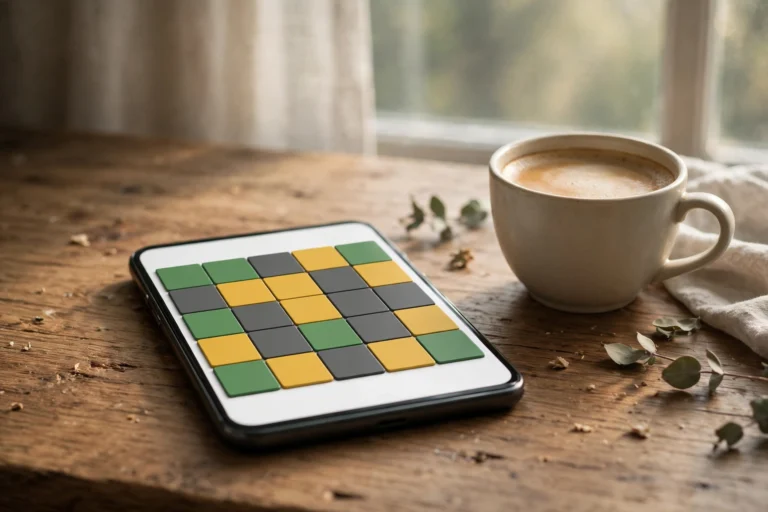
Here is the board in plain words. You get a 5 by 5 grid with five five-letter words. Three words run across, on the top row, the middle row, and the bottom row. Two words run down, on the left edge and the right edge. The six spots where an across word meets a down word are the four corners plus the two ends of the middle row. The center tile belongs to the middle across word only. There is no down word through the middle. That one fact changes how you read the board, and it will come up again in the tips below.
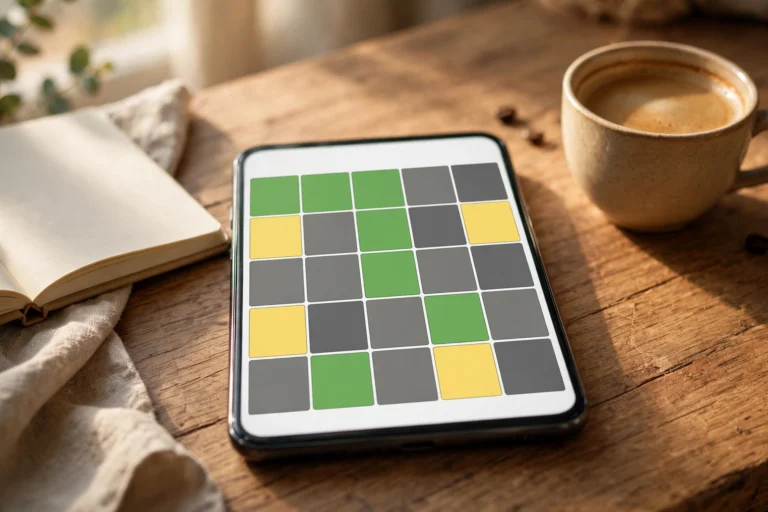
You get 15 swaps on a standard board. Green tiles lock in place and show a letter that is right and in the right spot. Yellow tiles show a letter that belongs in that word but sits in the wrong spot. Grey tiles show a letter that does not belong in that word. A grey tile can still belong in the crossing word, so do not throw it away in your head too fast. That is a common beginner mistake, and Tip 8 covers it in full.
There is no star score on this site, no streak, no shared daily puzzle, and no reset time. Every player gets a fresh board on demand. The original game is different. In the original game, every puzzle is solvable in 10 swaps, 10 swaps earns 5 stars, 15 swaps earns 0 stars, and the puzzle resets at midnight GMT. Those numbers belong to the original game only. Here, your swap count is a personal challenge. You can aim lower each time you play, and you can compare your own best runs, but there is no star award waiting at 10 swaps.
Today’s sample board is a good place to see these ideas in action. It hides TWINS, PLATE, and STEAL across the three rows, and TAPES and SMELL down the two edges. The left edge spells TAPES from top to bottom, and the right edge spells SMELL from top to bottom. The top row starts with T from TAPES and ends with S from SMELL. The middle row starts with P from TAPES and ends with E from SMELL. The bottom row starts with S from TAPES and ends with L from SMELL. Every corner does double duty. That is why corners matter so much, and why Tip 5 tells you to solve them first. You can try that board for practice in today’s sample puzzle, and you can warm up with yesterday’s sample puzzle if you want a second board before you start.
If you are brand new, start with how to play Waffle, the beginner’s guide before you dive into strategy. It covers the rules, the colors, and the swap button in simple steps. If you already know the rules, stay here. The 10 tips below build on each other in order. Tip 1 slows you down. Tips 2 to 5 give you a move order. Tips 6 to 9 fix the mistakes that waste the most swaps. Tip 10 tells you how to practice so the habits stick.
How This Board Is Different, And Why It Changes Your Plan
Before the tips, it helps to lock in the shape of this board, because most wasted swaps come from playing the wrong shape in your head.
On this site, the across words are the top row, the middle row, and the bottom row. The down words are the left column and the right column. There are 19 tiles in play, not 25, because the board is a waffle shape with gaps. The 19 tiles include the six crossings, the center tile of the middle row, and the middle tiles of the top and bottom rows that belong to across words only.
Think of the board in three kinds of spots. Corner spots belong to one across word and one down word. End spots on the middle row also belong to one across word and one down word. All other spots belong to one word only. The center tile is a good example. It sits in the middle of the middle row, in the word PLATE on today’s sample board, and it does not touch a down word at all. A letter in the center only has to please one word. A letter in a corner has to please two words at once. That is why a corner letter is harder to place, and also more valuable once it is right.
Many online guides tell you to watch the center column. On the original six-word board, that advice makes sense, because the middle column is a full down word with five letters. On this site, there is no center column word. If you spend your early swaps hunting for a middle column word that does not exist, you will waste moves and get confused. The same goes for crossing counts. The original board has nine crossings. This board has six. So when a guide says to lock nine crossings first, translate it in your head to six crossings here: four corners plus the two middle-row ends.
Swap math also changes in how you talk about it. The original game gives 15 swaps and calls 10 swaps par, with 5 stars at 10 swaps and 0 stars at 15 swaps. That is a neat scoring story, and it is true for the original game. This site also gives 15 swaps on a standard board, but it does not award stars. So do not chase a star target here. Chase a clean solve. A clean solve means few wasted moves, no late surprises, and a board that makes sense from the first scan to the last swap. If you finish in 11 or 12 swaps with a clear plan, that is a strong result. If you finish in 14 swaps after guessing, that is a sign to slow down next time, not a failed star run.
If you want the full rulebook on colors and swaps, read what the colours mean in Waffle and how many swaps you get in Waffle. Those two pages cover the basics in short form, so this article can stay focused on how to use the rules well.
Now, the 10 tips.
Tip 1: Scan the Whole Board Before Your First Swap
The best swap is often the one you do not make yet. Spend the first 20 to 30 seconds just looking. Do not touch a tile. Read each row left to right, then read each edge column top to bottom. Say the near words out loud in your head, even if they are messy. Your brain is good at spotting real words hiding inside jumbled letters, but only if you give it a quiet moment to work.
Start with the top row. What letters are there? Can you see the start of a word? Now check the middle row, then the bottom row. Then check the left edge and the right edge. Look for green tiles first, because they are fixed clues. Then look for yellow tiles, because they tell you which letters belong in that word even if they sit in the wrong place. Then look for grey tiles, and note which ones might belong in the crossing word instead.
Here is a worked mini-example on today’s sample board. The solved rows are TWINS, PLATE, and STEAL. The solved edges are TAPES on the left and SMELL on the right. Now imagine the board is shuffled, and the top row shows S, N, I, W, T in that order. At first glance it looks like noise. But if you scan slowly, you can see the letters for TWINS are all there, just out of order. The T sits at the end, the W sits in the middle, and the S sits at the start. A quick scan tells you the top word uses T, W, I, N, and S. That is a full set. You do not need to guess a new word. You need to sort the letters you already have.
Now scan the left edge in the same shuffled board. Suppose it shows S, E, P, A, T from top to bottom. Those are the letters for TAPES, just out of order. The T at the bottom belongs at the top. The S at the top belongs at the bottom. The middle letters need a small shuffle. If you had swapped in a hurry, you might have moved that top S into the top row and broken the edge word. A full scan stops that mistake, because you can see the S belongs to both the top row and the left edge, and its home is the bottom left corner, not the top left corner.
A good scan also tells you where the hard spots are. Look for rows with no green tiles. Those rows need the most thought. Look for rows with two or three green tiles. Those rows are close to done, and they can anchor the edges. Look for a letter that appears twice in one word. Duplicates are easy to miss in a fast scan, and they cause a lot of wasted swaps later. Tip 7 covers duplicates in detail, but the scan is where you first notice them.
Try this routine on your next three boards. First, read the three across words. Second, read the two down words. Third, count the green tiles and name the words that feel closest. Fourth, pick your first swap only after that. Most players find that the pause feels slow at first and then feels fast, because the first swap is right more often and the rest of the board falls into place with fewer fixes.
If you catch yourself swapping in the first five seconds, stop and reset your habit. Put your finger down, look again, and ask one question: what word am I trying to build here? If you cannot name the word, you are not ready to swap yet. That one question saves more swaps than any trick in this article.
Tip 2: Start From the Green Tiles
Green tiles are your anchors. A green tile means the letter is right and in the right spot. It will not move, and you can build around it. When a board gives you two or three green tiles in one word, that word is telling you its shape. Use it.
Say the middle row shows P in the first spot in green, A in the third spot in green, and the other spots are yellow or grey. On today’s sample board, the middle word is PLATE. The P at the start and the A in the middle already point to PLATE, or to a close cousin like PLACE or PLANE. The green letters narrow the word down fast. You do not need to try every P word in the book. You need to test the few words that fit P, blank, A, blank, blank, and check them against the edge letters at both ends.
Green tiles also help the crossing words. The P in the bottom left of the middle row is also the third letter of TAPES on the left edge. Once P is green in the middle row, you know the third letter of the left edge is P as well. That is free information. The same is true in reverse. A green tile in a corner helps two words at once, so a green corner is worth more than a green tile in the middle of the top row, which helps only one word.
Here is a worked mini-example. Imagine the bottom row shows S in green at the start, A in yellow, T in yellow, E in yellow, and L in green at the end. The solved bottom word is STEAL. The green S and L frame the word. You know the word starts with S and ends with L. The yellow A, T and E belong in the word but sit in the wrong spots: A belongs fourth, T belongs second, and E belongs third. So the smart move is to sort those three letters inside the row, starting with the A and T trade, and leave the green ends alone. The green ends make that plan clear. Without them, you might have chased the letters as if the word were still a mystery.
A common mistake is to ignore green tiles and keep shuffling the whole board. That wastes swaps and breaks words that were already close. Another mistake is to treat a green tile as a hint instead of a fact. Green is not a guess. It is locked. Build around it with trust.
If a board has almost no green tiles, do not panic. Look for the word with the most yellow tiles instead. Yellow still tells you the letters belong in that word. Green is the best anchor, yellow is the second best, and a word with four yellows is often one clean sort away from done. For more on how green tiles lock, see are green tiles locked in Waffle. It explains the lock rule in plain terms and clears up the common worry that a green tile might still move.
Practice this tip by naming the anchor word out loud before each swap. Say, “PLATE is anchored by P and A,” or, “STEAL is framed by S and L.” If you cannot name the anchor, look again. The name is the plan.
Tip 3: Hunt Trade-Places Pairs First
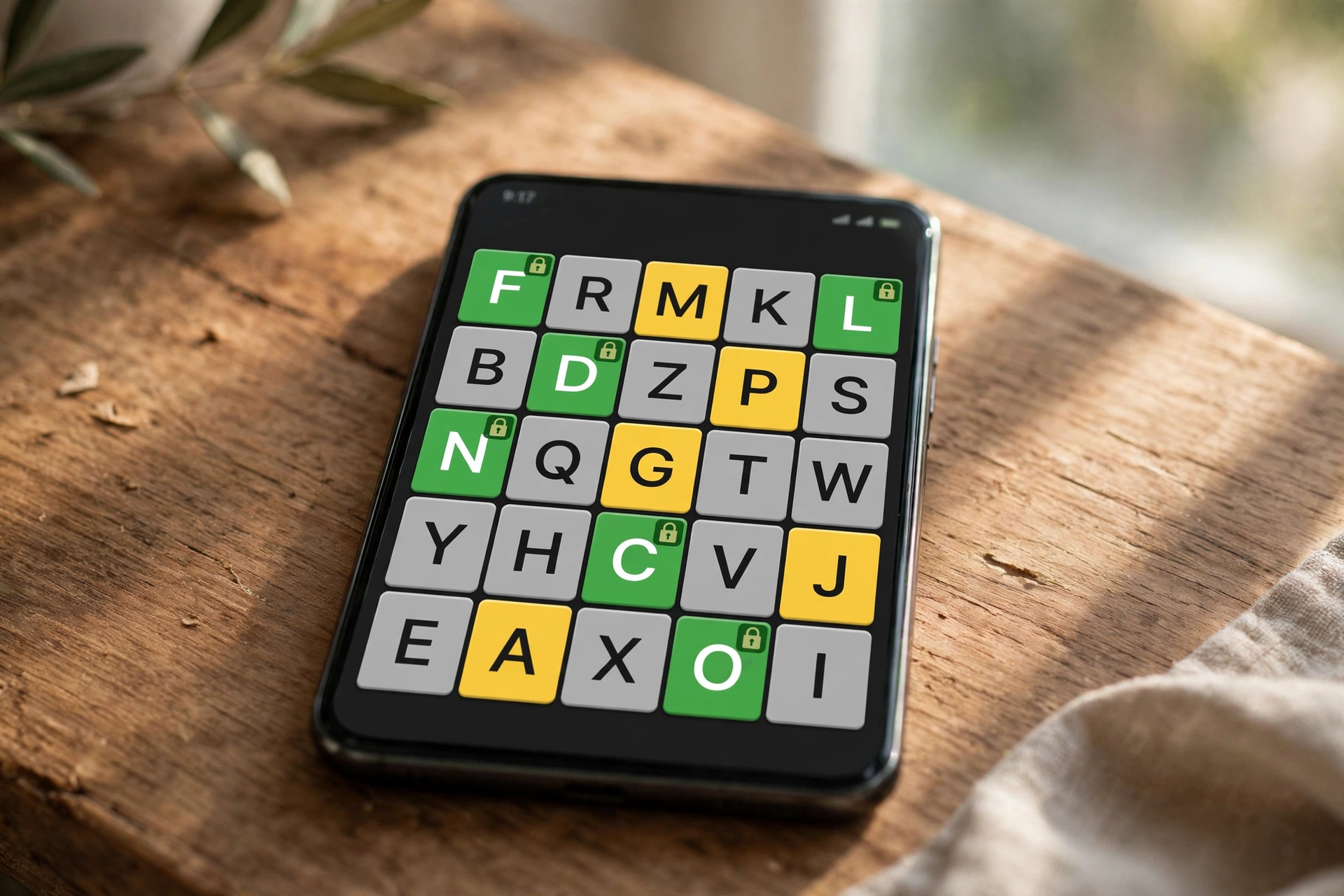
A trade-places pair is the cheapest fix in Waffle. Two tiles sit in each other’s spots. Swap them once, and both land home. One swap fixes two letters. That is the best value you can get, and good players hunt for these pairs before they do anything else.
Look for them after your scan. A pair often shows up as two yellow tiles that seem to point at each other. For example, in one word, the letter T sits where A should go, and the letter A sits where T should go. Swap T and A, and both turn green. You spent one swap and fixed two spots. Compare that with moving one letter at a time through a spare spot, which can cost two or three swaps for the same result.
Here is a worked mini-example on today’s sample board. The middle word is PLATE. Imagine the middle row shows P, T, A, L, E in shuffled order, with P green at the start, A green in the middle, and E green at the end. The two middle letters are T and L, but they sit in the wrong order. The row reads P, T, A, L, E, and it should read P, L, A, T, E. The T and L have traded places. One swap of T and L fixes both. That is a trade-places pair, and it is the first swap to make.
Trade pairs also hide across words. A letter in the top row might belong in the bottom row, and a letter in the bottom row might belong in the top row. If those two letters sit in matching spots, one swap can fix both rows at once. This is where the edge words help. If the left edge word is TAPES, and the top left corner holds S while the bottom left corner holds T, those two letters have traded places between the top and bottom rows. Swap them, and the top row gets its T and the bottom row gets its S, while the left edge gets closer to TAPES as well. One move, three words improved.
To find pairs, ask two questions for each yellow tile. First, where does this letter belong? Second, what letter sits in that home spot now, and where does that letter belong? If the answer to the second question points back to the first spot, you have a pair. Make that swap now.
Be careful with one trap. A pair can look like a trade when it is not. If two yellow letters belong in the same word but not in each other’s spots, swapping them will not fix either one. It will just move the problem around. Check the home spots before you swap. Name both homes out loud. If both homes match, swap. If only one home matches, hold off and look for a three-tile loop instead, which is Tip 4.
Guides like the SolveWordGames strategy guide describe these two-way swaps as a core skill, and they are right. You can read their take on SolveWordGames Waffle strategy for a second view. Their board is the six-word original, so translate their examples to five words here, but the pair logic is the same. A clean pair is always the cheapest move on any board.
Make pair hunting a habit. After your scan, spend ten seconds looking only for pairs. Circle them in your mind. Do the clearest pair first, then scan again. Often, one pair unlocks a second pair, because the first swap turns two tiles green and makes the next pair obvious. That chain is how low-swap solves happen.
Tip 4: Think in Loops: Three-Tile Cycles Cost 2 Swaps
Not every fix is a pair. Sometimes three letters sit in a small circle, each one in the next letter’s home. A holds B’s spot, B holds C’s spot, and C holds A’s spot. You cannot fix that with one swap. You need two swaps, and that is fine, as long as you see the loop before you start.
Here is the math in plain words. A two-tile trade costs 1 swap. A three-tile loop costs 2 swaps. A four-tile loop costs 3 swaps. In general, a loop of n letters costs n minus 1 swaps if you move them in order. So a three-tile loop is cheap for what it fixes, but it is not free. If you treat a three-tile loop like a pair and swap two letters at random, you will fix one letter and leave the other two still mixed, and you will spend a third swap cleaning up. Seeing the loop first saves that extra move.
Worked mini-example on today’s sample board. The top word is TWINS. Take the first three letters, T, W and I, but shuffled as W, I, T. The true order is T, W, I. The W sits in T’s spot. The I sits in W’s spot. The T sits in I’s spot. Swap W and T first. The row becomes T, I, W. Now T is home. Swap I and W. The row becomes T, W, I. Both moves were planned, and the loop is done in 2 swaps. If you had swapped W and I first without a plan, you would get I, W, T, which still needs two more swaps. The loop plan matters.
Loops also cross between words. A letter in the top row might belong in the middle row, a letter in the middle row might belong in the bottom row, and a letter in the bottom row might belong in the top row. That is a three-word loop. The fix is the same. Move the first letter home, then move the next letter home. Do not chase single letters one at a time without naming the loop, or you will lose track of where each letter came from.
A useful way to see loops is to point with your eyes, not your finger. Start on a yellow tile. Follow it to its home spot. Look at the letter sitting there. Follow that letter to its home spot. Look at the letter sitting there. If it points back to your start spot, you have a loop. Name the three letters in order, then make the two swaps in that order. If the chain keeps going past three letters, you have a longer loop. That is okay. Just name all the letters before you move, and count the swaps in your head so you do not run short near the end.
Beginners often break loops by swapping a loop letter with a green-adjacent letter that looks free. That is a waste. A loop letter should only swap with another loop letter. Keep the loop closed. If a letter in the loop also belongs in a crossing word, check the crossing word before you move it. The loop plan has to work for both words, or you will fix the across word and break the down word.
This loop idea is one of the gaps where online guides help but need translation. Many guides show loops on the six-word board with nine crossings. Here, loops still work the same way, but they run through six crossings, not nine, and the center tile never joins a down-word loop. Keep your loops inside the real shape, and the math stays honest.
Tip 5: Solve the Corners First
Corners are the hardest spots and the most helpful spots. Each corner belongs to two words at once, so a correct corner helps two words, and a wrong corner hurts two words. That is why Tip 5 says to solve the corners first, or at least early, before you polish the easy middle letters.
Today’s sample board makes this clear. The four corners are T at the top left, S at the top right, S at the bottom left, and L at the bottom right. The top left T starts TWINS and starts TAPES. The top right S ends TWINS and starts SMELL. The bottom left S starts STEAL and ends TAPES. The bottom right L ends STEAL and ends SMELL. If all four corners are right, the across words and the down words both have their frames. The middle letters then have far fewer places to hide.
Here is a worked mini-example. Imagine the board is shuffled and the top left corner holds L, the bottom right corner holds T, and the other two corners are already green. The L in the top left does not belong in TWINS or TAPES. The T in the bottom right does not belong in STEAL or SMELL. But L belongs in the bottom right, and T belongs in the top left. They have traded places across the whole board. One swap fixes both corners, and it helps all four words at once: TWINS gets its T, TAPES gets its T, STEAL gets its L, and SMELL gets its L. That is a corner pair, and it is the highest value swap on the board.
If the corners are not a clean pair, look for a corner loop. Suppose the top left holds S, the bottom left holds T, and the top right holds L. The true corners are T top left, S top right, S bottom left, and L bottom right. The S in the top left belongs in the top right or the bottom left. The T in the bottom left belongs in the top left. The L in the top right belongs in the bottom right. That is a three-corner loop, and it costs 2 swaps if you plan it. Swap the top left S with the bottom left T first, or swap in the order that puts one corner home on each move. Do not swap a corner with a middle tile just to get it out of the way. That move hides the corner letter in a spot where it does not belong, and you will have to fetch it back later.
The two middle-row ends deserve the same respect as corners. The middle row starts with P and ends with E on today’s board. Those two spots also belong to two words: the middle across word and one edge word. The left middle end, P, is the third letter of TAPES. The right middle end, E, is the third letter of SMELL. If you place P and E early, both edge words get their middles, and the middle row gets its frame. If you leave them till last, the edge words stay vague, and you may run out of swaps while guessing at the middle.
A good corner routine looks like this. First, name the four corner letters you need. Second, find where those letters sit now. Third, make the corner swaps before you polish the centers. Fourth, re-check the edges after each corner swap, because a corner swap changes two words at once. If an edge word suddenly reads clearly after a corner fix, trust that read. It is a sign the corners were the block.
For a deeper corner-first plan, see Waffle strategy: solve corners first. It walks through the same idea with more board examples, and it fits this five-word shape. The Satordle Waffle strategy guide also starts at the corners, and you can compare notes on Satordle Waffle strategy. Their board is the original six-word version, so their center advice does not map here, but their corner-first instinct is sound.
One warning: do not force a corner letter into place if the color says no. If a corner tile is grey for the across word but yellow for the down word, it may belong in the down word in a different spot, not in that corner. Read both colors before you lock a corner in your head. Corners reward patience, not force.
Tip 6: Name the Word Before You Move the Letters
This tip sounds simple, and that is the point. Before you swap, say the word you are building. Not the letters. The word. “I am building PLATE.” “I am building SMELL.” “I am building STEAL.” If you cannot say the word, you are guessing, and guessing wastes swaps.
Naming the word does three things. First, it stops random shuffling. You cannot shuffle at random if you have a target word in mind. Second, it helps you spot letters that do not belong. If you are building PLATE and you see a letter S in the row, you know S does not belong in PLATE, so you can look for where S does belong. Third, it helps you use the edge words. If you are building TAPES down the left edge, and you know the top letter must be T and the bottom letter must be S, you can place those ends with confidence.
Worked mini-example on today’s sample board. The bottom row is STEAL. Suppose the shuffled bottom row shows L, E, A, T, S. If you just start swapping, you might move L to the front because it looks out of place, or move S to the middle because it is yellow. But if you name STEAL first, the plan is clear. S goes first. T goes second. E goes third. A goes fourth. L goes last. The letters are all there. You need to sort them, not find new ones. The same is true for the right edge. If you name SMELL first, you know S starts it, M comes next, E sits in the middle, and L ends it twice. The double L at the end is a clue, not a problem, and Tip 7 covers how to handle it.
Naming words also helps when the board is messy and no word looks clear. Pick the clearest row and name it first, even if you are only 80 percent sure. Test it. Do the letters fit? Do the corners match the edge words? If the test fails, pick a second word. That is still better than swapping without a target, because a failed test teaches you something. A random swap teaches you nothing.
Try this on your next board. Before each swap, say the word in your head, then say the two letters you are swapping and where each one is going. For example: “Building PLATE. Swapping T and L so L goes to spot two and T goes to spot four.” That sentence is short, but it forces you to check both homes before you move. If the sentence does not make sense, do not make the swap.
This habit also helps with the center tile. The center tile belongs to PLATE only on today’s board. If you are building PLATE, the center letter must be A. If the center shows a different letter, that letter belongs somewhere else in PLATE or in another word. Naming PLATE tells you to move the center letter out, not to leave it because it looks central and safe.
New players often skip this tip because it feels slow. In practice, it is fast. Naming the word takes two seconds. Fixing a random swap takes two or three swaps. The math is clear. Name first, move second, every time.
Tip 7: Count Duplicate Letters Before You Place Them
Duplicates are the quiet trap in Waffle. A word can have the same letter twice, and the board will not warn you with a big sign. It will show you one yellow tile and one grey tile for the same letter, or two yellows that look the same, and you have to read them with care.
Today’s sample board has a perfect duplicate to learn from. SMELL, down the right edge, has two L letters at the end. The letters are S, M, E, L, L. The last two spots are both L. If you see an L in the right edge and assume there is only one L in the word, you will place one L and leave the other spot looking wrong. Count first. SMELL needs two L letters. STEAL, across the bottom, has one L at the end. So the board as a whole needs three L letters in different spots, and they are not interchangeable. The L in STEAL sits at the bottom right corner. The two L letters in SMELL sit in the fourth and fifth spots of the right edge, with the last one shared with STEAL.
Here is a worked mini-example. Suppose the right edge shows S, M, L, E, L from top to bottom, with the last L green. The solved order is S, M, E, L, L. The L in the third spot and the E in the fourth spot have traded places. One swap fixes both. But suppose you miscount and think SMELL has only one L. You might move the third-spot L out to the middle row, thinking it is extra, and then wonder why the edge still looks wrong. The count stops that mistake. SMELL needs two L letters, so both L tiles stay on the right edge. Only their order changes.
Duplicates also appear in the across words. PLATE has no duplicate, TWINS has no duplicate, and STEAL has no duplicate. But many boards will have a word like LEVEL, HELLO, or BOOKS, where one letter repeats. The rule is the same. Count the letters in the word you named in Tip 6, then count the tiles on the board that match. If the word needs two E letters, make sure you have two E tiles to place. If the board shows three E tiles, one of them belongs in a crossing word, not in this word. If the board shows only one E tile, your named word is probably wrong, and you should try a second word.
Color clues help with duplicates, but you have to read them slowly. If a letter appears twice in a word and one tile is yellow and the other is grey, the yellow one belongs in that word and the grey one does not belong in that word in that spot. It might belong in the same word in a different spot, or it might belong in the crossing word. Do not assume grey means the letter is dead everywhere. Grey means it does not belong in that word in that spot. That is a narrow fact, and Tip 8 builds on it.
A simple counting routine helps. When you name a word, write the letters in your head and mark the repeat. For SMELL, say “S, M, E, L, L, with L twice.” Then scan the board and point to the two L tiles. Are they both on the right edge? Is one of them hiding in an across row? If an L is hiding in the top row, it probably belongs on the right edge, and moving it home helps two words at once.
For more duplicate examples, read duplicate letters in Waffle. It covers the common cases and the color traps that go with them. The key habit is the same: count before you place, and place with the count in mind.
Tip 8: Read Grey Tiles as Signposts, Not Dead Ends
Grey is the most misunderstood color in Waffle. Many new players see grey and think the letter is useless. It is not. Grey means the letter does not belong in that word. It does not mean the letter does not belong anywhere on the board. That difference is worth a few swaps on every board.
Here is how to read grey. Each tile sits in two contexts at most: its across word and, if it sits on an edge or a middle-row end, its down word. A grey tile in the top row might be grey for the top across word but yellow or green for the left or right edge word. That is common at the corners. A letter that looks wrong across can be exactly right down.
Worked mini-example on today’s sample board. The letter E appears in PLATE in the middle, in STEAL in the middle, and in SMELL in the middle. Suppose the top row shows an E in the second spot, and it turns grey for TWINS. TWINS has no E, so grey is correct for that row. But E belongs in PLATE, STEAL, and SMELL. So that E tile is not dead. It is a signpost pointing to the middle row, the bottom row, or the right edge. The smart move is to move it toward a word that needs E, not to ignore it. If the middle row needs E at the end, swap that E down through a corner or a middle-row end, and watch both words improve.
Another example: the letter A appears in PLATE, TAPES, and STEAL. Suppose A shows grey in the top row. That is correct, because TWINS has no A. But A is needed in the middle row, the bottom row, and the left edge. A grey A in the top row is a clue, not a failure. It tells you A lives somewhere else, and the top row needs a different letter in that spot. Follow the clue.
The same logic works in reverse. On this board, only the six crossing spots have two words. The other spots have only one word, so a grey tile in a single-word spot is grey for that word only, and it must move to a different row or edge. That is still useful. It tells you where the letter does not go, which narrows where it does go.
To use grey well, ask one question for each grey tile: where else could this letter live? Check the other words on the board. Does PLATE need it? Does TAPES need it? Does SMELL need it? If the answer is yes, move it toward that word. If the answer is no for all five words, then the letter is a spare from the shuffle, and you can move it out of the way while you place the real letters.
A common waste is to swap a grey tile with another grey tile just to keep moving. That rarely helps. A grey-to-grey swap moves two wrong letters to two new wrong spots. It costs a swap and teaches you nothing. Instead, pair a grey tile with a yellow tile that belongs in the grey tile’s word. That swap fixes the yellow letter and moves the grey letter closer to its real home.
If you want a quick refresher on what each color means before you practice this, re-read what the colours mean in Waffle. The page is short, and it will make the grey-as-signpost idea click faster.
Tip 9: Finish the Closest Word First
When two or three words are close to done, finish the closest one first. Do not spread your swaps across all five words at once. A finished word locks in five letters, gives you green anchors for the edges, and shrinks the rest of the puzzle. A half-finished board stays vague everywhere.
How do you tell which word is closest? Count the green tiles, then count the yellow tiles. A word with three green tiles and two yellows is one or two swaps from done. A word with no green tiles and three yellows is further away, even if it looks tempting. Pick the word with the most green plus yellow, and finish it.
Worked mini-example on today’s sample board. Suppose the middle row, PLATE, shows P green, T yellow, A green, L yellow, and E green. That is three green and two yellow. The two yellows, T and L, have traded places, as in Tip 3. One swap finishes PLATE. Suppose the top row, TWINS, shows no green and three yellow. It needs more work. The smart order is to finish PLATE first with one swap, then use the new green letters to help the edges. Finishing PLATE puts P and E in place on the edges, which makes TAPES and SMELL clearer. Then TWINS becomes easier, because its corners are now framed by the finished middle row and the clearer edges.
Finishing the closest word first also protects your swap count. If you finish a word in one swap, you bank that progress. You do not have to revisit it. If you leave it half done and jump to another word, you may break it again with a later swap, and you will have to spend a second swap to fix it. That is how players run out of swaps near the end. They did a little bit everywhere and finished nothing until the last few moves, when the board is tight and every swap is risky.
There is one exception. If the closest word needs a letter that sits in a corner, and that corner letter also belongs in an edge word, check the edge word before you finish the across word. A corner swap helps two words, so it is often the right move even if it does not finish the across word on its own. The rule is still to finish the closest word first, but to finish it with corner-aware swaps, not with swaps that ignore the edges.
Another way to use this tip is to rank the five words at the start. After your scan in Tip 1, say the words in order from closest to farthest. For example: “PLATE is closest, then STEAL, then TAPES, then SMELL, then TWINS.” Then work in that order. If the order changes after a swap, re-rank quickly. That takes five seconds and keeps you from drifting.
This tip also helps with time and stress. A finished word is a small win. It makes the board look less messy, and it gives you a clear next step. If you are playing for fun and want a calm solve, finishing the closest word first is the most relaxing way to play. You get steady progress instead of a last-minute scramble.
If you are close to the end and low on swaps, this tip becomes a rule, not a suggestion. Do not start a new word when you have only two or three swaps left. Finish the word you are closest to, then use the last swaps on the next closest word. If you run out, read what happens if you run out of moves in Waffle so you know your options and can start a fresh board without stress.
Tip 10: Practise in Unlimited Mode, Then Stretch With Deluxe
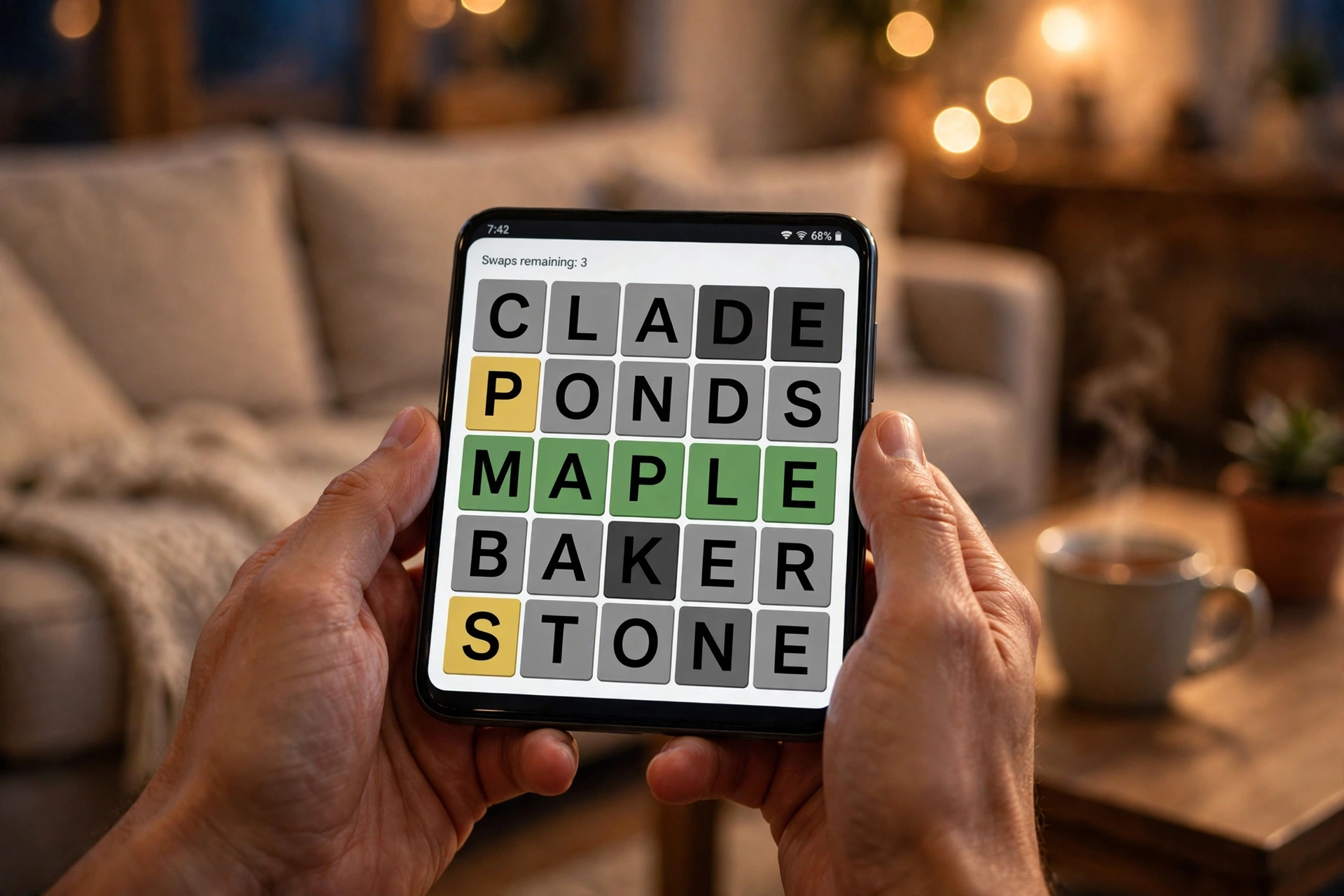
Tips only help if you practice them. The best place to practice is Unlimited mode, because it gives you endless fresh boards with no pressure. You can try a new habit, make a mistake, and start again right away. That fast loop is how scanning, pair hunting, and loop thinking become automatic.
Here is a simple practice plan that uses Unlimited mode well. Play three boards in a row with one tip as your focus. For the first board, focus only on Tip 1. Scan for 30 seconds before your first swap, and name the closest word before you move. For the second board, focus only on Tip 3. Hunt trade-places pairs first, and do the clearest pair before any other swap. For the third board, focus only on Tip 5. Solve the corners first, then finish the closest word. After three boards, you will have practiced three habits in real play, not just in theory. Repeat the cycle the next day with Tips 2, 4, and 6, and so on, until all 10 tips feel natural.
Unlimited mode is also the right place to test your swap count. Aim to finish each board with swaps to spare, but do not chase a star target, because this site has no star score. Your goal is a clean solve with few wasted moves. If you finish a board and you cannot name a wasted swap, that is a strong solve. If you can name two wasted swaps, replay the same habit on the next board and try to cut one of them. Small cuts add up fast.
For a full guide to Unlimited mode, see Waffle Unlimited guide. It covers how to start a fresh board, how the 15-swap limit works there, and how to use it for practice without stress.
Once Unlimited feels comfortable, stretch with Deluxe. Deluxe is a bigger board: 5 by 6, six words, 25 swaps. It adds a third down word through the middle, which changes the shape. The center tiles now belong to two words, not one, and the crossing count goes up. That makes Deluxe a good stretch goal, because it tests the same habits under more pressure. Your scan has to cover more words. Your corner plan has to cover more corners. Your loop plan has to handle longer loops. If you can solve Deluxe cleanly, standard boards will feel easier by comparison.
Worked mini-example for Deluxe practice: start with the same routine. Scan all six words. Name the closest word. Hunt pairs first. Solve the corners first. The only change is that you now have a middle down word to check as well. Do not skip it. A letter that looks grey in an across word might be green or yellow in that middle down word. The grey-as-signpost idea from Tip 8 matters even more on Deluxe, because each tile has more places to belong.
Do not jump to Deluxe too early. If standard boards still feel rushed, stay in Unlimited for a few more days. The goal is not to play the biggest board. The goal is to play the standard board well, then to carry those habits to a bigger board without losing them. When you do try Deluxe, play two or three Deluxe boards, then return to a standard board. You will notice the standard board feels roomier and calmer, and your swap count will often drop.
For the Deluxe rules and layout, read Deluxe Waffle guide. It explains the 5 by 6 shape, the 25-swap limit, and how the extra down word changes your plan.
Summary Table: The 10 Tips at a Glance
| Tip | What to do | Swaps it saves |
|---|---|---|
| 1. Scan the whole board first | Read all five words before your first swap | Saves wasted opening swaps by stopping random moves |
| 2. Start from the green tiles | Build around locked green letters | Saves swaps by using fixed anchors instead of guessing |
| 3. Hunt trade-places pairs first | Swap two letters that sit in each other’s spots | Saves 1 swap per pair by fixing two letters at once |
| 4. Think in loops | Plan three-tile cycles before you move | Saves 1 swap per loop by avoiding a cleanup move |
| 5. Solve the corners first | Place corner letters early | Saves swaps by fixing two words with one corner move |
| 6. Name the word before you move | Say the target word out loud in your head | Saves swaps by stopping moves with no target word |
| 7. Count duplicate letters | Count repeats like the double L in SMELL | Saves swaps by keeping both copies in the right word |
| 8. Read grey as a signpost | Ask where a grey letter could live instead | Saves swaps by moving grey letters toward their real word |
| 9. Finish the closest word first | Complete the nearest word before starting others | Saves swaps by banking finished words and avoiding rework |
| 10. Practise in Unlimited, then stretch with Deluxe | Drill one tip per board, then try the bigger board | Saves swaps over time by turning habits into reflexes |
A Simple Practice Plan for the Next 7 Days
You do not need a long study plan. You need a short loop you will actually use. Here is a seven-day plan that builds the 10 tips in order without overload.
Day 1: Play three Unlimited boards. Focus only on scanning and naming the word. No fast swaps. If you swap before you can name the word, pause and look again.
Day 2: Play three Unlimited boards. Focus only on green tiles and trade-places pairs. Do the clearest pair first on each board.
Day 3: Play three Unlimited boards. Focus only on corners and loops. Name each corner letter you need, then find where it sits now.
Day 4: Play three Unlimited boards. Focus only on duplicates and grey tiles. Count repeats before you place them, and ask where each grey letter could live.
Day 5: Play three Unlimited boards. Focus only on finishing the closest word first. Rank the five words after your scan, then work in that order.
Day 6: Play two standard boards and one Deluxe board. Use all 10 tips together. Notice which tip feels weakest, and drill that tip on the next board.
Day 7: Rest from drills and just play for fun. Pick today’s sample puzzle from today’s sample puzzle and solve it with a calm scan. If you finish with swaps to spare, note which tip helped most. That note is your focus for next week.
If you miss a day, do not double up the next day. Just pick up where you left off. Habits build from steady reps, not from one long session. Three focused boards a day beats ten rushed boards once a week.
Frequently Asked Questions
How many swaps do I get in Waffle?
On this site, a standard board gives you 15 swaps. Deluxe gives you 25 swaps. There is no star score here, so use the count as a personal challenge and aim to finish with swaps to spare.
Can green tiles move once they turn green?
No. Green tiles lock in place. A green tile means the letter is right and in the right spot, so build around it and do not try to swap it away.
Do these tips work on Deluxe Waffle?
Yes. The same habits work on Deluxe, but the board is bigger at 5 by 6 with six words and 25 swaps, and it adds a middle down word. Scan all six words, watch the extra crossings, and expect longer loops.
How do I get faster at Waffle without guessing?
Scan first, name the word before you move, and hunt trade-places pairs. Speed comes from a clear plan, not from fast fingers. Practice one tip per board in Unlimited mode until it feels automatic.
What happens if I run out of swaps?
The board stays unsolved and you start a fresh board. You do not lose anything else, and you can try again right away. Use the next board to practice the tip that would have saved the swaps you needed.
Does this site have a daily puzzle with one set of answers?
No. Every player gets a different random board, and boards are made fresh on demand. There is no shared daily puzzle, no single set of answers, and no reset time. The sample puzzles on this site are labeled samples for practice only.
How many words are on the board on this site?
Five words: three across on the top, middle, and bottom rows, and two down on the left and right edges. The board has 19 tiles and six crossings. The original game has six words and 21 tiles, which is a different shape.
Conclusion
Waffle rewards calm eyes more than fast fingers. Scan the whole board, trust your green tiles, trade pairs first, think in loops, solve the corners early, name each word before you move, count duplicates, read grey as a signpost, finish the closest word first, and practice in Unlimited mode before you stretch with Deluxe. Those 10 habits fit this site’s five-word board, and they work together as one routine.
Start with one tip on your next board. Add a second tip on the board after that. Within a week, the routine will feel natural, and your swap count will drop without you forcing it. Open a fresh board, take a slow first look, and make your first swap with a reason. That first reasoned swap is where every good solve begins.
For a second view on pair swaps and corner play, the Insider Gaming guide to the original game is worth a read on Insider Gaming Waffle guide. Remember that its star maths and 10-swap par describe the original game only, not this site. Use its tactics, keep this site’s shape in mind, and enjoy the solve.