Games Like Waffle | 10 Word Games to Play After Your Daily Puzzle
Quick answer: The best games like Waffle are Wordle, Quordle, Octordle, Connections, and Weave. Wordle is the simplest daily word game, Quordle and Octordle multiply the challenge, Connections tests grouping instead of guessing, and Weave is the closest match because it also asks you to swap letters on a grid. Start with Wordle, then try Weave.
You just finished your Waffle board, and you want more. Maybe you solved it in seven swaps and you are still warmed up. Maybe it beat you, and you want a different kind of puzzle to clear your head. Either way, the same itch is there: a short word game that fits into a coffee break and gives your brain something real to chew on.
The good news is that the word game world has grown far beyond one daily puzzle. Since Wordle went viral, dozens of spin-offs have appeared, and many of them are excellent. Some keep the guessing. Some swap the guessing for arranging, grouping, or maths. Some are harder than Waffle, and some are gentler. This guide ranks the ten best games like Waffle, explains how each one differs from the board you already know, and helps you pick the one that fits your morning.
A quick note before the list, so nothing here confuses you. This site’s Waffle hides five words on a 5 by 5 grid, three across and two down, and gives you 15 swaps to fix them. Every board is random, so there is no shared daily puzzle, no reset time, and no star score here. The original game hides six words, also with 15 swaps, and it does award stars: 10 swaps earns 5 stars there. That star maths belongs to the original game only. The games below are judged against this site’s Waffle, and any facts about the original game are labelled as such.
The 10 Games at a Glance
Here is the whole list in one table, so you can skim it and jump to the game that catches your eye. The rest of this guide gives each game its own section, with the details that matter: what you do, how it differs from Waffle, who it suits, how long it takes, and whether it costs anything.
| Game | What you do | Closest to Waffle? | Time per puzzle |
|---|---|---|---|
| Wordle | Guess one hidden five-letter word in six tries | The original, but guessing not swapping | About 3 minutes |
| Quordle | Solve four five-letter words at once in nine guesses | Same colors, four times the work | About 10 minutes |
| Octordle | Solve eight five-letter words at once in thirteen guesses | The biggest guessing challenge | About 15 to 20 minutes |
| Connections | Sort sixteen words into four groups of four | Word grouping, no grid at all | About 5 minutes |
| Dordle | Solve two five-letter words at once in seven guesses | A gentle step up from Wordle | About 5 minutes |
| Nerdle | Guess a hidden maths equation in six tries | Same guessing shape, numbers not words | About 5 minutes |
| Spelling Bee | Build words from seven letters around a centre letter | Free word building, no grid | About 5 to 10 minutes |
| Letter Boxed | Connect letters around a square into words | Letter patterns, no guessing | About 5 to 10 minutes |
| Strands | Find theme words hidden in a letter grid | A word search with a twist | About 5 to 10 minutes |
| Weave | Swap letters on a grid until six words read correctly | The closest match to Waffle | About 5 to 10 minutes |
If you only have time for one new game today, pick Weave. It is the only game on this list that plays like Waffle, because it is also a swap game. If you want the safest first step, pick Wordle. It is the game Waffle grew out of, and it takes three minutes to learn.
How Waffle Works, in Brief
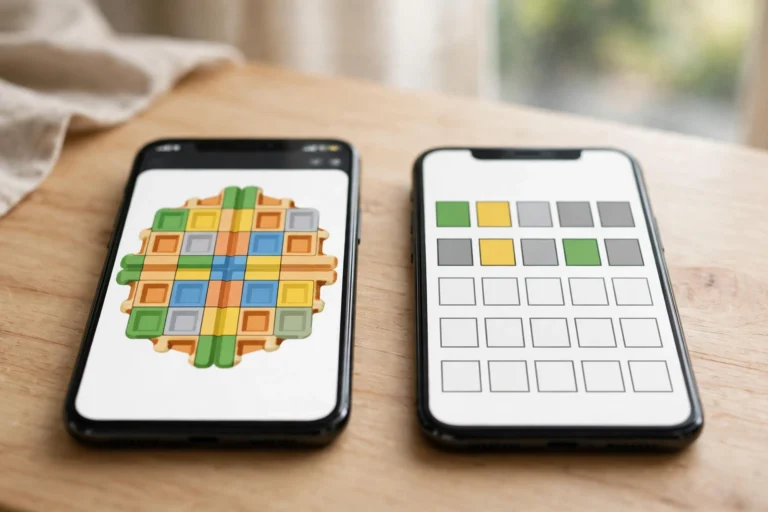
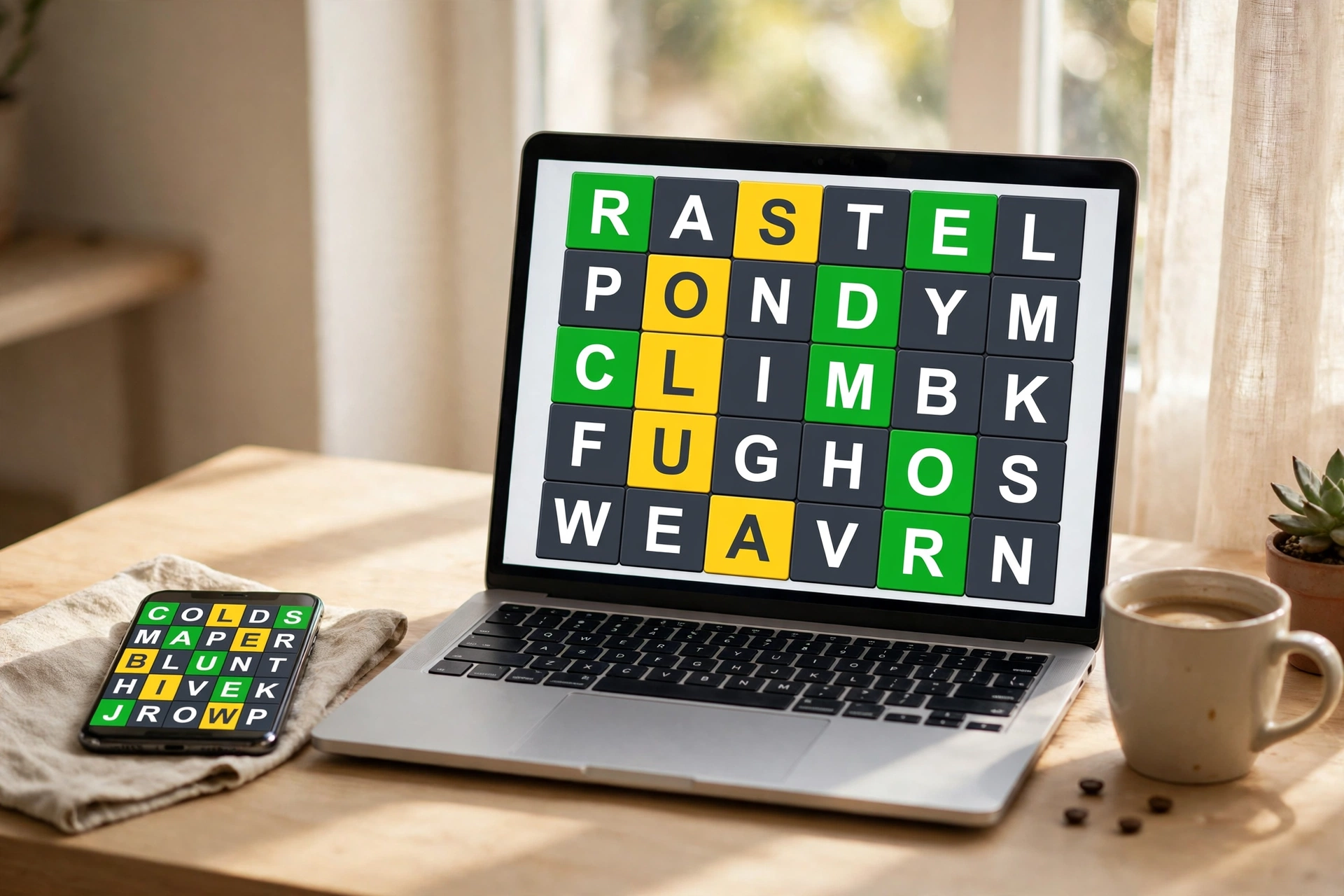
If you are new here, here is the short version. Waffle shows you a grid with all the letters already on it, in the wrong order. You swap two tiles at a time until every word reads correctly. Green tiles are in the right spot and lock in place. Yellow tiles belong in that word but sit in the wrong spot. Grey tiles do not belong in the word they sit in. Our beginner’s guide to Waffle walks through the rules, the colors, and the game modes step by step, and our guide to what the colors mean in Waffle covers each color with board examples.
That setup is what makes Waffle unusual. Most word games ask you to guess a word you cannot see. Waffle shows you every letter and asks you to put them in order. It rewards planning and pattern spotting more than vocabulary. Keep that in mind as you read the list, because every game below either keeps the guessing, keeps the grid, or keeps the planning, and the one you enjoy most will be the one that keeps the part you love.
1. Wordle
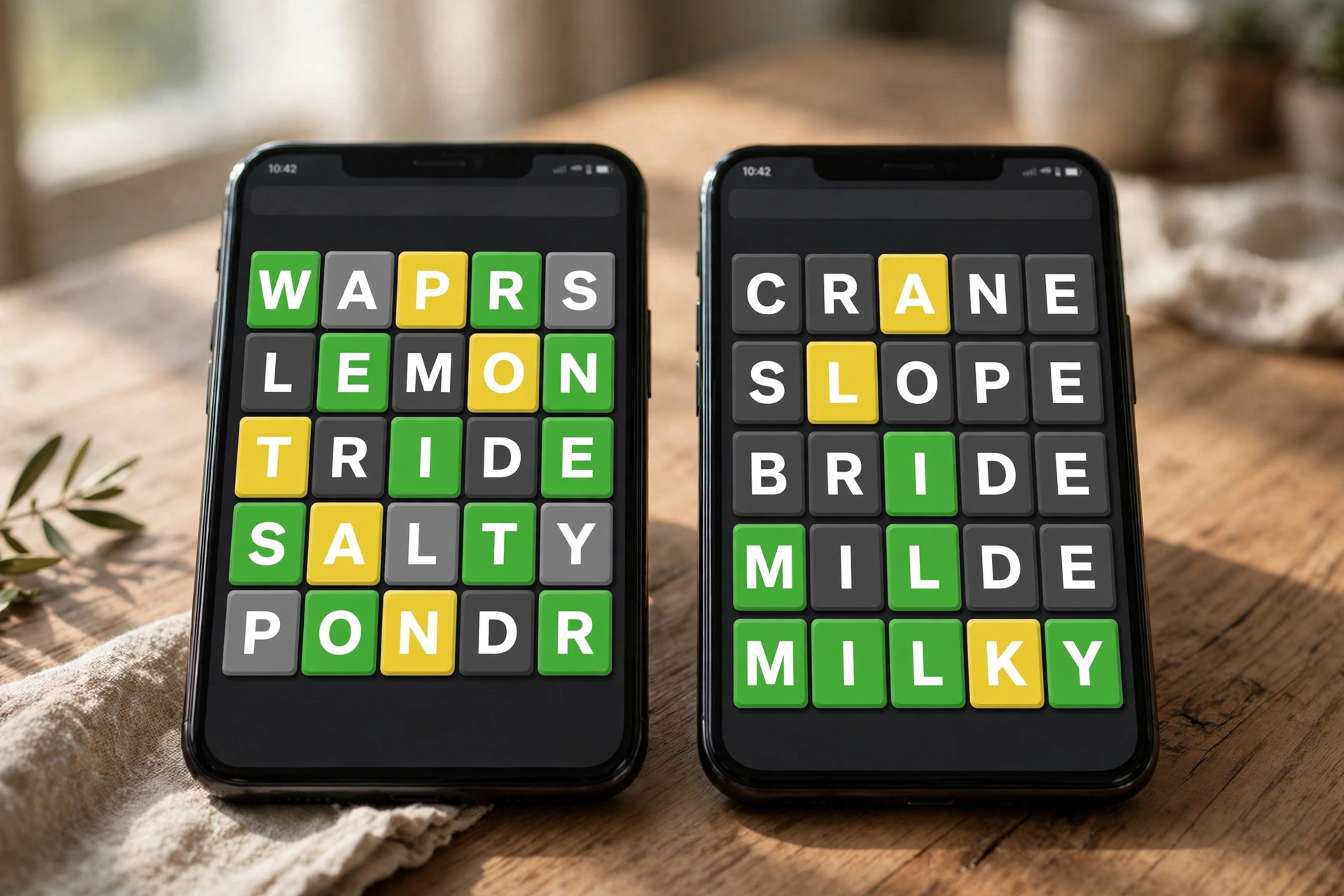
Wordle is the game that started it all, and it is still the best first stop after Waffle. You get one hidden five-letter word and six guesses to find it. Type a word, read the colors, and narrow it down. Green means the letter is in the right spot. Yellow means it belongs in the word but sits in the wrong spot. Grey means it is not in the word at all. Solve it in six guesses or fewer, and you win.
How it differs from Waffle is simple: Wordle is a guessing game, and Waffle is a rearranging game. In Wordle the board starts blank, and every letter you learn comes from a guess you made. In Waffle every letter is already on the board, and the puzzle is putting them in the right order. That difference changes the skill completely. Wordle rewards vocabulary and good opening guesses. Waffle rewards logic, planning, and holding several words in your head at once. Our full Waffle vs Wordle comparison covers the two games side by side, including a table of the main differences, and our Is Waffle Harder Than Wordle guide compares them on difficulty, time, and skill.
Wordle suits players who want a quick daily puzzle and a shared score to compare with friends. Every player in the world gets the same word each day, which is something this site’s Waffle cannot offer, because every board here is random per player. That shared puzzle is a big part of Wordle’s charm. You can talk about the same word over breakfast, share your grid of colored squares, and feel the same sting when the word beats you.
A Wordle takes about three minutes. It is free to play daily in your browser on the New York Times site. The one thing to know is that the free version is one word a day, so it will not fill a long evening on its own. That is exactly why it pairs so well with Waffle: Wordle first as a warm-up, Waffle second as the main event.
2. Quordle
Quordle is Wordle with the volume turned up. You solve four five-letter words at the same time, and you get nine guesses to find them all. Every guess you type is entered into all four boards at once, and each board colors your letters on its own. A guess that is useless on one board can be the key on another, and a guess that helps all four at once is the best move in the game.
How it differs from Waffle is the size of the job. Waffle asks you to solve five words on one shared grid, where the words cross and share letters. Quordle asks you to solve four words on four separate boards, where the words never touch. The mental load is similar, because both games ask you to hold several words in your head, but Quordle adds the guessing back in. You start from nothing on each board, and every letter you learn comes from a guess. A round of Quordle takes about ten minutes, which makes it a good match for a Waffle player who wants a longer puzzle.
Quordle suits players who find one Wordle too easy but are not ready for the eight-board chaos of Octordle. It is also the game that teaches you the most useful skill for Waffle: working across several words at once without losing track of any of them. If you can keep four Quordle boards straight, a five-word Waffle grid will feel calmer.
It is free to play daily in your browser, with a practice mode for extra rounds. The nine-guess limit sounds generous until you are staring at three unsolved boards with two guesses left, and that squeeze is the whole fun of it.
3. Octordle
Octordle is Quordle doubled. You solve eight five-letter words at the same time, and you get thirteen guesses. The screen fills with eight small boards, each one coloring your guesses on its own, and your job is to keep all eight in your head while the guesses tick down. It is the biggest guessing challenge on this list, and it is not a gentle game.
How it differs from Waffle is mostly scale. A Waffle board hides five words on one grid, and you can see every letter from the start. Octordle hides eight words across eight boards, and you start from nothing. The planning skill transfers, because both games punish waste: in Waffle a bad swap costs one of your 15 swaps, and in Octordle a bad guess costs one of your 13. But Octordle adds a kind of juggling that Waffle never asks for, because you are tracking eight separate sets of clues at once.
Octordle suits confident players who want a real workout. A round takes about 15 to 20 minutes, so it is the longest game on this list, and it needs your full attention. It is free to play daily in your browser. One guide to games like Wordle notes that Octordle gives you eight hidden words with thirteen guesses, and the same guide ranks it among the hardest daily word games. If Quordle feels comfortable, Octordle is the next rung up the ladder.
A warning, though: do not start your word game journey with Octordle. Eight boards are overwhelming for a first game, and a bad first experience can put you off the whole genre. Play Wordle for a week, try Quordle for a week, and then take on Octordle when the four-board version feels easy.
4. Connections
Connections is the odd one out on this list, because there is no guessing and no grid. The New York Times gives you sixteen words, and you sort them into four groups of four, where each group shares a hidden link. The groups might be types of fish, words that follow the same prefix, or things you find in a kitchen. You get four mistakes before the game ends.
How it differs from Waffle could hardly be bigger. Waffle is about letters and positions. Connections is about meaning and grouping. You never type a word, and you never swap a tile. Instead you stare at sixteen words and ask what four of them have in common. The skill it rewards is lateral thinking, not vocabulary or planning, and that is exactly why it is such a good second game for a Waffle player. It uses a different part of your brain, so it feels like a rest even while it is still a puzzle.
Connections suits players who like crosswords, trivia, or pub quizzes, and players who find pure word guessing a little dry. A round takes about five minutes, and it is free to play daily in your browser. One 2026 roundup of games like Wordle calls Connections the best second daily puzzle, and that verdict feels right: it is short, it is free, and it is nothing like the game you just played, which is the point.
The one frustration to expect is the purple group. Connections sorts its groups by difficulty, from yellow (easiest) to green, blue, and purple (hardest), and the purple group is often a wordplay trick rather than a normal category. If you finish three groups and the last four words make no sense together, look for the trick: a shared prefix, a hidden word, or a pun.
5. Dordle
Dordle is the gentlest step up from Wordle. You solve two five-letter words at the same time, and you get seven guesses. Every guess is entered into both boards at once, and each board colors your letters on its own. It is Quordle with half the boards, and it is the best choice if Quordle sounds fun but four boards sound like too many.
How it differs from Waffle is that it keeps the guessing and drops the grid. Waffle shows you all the letters and asks you to arrange them. Dordle hides both words and asks you to find them, two at a time. The mental load is lighter than Waffle, because two words are easier to hold in your head than five, and the seven-guess limit is forgiving enough that a bad guess rarely ends the game.
Dordle suits new players, busy players, and anyone who wants a second daily puzzle without a second big time commitment. A round takes about five minutes, and it is free to play daily in your browser. It is also a good training game: if you can solve two words at once without getting confused, you are ready for Quordle, and the jump from Quordle to a five-word Waffle grid gets smaller too.
One small tip: use your first two guesses to test different letters, not to chase one board. A guess that is wrong on both boards still teaches you ten letters that are not in either word, and that information is worth more than a lucky hit on one board.
6. Nerdle
Nerdle is Wordle for people who like numbers. Instead of a hidden word, you guess a hidden maths equation, and you get six tries. You type an equation using digits and symbols, and the game colors each tile green, yellow, or grey, exactly like Wordle. Green means the digit or symbol is in the right spot. Yellow means it belongs in the equation but sits in the wrong spot. Grey means it is not in the equation at all.
How it differs from Waffle is the material, not the shape. Nerdle keeps Wordle’s guessing structure, so it is a cousin of Waffle rather than a sibling. The skill is different, though: instead of vocabulary you need number sense, and instead of spotting words you need to spot which operations fit the answer. A player who is strong at Waffle will not automatically be strong at Nerdle, and that is part of the appeal. It is a fresh challenge with a familiar shape.
Nerdle suits players who enjoy Sudoku, maths puzzles, or a break from letters. A round takes about five minutes, and it is free to play daily in your browser. There are also variants if the standard game clicks: Mini Nerdle uses shorter equations, and Instant Nerdle gives you a fresh equation on demand instead of one a day.
The learning curve is short if you are comfortable with basic arithmetic. If you are not, the first few games can feel hard, because you are guessing at the structure of the equation as well as its digits. Stick with it for three or four days. Once you learn the common equation shapes, the game opens up fast.
7. Spelling Bee
Spelling Bee is the New York Times game for players who like building words without a grid. You get seven letters arranged around a centre letter, and you make as many words as you can, using the centre letter in every word. Words must be at least four letters long, and longer words earn more points. Find the pangram, the word that uses all seven letters, and you earn the biggest bonus.
How it differs from Waffle is freedom. Waffle gives you a fixed grid and a fixed swap limit, and every move is a trade. Spelling Bee gives you seven letters and no limit at all: you can keep finding words until you run out of ideas, and the only score is your own total. It rewards vocabulary more than planning, and it rewards patience more than speed, because there is no clock and no move limit.
Spelling Bee suits players who love word lists, anagrams, and slow puzzles you can dip in and out of all day. A session takes about 5 to 10 minutes, though many players keep coming back to the same puzzle across the day. The free play is limited: you can play the daily puzzle in your browser, but the full game, with your score saved and the whole word list open, sits behind a New York Times Games subscription. That is worth knowing before you fall in love with it, because the paywall arrives just as the game gets good.
If the subscription puts you off, the free daily puzzle is still worth playing. Try to find the pangram first, because it uses every letter, and then build out from it. The pangram is usually the hardest word on the board, and finding it early makes the rest of the puzzle easier.
8. Letter Boxed
Letter Boxed is the New York Times game for players who like letter patterns. You get a square with three letters on each side, twelve letters in total. You build words by connecting letters, and each word must start with the last letter of the previous word. You cannot use two letters from the same side in a row, which forces you to jump around the square. The goal is to use every letter in as few words as you can.
How it differs from Waffle is that there is no grid to fix and no guessing at all. Every letter is on the screen from the start, which will feel familiar to a Waffle player, but the job is building words from scratch instead of arranging a scrambled grid. It rewards the same pattern spotting that makes a good Waffle player: seeing which letters belong together, and planning two or three moves ahead.
Letter Boxed suits players who like crosswords and word ladders, and players who want a puzzle with no time pressure and no move limit. A round takes about 5 to 10 minutes. The full game sits behind a subscription, according to a 2026 list of games like Wordle, though the daily puzzle is there to try. If you play it, the key habit is to plan your last word first: work out which letters are hardest to use, and save a word that covers them for the end.
9. Strands
Strands is the New York Times word search with a twist. You get a grid of letters, and hidden inside it are several words that all share a theme. Find the theme words, and then find the spangram, the one long word that stretches from one side of the grid to the other and describes the theme itself. Every letter on the board belongs to a theme word or the spangram, so nothing is wasted.
How it differs from Waffle is that you are finding words, not fixing them. The grid is already correct, and your job is to see the words hiding in it. That makes Strands a gentler, more visual game than Waffle. It still rewards pattern spotting, and a Waffle player will be good at it, because reading a letter grid is a skill that transfers directly. The difference is the pressure: there is no swap limit, no guess limit, and no way to fail. You can take as long as you like.
Strands suits players who like word searches, crosswords, and a calm puzzle to end the day with. A round takes about 5 to 10 minutes, and it is free to play daily in your browser. The spangram is the part to aim for: once you find it, the theme clicks into place, and the remaining words are much easier to spot. If you are stuck, the game gives you a hint for every three non-theme words you find, so keep dragging out any word you can see, even if it is not a theme word, because those finds earn hints.
10. Weave
Weave is the closest game to Waffle on this list, and it is the one to try first if you want more of the same feeling. It is a daily six-word swap grid: the letters are already on the board, in the wrong order, and you swap tiles until all six words read correctly. There is no guessing, no typing, and no blank board. It is the same job as Waffle, on a different board.
How it differs from Waffle is small but real. Weave hides six words, where this site’s Waffle hides five, so the grid is a little bigger and the solve takes a little longer. The swap logic is the same: green tiles are home, yellow tiles belong in the word but sit in the wrong spot, and grey tiles do not belong there. A guide to Waffle alternatives calls Weave the closest Waffle-like game, and that is a fair verdict. If you enjoy the feeling of a Waffle board clicking into place, Weave gives you that feeling again on a fresh grid.
Weave suits Waffle players who want a second daily swap puzzle without learning a new game. A round takes about 5 to 10 minutes. It plays in your browser, and I could not verify a paid tier, so try the daily puzzle and see for yourself. The habits you already know transfer directly: read the colors first, find the trade-places pairs, start at the corners, and plan before you swap. Our guide to how many swaps you get in Waffle explains the swap budget, and our Deluxe guide covers this site’s bigger six-word board, which is the closest thing to Weave you can play here.
If you play both games daily, you will notice something useful: the skills sharpen each other. A pair you learn to spot in Weave will show up on your next Waffle board, and a corner habit you build in Waffle will save you swaps in Weave. That is the real reason Weave sits at number one for Waffle players, even though it sits at number ten on this list. It is not just similar. It is the same muscle, trained twice a day.
How to Pick Your Next Game
Ten games is a lot to choose from, so here is a short way to narrow it down. Pick the game that matches the part of Waffle you love most, because that is the part you will enjoy again.
If you love the guessing, pick Wordle or Dordle. Both games hide the word and ask you to find it, which is the opposite of Waffle’s open board. Wordle is the gentler start, Dordle is the step up, and both take about five minutes or less.
If you love solving several words at once, pick Quordle or Octordle. Quordle gives you four boards and nine guesses, Octordle gives you eight boards and thirteen guesses. Start with Quordle. Octordle is there when four boards feel easy.
If you love the swap itself, pick Weave. It is the only game on this list where you swap tiles on a grid until the words read correctly. It is the closest thing to a second Waffle board, and it trains the same skill.
If you want a break from letters, pick Connections or Nerdle. Connections sorts words into groups, and Nerdle guesses a maths equation. Both games use a different part of your brain, which makes them good second games after a hard Waffle board.
If you want a slow puzzle with no pressure, pick Spelling Bee, Letter Boxed, or Strands. None of the three has a move limit or a fail state, and all three reward patience. They are the best games on this list for a quiet evening.
Two practical notes before you commit. First, check the paywall before you fall in love with a game. Wordle, Quordle, Octordle, Connections, Dordle, Nerdle, and Strands are all free to play daily in your browser. Spelling Bee offers limited free play, and Letter Boxed is subscription based, according to a 2026 list of games like Wordle. Second, do not try to play all ten every day. Pick two or three, learn them properly, and let the rest wait. A game you play well is worth more than ten games you play badly.
A good way to compare the top contenders is to read what other players say about them. A 2026 list of games like Wordle covers twenty-one games, from Dordle and Quordle to Spelling Bee, Letter Boxed, and Strands, and it is a useful cross-check for the free and paid details in this guide. A second 2026 roundup compares Wordle alternatives in more depth and calls Connections the best second daily puzzle, Quordle the best game if you want more Wordle, and Waffle the best two-minute game, which is a fair summary of how the top three fit together. A third ranked list of games like Wordle gives the clearest statement of the Octordle format: eight hidden words with thirteen guesses.
Build a Three-Game Morning Routine
One game a day is a habit. Three games a day is a routine, and a routine is what turns a casual player into a regular. Here is a morning routine that takes about fifteen minutes and trains a different skill in each game.
Game one, Wordle, three minutes. Play it first, while the coffee brews. It is quick, it is the same word your friends are playing, and it warms up your vocabulary. One word, six guesses, and you are done. If you solve it in three guesses, the day has started well.
Game two, Waffle, five to ten minutes. Play it second, once your brain is awake. This is the main event: five words on a 5 by 5 grid, 15 swaps, and the planning skill that makes the game worth playing. If you want extra practice first, Unlimited mode gives you endless fresh boards with the same budget, and Deluxe mode gives you a bigger 5 by 6 board with six words and 25 swaps when the standard board starts to feel easy.
Game three, Connections or Weave, five minutes. Pick one and stick with it for a week. Connections if you want a change of pace: sixteen words, four groups, no letters to arrange. Weave if you want more of the swap feeling: a six-word grid that plays like a second Waffle board. Either way, this third game is the cool-down, and it is the one you can skip on a busy day without breaking the routine.
Why three games and not one? Because each game trains something the others miss. Wordle trains guessing and vocabulary. Waffle trains planning and pattern spotting. Connections trains grouping and lateral thinking. Weave trains the swap itself. Play one and you get one skill. Play three and you get a balanced workout, and each game makes you better at the others: Wordle sharpens your sense of common words, which helps you spot Waffle words faster, and Waffle sharpens your sense of letter patterns, which helps you pick better Wordle guesses.
If fifteen minutes is too much, cut the routine to two games: Wordle and Waffle. That is the core of it, and it takes under ten minutes. Add the third game back on weekends, when you have time to enjoy it. The routine works because it is short enough to keep, not because it is long enough to impress anyone.
Frequently Asked Questions
Is Waffle free to play?
Yes. Waffle on this site is free to play in your browser, with no account and nothing to download. The original game is also free to play daily. Most of the games on this list are free daily in your browser too, though Spelling Bee offers limited free play and Letter Boxed is subscription based.
What game is most like Waffle?
Weave is the most like Waffle. It is a daily six-word swap grid where you swap letters until all six words read correctly, which is the same job as Waffle. Wordle and Octordle are the next closest in feel, according to a 2026 comparison, but they are guessing games, not swap games, so Weave is the true match.
Is Quordle harder than Waffle?
It depends on which skill you are better at. Quordle asks you to solve four words at once in nine guesses, starting from a blank board, while Waffle asks you to arrange five words that are already on the grid in 15 swaps. Most players find Waffle harder, because the swap planning is less forgiving than guessing, but a player who is weak at vocabulary will find Quordle harder. Try both for a week and judge for yourself.
Can I play these games on my phone?
Yes. Every game on this list plays in your phone’s browser, and most of them also work well on a tablet or a laptop. None of them needs an app installed to play the daily puzzle, though the original Waffle also has apps from Waffle Studio. If a game feels cramped on a small screen, try it in landscape mode, where the grid has more room.
Which game is best after Wordle?
It depends on what you liked about Wordle. If you liked the guessing, try Dordle, then Quordle, then Octordle, in that order. If you liked the colors and want something different, try Waffle, because it keeps the colors and swaps the guessing for arranging. If you want a change of pace, try Connections, which sorts words into groups instead of guessing them. A 2026 roundup of games like Wordle picks Quordle as the best game if you want more Wordle, and that is a good default answer.
Do any of these games have a daily puzzle like Waffle?
Most of them do. Wordle, Quordle, Octordle, Connections, Dordle, Nerdle, Spelling Bee, Letter Boxed, Strands, and Weave all run a daily puzzle. The difference is that those daily puzzles are shared, so every player gets the same one, while this site’s Waffle gives every player a different random board, so there is no shared daily puzzle here. The original game does have a shared daily puzzle, with a new one at midnight.
How long does a game of Waffle take compared to these games?
A Waffle board takes about five to ten minutes. That puts it in the middle of this list: Wordle takes about three minutes, Dordle, Connections, and Nerdle take about five minutes, and Quordle takes about ten. Octordle is the longest at about 15 to 20 minutes. If you want a game that fits the same time slot as Waffle, Quordle and Weave are the closest matches.
Conclusion
The best games like Waffle are Wordle, Quordle, Octordle, Connections, Dordle, Nerdle, Spelling Bee, Letter Boxed, Strands, and Weave, and the right one for you depends on which part of Waffle you love. If you love the guessing, start with Wordle and work up through Dordle and Quordle to Octordle. If you love the swap itself, go straight to Weave, because it is the only game here that plays like Waffle. If you want a change of pace, try Connections for grouping or Nerdle for numbers. And if you want a slow puzzle with no pressure, Spelling Bee, Letter Boxed, and Strands are waiting.
You do not need to play all ten. Pick two or three, learn them properly, and build a short morning routine around them: Wordle to warm up, Waffle as the main event, and Connections or Weave to cool down. Fifteen minutes, three different skills, and a fresh puzzle every day. Try a board on thewafflegame.uk today, then try Weave, and see which game earns your mornings.